

Why Branding Matters More Than Ever for Accounting Firms
Accounting is a trust-based industry. Before a prospective client schedules a call, they've already formed an opinion — based on your website, your logo, your Google reviews, and how clearly you explain what you do.
That screening process happens fast. Research from Hinge Marketing found that 80% of buyers examined a referred firm's website before making contact, and 51.9% had already ruled out a referral before speaking to the firm. A referral doesn't bypass the digital credibility test — it just starts it.
The competitive pressure makes this harder to ignore. NASBA reports 653,408 actively licensed CPAs as of August 2025. That's not firms — that's individual license holders. Without a clear, differentiated brand, your firm looks identical to hundreds of others competing for the same clients.
Branding solves more than a marketing problem. A well-built brand identity makes it easier to delegate marketing decisions, hire staff who align with your firm's mission, and raise rates with confidence. It's the operational foundation that makes every other growth decision easier.
The sections below break down each piece of that foundation — from defining your niche and brand strategy to building a visual identity and activating it consistently across every client touchpoint.
Key Takeaways
- A strong accounting firm brand covers your niche, positioning, values, visual identity, and client experience — not just a logo.
- Defining your target audience and niche before any visual work is the most critical first step.
- Brand strategy — mission, vision, and USP — sets the direction for every external decision.
- Consistency across all touchpoints converts brand awareness into trust and referrals.
- Branding is an ongoing investment — review and evolve it at least annually.
Step 1: Lay the Foundation — Know Your Audience and Define Your Niche
Most accounting firms make the same mistake: they start with a logo before they understand who they're building the brand for. The result is a polished-looking firm that communicates nothing distinctive, blending in with every competitor on the search results page.
Identify Your Target Audience and Build Client Personas
There's a meaningful difference between a target market and a buyer persona.
- Target market: Small business owners
- Buyer persona: A restaurant owner with 8–15 employees who struggles with cash flow predictability and needs monthly bookkeeping plus quarterly tax planning
That level of specificity shapes every downstream decision — from your website copy to which industries you seek referrals from.
Every accounting firm should be able to answer these questions about their ideal client:
- What industry are they in, and what stage of business growth?
- What financial pain points keep them up at night?
- Where do they search for an accountant (Google, LinkedIn, peer groups)?
- What do they value most — responsiveness, niche expertise, or technology?
Define Your Accounting Niche
Choosing a niche is one of the most impactful brand decisions an accounting firm can make. The data supports it.
AICPA and CPA.com's 2024 benchmark of 206 CAS practices found that firms deriving most of their CAS revenue from defined industry niches reported 38% higher median CAS revenue and 51% higher net revenue per client than their generalist counterparts.
The buyer side tells the same story. A TaxDome survey of 350 US business clients found that 85% were willing to pay more for a specialist accountant, and 98% of businesses that left a specialist hired another specialist rather than switching to a generalist.
Real-world examples confirm this works at any firm size:
- Genske, Mulder & Company built over 90% of its business around agriculture — primarily dairy farms — and scaled to four offices, 80+ employees, and clients in 33 states.
- Small Batch Standard built authority in craft brewing and distilling, including a newsletter audience of 900+.
- Healthy Coin PLLC serves therapists and counselors exclusively and scaled to eight employees as a sole-owner firm.
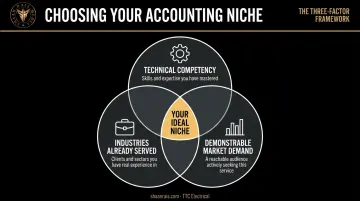
Each of these firms succeeded by committing fully rather than hedging. To choose your niche, look for the intersection of three things: your strongest technical competency, the industries you've already served successfully, and demonstrable market demand. Don't choose a niche purely because it sounds lucrative — without genuine expertise, it shows immediately.
Conduct a Competitive Audit
Before you position your brand, understand how your competitors are already positioned. Analyze the top 3–5 local firms' websites, messaging, and social profiles and identify:
- What claims every competitor makes (responsiveness, years of experience)
- What none of them own (almost certainly: a clear niche)
- What gap your firm could credibly fill
This audit takes a few hours and prevents the most common branding failure: building a brand that says exactly what everyone else says.
Step 2: Build Your Brand Strategy — Mission, Positioning, and Values
Visual design decisions without a documented strategy behind them are just guesses. This step builds the strategic foundation of your brand — the operating framework that informs every external decision, from website copy to how your team answers the phone.
Define Your Mission, Vision, and Core Values
Your mission statement answers: Why does this firm exist beyond generating revenue? Your vision statement answers: Where is the firm heading in the next 5–10 years?
Sample statements for an accounting firm context:
- Mission: "We help construction business owners gain financial clarity so they can build profitable, sustainable companies."
- Vision: "To be the most trusted financial partner for small contractors in the Southeast."
Core values aren't wall art. They guide hiring decisions, service standards, and how your team handles a difficult client conversation. The most credible values come from observing what your team already does consistently — not from brainstorming what sounds good in a branding session.
Relevant examples for accounting firms: integrity, proactive communication, client-first thinking, transparency in fees.
Craft Your Unique Positioning Statement
Use this framework to draft yours:
"We help [target clients] solve [specific problem] by providing [core services] through [unique advantage]."
For example: "We help independent restaurant owners solve cash flow instability by providing monthly bookkeeping and tax planning through a team that specializes exclusively in the food service industry."
A strong positioning statement does three things at once:
- Anchors your website homepage and elevator pitch to a single clear message
- Filters out the wrong clients before they ever reach your intake form
- Signals specialization — so your ideal client reads it and thinks, that's exactly me
Develop Your Messaging Pillars
Messaging pillars are 3–4 consistent statements your firm repeats across all channels to reinforce its brand promise. For an accounting firm, these might look like:
- "We specialize in [niche] — it's the only thing we do."
- "We go beyond filing to deliver proactive financial guidance year-round."
- "We build long-term advisory relationships, not transactional ones."
- "Our clients never face a tax surprise — we plan ahead."
Every team member should be able to explain these without referencing a document. Test it: ask your newest team member how they'd describe the firm to a stranger. Their answer tells you exactly how well the messaging has taken root.
Step 3: Design Your Visual Identity and Brand Voice
Visual identity is how your brand looks. Brand voice is how it sounds. Together, they create the first impression that either confirms or contradicts your positioning — within seconds of a prospect landing on your website.
Visual Identity Essentials
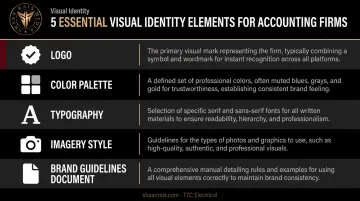
Every accounting firm needs these five core elements:
| Element | What It Requires |
|---|---|
| Logo | Clean, professional, scalable across digital and print |
| Color palette | 2–4 colors reflecting your firm's personality; blue and deep green signal trust and stability |
| Typography | 2–3 complementary fonts: one for headlines, one for body text |
| Imagery style | Authentic staff and office photos — avoid generic stock imagery |
| Brand guidelines document | A reference file so anyone creating content applies the brand consistently |
On imagery: Nielsen Norman Group research shows users actively engage with real photos of people and routinely ignore generic stock. A headshot of your actual team signals authenticity in a way a handshake stock photo never will.
Developing Your Brand Voice and Tone
Brand voice is your firm's consistent communication personality. Tone adapts to context — a tax deadline reminder sounds different from a new client welcome email, even if both come from the same firm.
Start by identifying your voice archetype:
- Friendly Expert — knowledgeable, but approachable and jargon-light
- Empathetic Advisor — warm, relationship-first, emotionally attuned
- Business-First Strategist — direct, data-driven, outcomes-focused
Once you've chosen your archetype, document it with real examples. Create a simple "we say / we don't say" reference:
- ✅ We say: "Let's talk through your numbers before year-end so you're not caught off guard."
- ❌ We don't say: "We offer comprehensive year-end tax optimization solutions."
Keep this guide short — one page is enough. The goal is a reference your team actually opens before drafting client communications, not a brand manifesto that sits in a shared drive unopened.
Step 4: Activate, Align, and Monitor Your Brand
The previous steps build your brand on paper. This step puts it to work — in client conversations, search results, and how your team shows up every day.
Online Brand Activation
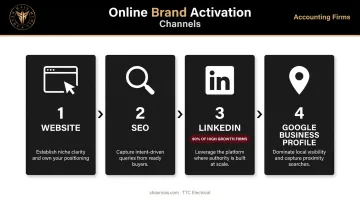
Four channels matter most for accounting firms:
- Website — Your digital headquarters. It must clearly communicate your niche, positioning, and next step. Vague "About Us" pages and generic service lists are credibility killers. Remember: 43.6% of prospects rejected a referral because the website didn't clearly explain how the firm could help them.
- SEO — Optimize for search terms your target audience actually uses. A niche firm can rank far more efficiently than a generalist by targeting specific, intent-driven queries.
- LinkedIn — 90% of High Growth professional services firms use LinkedIn, making it the dominant platform for expertise-led B2B positioning. Post consistently. Share niche insights. Let your expertise do the selling.
- Google Business Profile — Often the first thing a local prospect sees. Keep it complete, accurate, and actively managed with fresh reviews.
Internal Brand Alignment
A brand falls apart at the client interaction level if your team isn't aligned. Document your brand guidelines and onboard every staff member — including new hires — to your firm's mission, messaging pillars, and tone standards.
The client experience should feel identical whether someone speaks to the founding partner or a first-year associate. When it does, your brand stops being a document and starts being something clients actually feel.
Monitor and Evolve the Brand
Internal alignment is only half the equation. Externally, your brand needs regular audits to stay relevant and accurate. Watch for these signals that something needs attention:
- Client feedback is inconsistent or confused about what your firm actually specializes in
- You're serving clients outside your intended niche more often than within it
- Your visual assets look noticeably dated compared to competitors
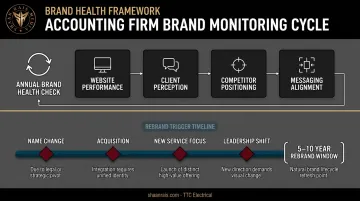
- A major firm event has occurred — name change, acquisition, new service focus, or leadership shift
The Association for Accounting Marketing recommends an annual brand health check covering website performance, client perception, competitor positioning, and whether your messaging still reflects where the firm is headed. A full rebrand typically makes sense every 5–10 years, or when a genuine strategic shift demands it. Chasing a slow quarter or aesthetic trends rarely justifies the cost.
Frequently Asked Questions
What are the 7 stages of the branding process?
The seven stages are: (1) research and audience definition, (2) niche and competitive analysis, (3) brand strategy — mission, vision, values, and positioning, (4) personality and voice development, (5) visual identity design, (6) brand activation across touchpoints, and (7) monitoring and evolution. For accounting firms, stages 1–3 are most commonly skipped, which is why many firm brands feel generic and interchangeable.
What color symbolizes accounting?
Blue is the most widely used color in accounting and financial services because it signals trust, reliability, and competence. Navy, deep teal, and forest green are also common choices. The right color depends on your firm's brand personality and target audience — convention is a useful starting point, but it shouldn't override strategic thinking about differentiation.
How long does it take to build a brand for an accounting firm?
The Association for Accounting Marketing notes that a mid-sized firm rebrand typically takes nine months or more. Strategy work alone — research, positioning, and messaging — runs 4–8 weeks, followed by visual design and implementation across the website and marketing materials. Firm size and internal approval cycles can shift that timeline by weeks or months.
What is the difference between branding and marketing for an accounting firm?
Branding is who your firm is — your identity, values, positioning, and visual language. Marketing is how you make that identity visible to attract clients. Hinge Marketing defines a professional services brand as a firm's reputation multiplied by its visibility. Branding comes first and makes every marketing effort more efficient because there's a clear, consistent message to amplify.
Can a small accounting firm compete with larger firms through branding?
Smaller firms often out-brand large generalists by niching down and owning a specific identity. A boutique firm serving one industry with deep expertise — like Genske Mulder or Healthy Coin — will attract more loyal, higher-value clients than a large firm with generic "we do everything" positioning. Specialization creates advantages that firm size alone cannot match.
How often should an accounting firm update or rebrand?
An annual brand audit is a reasonable baseline — checking alignment, consistency, and whether messaging still reflects the firm's direction. A full rebrand is typically warranted every 5–10 years, or when a major strategic shift occurs: a new niche, a merger, a name change, or a major repositioning. Changes should be deliberate, not reactive to a slow quarter or a competitor's new website.