Here's the problem: most conversations about development stop at theory. They cover macroeconomic frameworks or corporate strategy decks, then leave out the practical, human question — how does someone (or some place, or some organization) actually turn potential into recognized value?
That gap is what this guide addresses. We'll break down the real types of development, the challenges practitioners face at every level, and the best practices that separate people who grow quietly in obscurity from those who get paid and promoted for what they've built.
Key Takeaways
- Development takes economic, organizational, professional, and personal forms, each measured differently
- Global development stalls on poverty, limited resources, and resistance to reform
- Development economists and positioning strategists both work to close the gap between potential and realized value
- Skill-building rarely gets rewarded on its own; it needs visibility and positioning to convert into recognition
Understanding Development: Key Definitions and Types
Development, broadly, is the process of improving capability, capacity, or value over time. That applies whether you're talking about a country, a company, or a career.
Growth and development are not the same thing. Economic growth is quantitative — it's measured by GDP, the total income earned from producing goods and services in a given period. Development is qualitative. The World Bank defines GDP growth strictly as an annual percentage change in output. That figure alone says nothing about whether people's lives actually improved.
The UNDP draws this distinction sharply. Human development, according to UNDP's framework, means expanding "the richness of human life," not just the richness of the economy. Income becomes a means to an end, not the end itself.
The Four Categories of Development
While there's no single official taxonomy that names exactly these four categories, they're a useful synthesis of how development frameworks from the World Bank, UN, and UNDP overlap:
- Human development — education, health, and skills-building. This is what the UN's Human Development Index measures through life expectancy, schooling, and income.
- Infrastructure development — roads, utilities, and technology systems. The UN's Sustainable Development Goal 9 ties resilient infrastructure directly to economic development and well-being.
- Institutional development — governance, policy, and regulatory frameworks. UNDP describes capacity operating at three levels: the enabling environment, organizations, and individuals.
- Economic/industrial development — business growth, job creation, investment. This connects to SDG target 9.2, which calls for higher industry share of employment and GDP.
These same four buckets map directly onto organizational and personal growth, including the kind of career and brand development this blog focuses on.
- Skills ≈ human development
- Tools/systems ≈ infrastructure
- Processes/governance ≈ institutional development
- Career/financial growth ≈ economic development
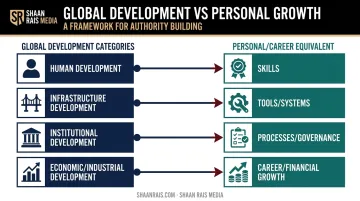
Same structure, different scale.
Major Issues and Challenges in Development Today
Poverty and Inequality Haven't Been Solved — They've Shifted
Progress on global poverty is real but uneven, and the numbers themselves have gotten more complicated. In June 2025, the World Bank updated its extreme poverty line to $3.00 per person per day, replacing the old $2.15 benchmark.
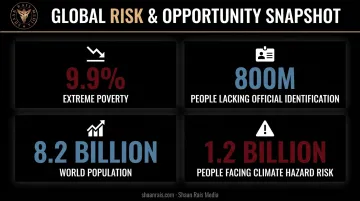
Under the new methodology, global extreme poverty is projected to fall from 10.5% in 2022 to 9.9% in 2025 — according to the World Bank's 2025 update. Progress, yes. But nearly one in ten people on the planet still lives in extreme poverty.
Private Capital Is Now a Development Engine
Governments alone can't fund development at the scale required, which is why blended finance has become central. In 2024, $77 billion in private finance was mobilized for development, mostly through guarantees and direct investment, per the OECD's mobilization data. Multilateral development banks generated 71% of that total.
Technology Cuts Both Ways
The capital gap isn't the only structural challenge. Digital tools are closing some gaps and exposing others:
- 800 million people lacked official identification in 2024, over half of them children
- 2.8 billion people lacked a digital ID suitable for secure online transactions
- 40% of adults in developing economies saved in a financial account in 2024, up 16 percentage points from 2021, per the World Bank's Global Findex Database
Paraguay illustrates the upside. Its procurement transparency system, launched in 2020, flagged irregularities and led to official resignations, proof that tech-driven accountability isn't just theoretical.
Demographics and Climate Are Reshaping Priorities
Population trends are shifting the ground beneath these funding questions. The world hit 8.2 billion people in 2024 and is projected to peak near 10.3 billion in the mid-2080s. Meanwhile, nine countries, including the Democratic Republic of the Congo and Niger, are projected to double their populations by 2054.
On the other end, the global population aged 65+ is expected to hit 2.2 billion by the late 2070s, outnumbering children under 18.
Climate adds urgency. 1.2 billion people faced life-changing risk from at least one severe climate hazard in 2024. The adaptation-finance gap sits at $187-359 billion per year, and doubling the 2019 funding level would close only about 5% of it.
Governance Failures Are the Quiet Killer
Poor implementation, not lack of ideas, sinks most development efforts. The World Bank's concept of a "capability trap" describes organizations that copy the form of successful reforms without building the actual capability behind them.
This pattern repeats at every scale, from national ministries to individual companies: adopting the language of change without the systems to sustain it.
The Role of Development Economists and Modern Positioning Strategists
Development economists aren't just theorists. Their day-to-day work at institutions like the World Bank includes:
- Collecting and analyzing household and firm-level data
- Designing and running impact evaluations
- Building economic models and policy simulations
- Translating research into recommendations for governments
Pulling this off requires a genuinely cross-disciplinary skill set: economics, statistics, sociology, and political science, layered with fieldwork experience. MIT's Data, Economics, and Design of Policy program, for example, requires probability, econometrics, and hands-on evaluation design.
The parallel is direct: a development economist's job is to diagnose the gap between a country's current state and its potential, then design an intervention to close it. That's structurally identical to what a modern positioning strategist does for an individual or a brand.
Shaan Rais built his entire practice around this exact idea. His view: most professionals aren't underqualified, they're under-positioned, and the market has stopped noticing their capability because their positioning hasn't caught up to it.
That's the same diagnostic instinct a development economist brings to a struggling economy, just applied to a person's career.
Best Practices for Effective Development
Diagnose the Gap Before You Touch Tactics
Development efforts don't usually fail from lack of effort. They fail because nobody accurately identified what was actually broken before throwing solutions at it.
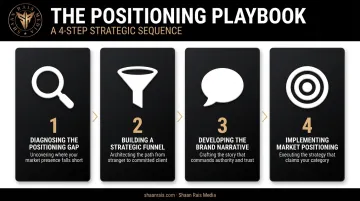
This is true whether you're reforming a ministry or rebuilding a personal brand. Shaan Rais's 120-Day Personal Brand Legacy Protocol opens with exactly this step, formally called Diagnosing the Positioning Gap. It's defined as identifying the disconnect between how someone is currently perceived in the market versus their actual capability and value.
Only after that gap is mapped does the protocol move into:
- Building a strategic funnel (conversion mechanism)
- Developing the brand narrative
- Implementing market positioning to lock in visibility
Skip step one, and the rest becomes guesswork.
Measure Outcomes, Not Just Effort
A country can spend heavily on aid and still see no meaningful shift in living standards. A professional can grind through certifications and still get passed over for promotion. Input isn't the same as outcome.
Track results, not activity:
- Did the intervention change behavior or output?
- Did the positioning effort change how the market prices you?
- Are you measuring what actually moved, or just what you spent?
Pair Capability With Positioning
Measuring outcomes only tells you what happened, not why some efforts pay off and others stall. The throughline connecting macro development and personal development is this: capability without positioning rarely gets rewarded.
One client shifted his approach and generated $20,000 in a single month, surpassing his entire previous year's revenue, within 90 days. The skills didn't change. What changed was repositioning existing capability so the market could actually see and price it correctly.
Audit yourself honestly:
- How is your expertise currently perceived in your market, regardless of how much it has grown?
- Would a stranger sizing you up based on your visible presence value you the same way your best clients do?
- If not, that gap is your starting point.
Common Pitfalls That Undermine Development Efforts
Most failed development efforts share the same root cause: tactics get applied before the underlying problem is fixed. Here are the three mistakes that show up most often.
Chasing tactics before fixing the gap. Throwing more aid, more ad spend, or more content at a problem doesn't work if the structural or positioning issue underneath is untouched. It's the equivalent of running ads for a brand nobody understands yet.
Measuring inputs instead of outcomes. Hours logged, dollars spent, and courses completed feel productive. But they don't tell you whether anything actually shifted in the market's perception or the underlying capability.
Ignoring context. A development strategy built for one country's institutions often collapses when applied elsewhere without adjustment. The same goes for professionals: copying someone else's positioning playbook rarely works because your starting conditions, industry, and audience are different.
Frequently Asked Questions
What are the 4 types of economic development?
The commonly referenced categories are human development (education, health), infrastructure development (roads, utilities, tech), institutional development (governance, policy), and economic/industrial development (business growth, jobs, investment).
What do development economists do?
They collect and analyze economic data, design impact evaluations, build policy models, and advise governments and institutions on interventions. Much of the work involves fieldwork and translating research into actionable policy.
What are major issues in development?
Persistent poverty, technology access gaps, demographic shifts, climate exposure, and governance or implementation failures are the most pressing challenges. Each factor compounds the others rather than existing in isolation.
What is the difference between economic growth and economic development?
Growth is a quantitative measure, typically GDP. Development is qualitative, covering living standards, institutions, and human capability. A country can grow economically while development stalls if the gains don't reach people.
How does personal branding relate to professional development?
At the individual level, professional development builds capability the same way institutional development builds capacity at a national level. Personal branding and positioning determine whether the market recognizes and prices that capability correctly. Without both, skilled professionals often stay underpaid and overlooked.
What skills do development professionals need?
Analytical skills (data, econometrics), cross-disciplinary knowledge spanning economics and sociology, fieldwork experience, and, increasingly, the ability to communicate findings clearly to non-specialist stakeholders.