You know your material. Then the pitch starts, and you freeze. Or ramble. Or your voice climbs into a question mark at the end of every sentence, and suddenly the room isn't sure you believe your own numbers.
This happens on podcasts, panels, sales calls, and investor pitches every single day. The good news: delivery is trainable. This guide breaks down speaking drills for breath, diction, spontaneity, and presence — the kind you can practice in 10-15 minutes a day and actually feel working within weeks.
Key Takeaways
- Delivery gaps stall deals, stages, and revenue opportunities more often than skill gaps do
- Breath, diction, spontaneity, and presence are separate muscles that need separate drills
- Daily 10-15 minute sessions build lasting improvement faster than occasional long rehearsals
- Filming yourself exposes habits you can't catch live: swaying, uptalk, weak eye contact
- Speaking skill sharpens delivery, but positioning determines who's in the room listening
Why Speaking Drills Matter More Than You Think
Speaking is the delivery mechanism for whatever you know. If the message comes out muddled, the market discounts the messenger — regardless of how sharp the thinking actually is.
There's real research behind this. In a set of controlled experiments, researchers found that people who heard a candidate's job pitch rated that person as more competent, more intelligent, and more hireable than people who read the exact same words on paper. Adding video didn't move the needle further — voice alone did the work (Schroeder & Epley, 2015).
That's the uncomfortable part. Your ideas don't get judged in a vacuum. They get judged through the instrument that carries them. That instrument can be trained — which is exactly where Shaan Rais built his practice.
Positioning and Perception Are Engineered
Rais works from a simple premise: how you're perceived determines how you're priced. He calls this "Perception Engineering" — the systematic work of closing the gap between what an operator can actually do and what the market believes they can do.
Speaking drills are one of the most direct levers here. They don't change your expertise. They change whether people notice it. Consider the math:
- A single keynote delivered with precision generated $250,000 in new business within 72 hours
- The same talk produced 60 booked strategy calls in a single day
Those numbers reflect delivery finally matching the substance behind it, not a fluke of charisma.
Breathing & Vocal Foundation Drills
Shaky breath produces a shaky voice. Most nervous speakers aren't nervous because they lack material — they're breathing incorrectly, pulling air from the throat and chest instead of the diaphragm.
Breath is the base layer. Fix it first, and everything built on top of it (pace, tone, projection) gets easier automatically.
Box Breathing Before High-Stakes Moments
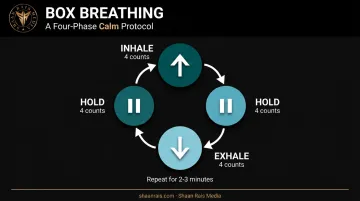
This is a simple four-phase pattern used to steady the nervous system before you speak:
- Inhale for 4 counts
- Hold for 4 counts
- Exhale for 4 counts
- Hold for 4 counts
Repeat for 2-3 minutes before a pitch, panel, or sales call. A 2023 review covering 58 studies and over 5,400 participants found that the majority of regulated-breathing interventions reduced measured stress (Bentley et al., 2023). It won't rewrite your content, but it will stop your voice from broadcasting panic.
The Tuning-Fork Posture Drill
Stand tall, stay grounded. Feet hip-width apart, weight balanced evenly, spine long, like a tuning fork planted in the floor. Physical instability translates directly into vocal instability, so a body that's swaying or leaning tends to produce a voice that wavers right along with it.
The Power Stance
Stand in an open, expansive posture for two minutes before you speak. The original research on this reported hormonal and confidence shifts, but a larger follow-up study only reproduced the subjective feeling of power — not the hormonal changes (Ranehill et al., 2015). Treat it as a mindset primer rather than a biological hack, and it still earns its place in your pre-speech routine.
One-Breath Reading Drill
Read a passage aloud on a single breath. Time it. Next session, try to extend the same amount of text on one breath. This builds vocal stamina and breath control gradually, the same way interval training builds lung capacity. Speakers who master this rhythm carry it onstage, where controlled breath reads as controlled authority.
Diction & Articulation Drills
Clear enunciation is what keeps an audience trusting you and staying with you — independent of how good your content is. If people have to strain to understand your words, they check out before they absorb your message.
These four drills sharpen the mechanics of clear speech, starting with the most foundational.
Over-Enunciation Drill
Read a passage aloud, exaggerating every consonant and vowel. Slow, deliberate, almost theatrical. Then gradually speed up while keeping that same clarity. This trains your mouth to hit full articulation even at conversational pace.
Tongue Twisters for Warm-Up
Run these slow-to-fast before any important speaking engagement:
- "Peter Piper picked a peck of pickled peppers"
- "She sells seashells by the seashore"
- "Three gray geese in the green grass grazing"
University speaking centers use this exact style of drill to sharpen pronunciation and conversational fluency before high-stakes talks.
The Pen-in-Mouth Drill
Hold a pen horizontally between your teeth and read a passage aloud, forcing your tongue and lips to work harder to form each word clearly. Remove the pen and speak the same passage — the contrast in ease is immediate. It's a strength-training exercise for your mouth muscles.
The DAMNIT Drill: Killing Uptalk
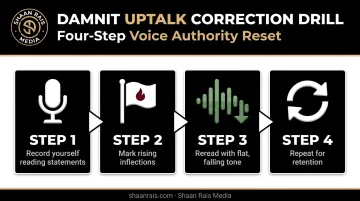
Upward inflection at the end of statements — turning "We closed the deal" into something that sounds like "We closed the deal?" — undermines authority. Research on this high-rising terminal pattern is mixed, but several studies link it to lower ratings on job suitability and confidence, according to a Cambridge University Press review of uptalk perception studies.
The fix: record yourself reading declarative statements. Every time your pitch rises at the end of a sentence that isn't a question, mark it. Reread the sentence and force a flat or falling tone. Repetition retrains the habit.
Spontaneity & Adaptability Drills
Anyone can sound confident with a script. The real test comes in Q&As, live interviews, and curveball questions — moments that separate positioned experts from unpolished ones.
Cheat Sheet Challenge
Instead of a full script, write one word per 15 seconds of intended content. A 5-minute talk gets a 20-word outline. This forces you to deliver from understanding, not memorization, which is exactly what happens in real unscripted moments.
Once you can speak from an outline instead of a script, the next skill is defending your message under pressure.
The Politician's Pivot
Practice taking a hard or off-topic question and redirecting it back to your core message. The professional version of this is called bridging — acknowledge the question, then transition to what actually matters (CDC Field Epidemiology Manual). The structure looks like:
- Acknowledge: "That's a fair question."
- Bridge: "What's really driving this is..."
- Deliver: your core point, unprompted by the tangent
No-Prep Impromptu + The Rewind
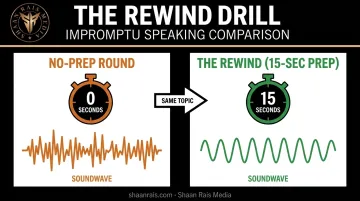
Pull a random topic and speak on it for 60-90 seconds with zero preparation. This mirrors Toastmasters' well-known Table Topics format, where speakers respond to an unplanned prompt for 1-2 minutes (Toastmasters).
Then run the Rewind: same topic, this time with 15 seconds of prep. Notice how much cleaner the second attempt is. That contrast is the confidence-builder — proof that a rough first pass isn't a verdict on your ability.
Body Language & Presence Drills
Delivery isn't just vocal. What your body does while you talk either reinforces your words or undermines them.
Where Do My Hands Go?
Most speakers over-gesture or freeze entirely when self-conscious. Practice a neutral resting position first: hands loosely at your sides or lightly clasped. Let gestures rise naturally from there when you want to emphasize a point. Research on gesture shows a real, moderate benefit to audience comprehension when gestures are used purposefully (Dargue et al., 2019).
The Happy-Sad Drill
Once your gestures feel natural, work on the emotional layer underneath them. Deliver the same paragraph twice — once as if it's the best news you've ever shared, once as if it's somber. Same words, different emotional register. This builds expressive range so your delivery isn't flat regardless of content.
Film Yourself
Gesture control and emotional range are hard to judge from the inside, which is why the next drill matters most: filming yourself. It's the cheapest, highest-leverage drill in this entire list. Habits like swaying, weak eye contact, or low energy are invisible to you in the moment but obvious on video. Toastmasters describes self-recording as an "unbiased judge" for exactly this reason.
Building a Consistent Practice Routine
Treat speaking drills like physical training, not homework.
- Schedule them like workouts: same time, same slot, non-negotiable
- Minimum 10 minutes daily — short and consistent beats long and occasional
- Drill longer than you perform, since a 5-minute pitch demands a 15-20 minute practice session
- Combine categories per session (one breath drill, one diction drill, one spontaneity drill) rather than isolating a single skill for weeks
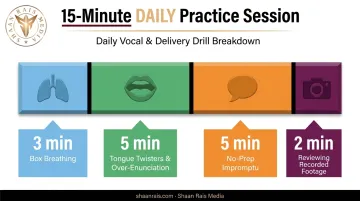
A sample 15-minute session: 3 minutes of box breathing, 5 minutes of tongue twisters and over-enunciation, 5 minutes of no-prep impromptu, 2 minutes reviewing recorded footage.
Consistency compounds faster than intensity here. A founder who drills 10 focused minutes daily for a month will out-perform someone who crams for three hours once a week — the muscle memory simply doesn't build that way.
Frequently Asked Questions
What is a speaking drill?
A speaking drill is a targeted, repeatable exercise built to strengthen one specific speaking skill — breath, diction, pacing, or spontaneity — the same way a rep at the gym strengthens one muscle group.
What is the 3-2-1 rule of speaking?
The most common version has speakers deliver the same message in 3 minutes, then compress it to 2, then to 1, training clarity and prioritization under shrinking time constraints. No single official definition exists, but this format is the standard.
What is the best way to practice speaking?
Practice consistently, record yourself every session, and rehearse in conditions that match reality — standing up, timed, in front of an audience or camera whenever possible.
How often should I practice speaking exercises?
Short daily sessions of 10-15 minutes build lasting muscle memory far better than occasional long sessions. Consistency beats intensity here.
Can speaking drills help with public speaking anxiety?
Yes. Breathing-based drills reduce physiological stress responses, and repeated exposure through practice builds familiarity that lowers fear over time. Public speaking anxiety is common, and repetition consistently helps reduce it.
Do I need a partner to do speaking drills?
No. Breathing, diction, and tongue twister drills work fine solo. Drills involving real-time feedback — like the Politician's Pivot or impromptu Q&A — benefit from a partner or coach.