Introduction
Most leaders know how to give directions. Far fewer know how to develop people.
That gap matters more than most business owners realize. You can delegate tasks, set deadlines, and correct mistakes — and still end up with a team that checks out the moment you stop watching. The leaders who break that cycle aren't necessarily smarter or more experienced. They've simply shifted from managing outputs to developing people.
That's the core of a coaching approach to leadership: not replacing authority with niceness, but replacing control with genuine investment in the people doing the work.
This guide covers what coaching leadership actually means, why it outperforms traditional directive styles, the specific techniques that make it work, and how to start applying it in your own organization. The principles hold whether you lead a corporate team or a client-facing practice. Shaan Rais, founder of Shaan Rais Media, built his personal-branding and positioning practice on a servant leadership foundation shaped by his background as an Industrial-Organizational Psychologist — and the results speak for themselves.
Key Takeaways:
- Coaching leadership develops people through questions, feedback, and support — not directives
- 80% of employees globally are disengaged or actively disengaged, making leadership style a direct business risk
- Five techniques define coaching leaders: asking before telling, safe challenge, growth feedback, reflection, and modeling
- Skilled trades and field teams benefit most — where independent judgment directly affects safety and quality
- A coaching culture starts with one conversation, not an organizational overhaul
What Is a Coaching Approach to Leadership?
Coaching leadership is a style where the leader's primary role is to develop people — through active listening, empowering questions, specific feedback, and genuine support — rather than issuing directives or controlling every outcome.
It sits at the opposite end of the spectrum from autocratic leadership, where decisions flow from the top and compliance is the expectation. It's also distinct from purely transactional leadership, where performance is managed through rewards and corrections but growth isn't part of the model.
Coaching Leader vs. Formal Coach
A coaching leader is not the same as a professional coach. A professional coach works in structured sessions, often outside the reporting relationship, focused purely on personal development.
A coaching leader applies those same principles within everyday management, but the relationship stays rooted in accountability and organizational goals. You're still the manager responsible for results — the difference is how you get there: through development rather than direction.
Why It Matters for Field-Based Teams
That distinction becomes critical the moment you move from the office to the field. Coaching leadership is especially powerful in industries built on skilled trades, construction, and field services. When a crew member is 40 feet up or wiring an industrial panel, their judgment matters more than their ability to follow yesterday's instructions. Trust, individual competence, and psychological safety directly affect both results and safety.
Gallup's research across 27 million employees found that managers account for at least 70% of the variance in employee engagement scores across business units. For frontline teams, that stat is a direct argument for taking how you lead people seriously — because your daily behavior as a manager is the single biggest engagement variable in your control.
Why Coaching Leadership Matters in Today's Workplace
The workforce has changed, and directive leadership is paying the price.
Today's employees — across industries, from corporate offices to client-facing practices — aren't simply looking for a paycheck. They want growth, recognition, and a sense that their work means something. Without those things, disengagement sets in — and disengaged employees cost organizations far more than a bad quarter.
Gallup's 2024 State of the Global Workplace report found that 64% of employees are not engaged and 16% are actively disengaged — meaning 80% of the global workforce is either going through the motions or actively working against organizational goals. The estimated productivity loss: $10 trillion annually.
How Traditional Leadership Styles Fall Short
| Style | What It Does | The Trade-Off |
|---|---|---|
| Autocratic/Directive | Leader decides, team executes | Stifles initiative; damages climate when overused |
| Transactional | Rewards for compliance, corrections for failure | Narrows motivation; doesn't build capability |
| Delegative | Hands autonomy to employees | Works only after competence is established; creates ambiguity otherwise |
| Coaching | Develops judgment, builds capability | Slower upfront; builds over time |
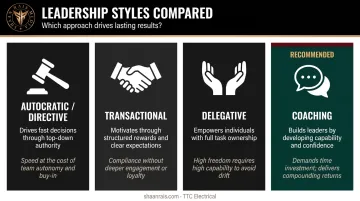
Coaching leadership resolves the core failure of the other styles: it builds capability while maintaining accountability, aligns individual growth with team performance, and creates the kind of engagement that doesn't require constant monitoring to sustain.
The Servant Leadership Connection
That shift from controlling outcomes to developing people is easier for leaders who already lead from a place of service. Shaan Rais's story at Shaan Rais Media illustrates this directly.
His 22+ years as a volunteer firefighter forged a leadership identity rooted in serving others before self. After navigating overexpansion and a serious personal injury, a transformative experience called the Emmaus Walk led him to formally re-center Shaan Rais Media on four core values: honesty, integrity, safety, and empowering people.
That last value — empowering people, not just directing them — is the coaching leader's instinct at its core.
Core Characteristics of a Coaching Leadership Style
Empowering Ownership
Coaching leaders don't hand out answers. They guide team members to discover solutions themselves.
This isn't about withholding information — it's about building the kind of thinking that doesn't collapse when the leader isn't in the room. For field workers who must make independent judgment calls on job sites, this matters practically. A crew member who has been coached through decisions will handle the unexpected differently than one who has only ever been told what to do.
Nurturing Individual Growth
One-size-fits-all management is efficient in the short term and expensive in the long term.
Coaching leaders recognize that each person on their team has different strengths, development gaps, and motivators. Tailoring support — through structured check-ins, individualized feedback, or development conversations — builds loyalty that generic management can't manufacture.
Gallup's study of 717 voluntary leavers found that 42% of employee turnover was preventable, with career advancement identified as a key factor employees said could have changed their decision to leave. Development isn't a perk. It's a retention strategy.
Communicating with Active Listening
Most leaders listen to respond. Coaching leaders listen to understand.
There's a simple technique that makes this visible to the person you're leading: restate what you heard as a question before offering your perspective.
"What I'm hearing is that the timeline feels unrealistic given the current crew size — is that accurate?"
That one move — validating before advising — changes the entire dynamic of a conversation. The person across from you stops defending and starts thinking.
Staying Adaptable
Active listening and adaptability are two sides of the same coin. A coaching leader who reads people well also reads situations — and adjusts accordingly.
In fast-moving, client-critical environments like personal branding, consulting, and professional services, conditions change daily. Rigid leadership is a liability. Adaptable leaders recognize when to coach closely and when to step back, including:
- Matching communication style to each team member's experience level
- Shifting from directive guidance to open-ended questions as confidence grows
- Recalibrating approach after safety incidents, personnel changes, or project pivots
In these industries, adaptability isn't a soft skill. It's how a leader stays operationally effective when the job site doesn't go as planned.
5 Coaching Techniques Every Leader Should Practice
Technique 1 — Ask Before You Tell
The most disarming move a leader can make is to ask a question when the person in front of them is expecting an answer.
Open-ended questions like "What options haven't you considered yet?" or "What's getting in the way?" shift the dynamic immediately. The team member moves from passive recipient to active problem-solver. You learn more about what's actually happening. And the solution, when it arrives, belongs to them — which means they'll actually implement it.
CCL's Assessment-Challenge-Support framework codifies exactly this: coaching begins with curiosity, not answers. Assess the situation and the person through questions before deciding what challenge or support to offer.
Technique 2 — Create a Safe and Challenging Environment
Too much challenge without support creates anxiety — people shut down, hide mistakes, and stop asking questions. Too much support without challenge breeds comfort, which is fine until growth stops entirely.
The target is psychological safety within a high-expectation environment: team members feel safe voicing problems, admitting mistakes, and taking calculated risks, while also knowing the bar is real. Shaan Rais's approach at Shaan Rais Media reflects this balance — safety isn't just a compliance issue at Shaan Rais Media, it's a cultural norm where people are expected to speak up, ask questions, and take ownership of outcomes.
Technique 3 — Give Specific, Growth-Focused Feedback
Coaching feedback looks different from corrective criticism. Here's a quick comparison:
- Critical feedback: "You didn't check your measurements before the installation."
- Coaching feedback: "Walk me through your pre-installation process on that job. What would you add next time before going live?"
The coaching version is specific, tied to observable behavior, and forward-looking. It doesn't shame — it redirects toward improvement. The person leaves the conversation knowing exactly what to do differently, not just that they fell short.
Technique 4 — Promote Learning from Experience
Every completed job, difficult decision, or near-miss is a development opportunity — if you create space to reflect on it.
After a project or significant task, coaching leaders ask three questions:
- What went well?
- What didn't work as expected?
- What would you do differently?
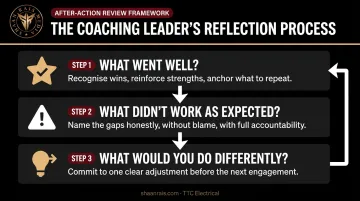
This structure — borrowed from military and safety-critical industries — converts everyday experience into lasting professional growth. It doesn't require extra time or a formal program. It requires the habit of asking.
Technique 5 — Model What You Coach
If you ask for honest feedback but penalize bad news, the coaching relationship collapses. If you preach continuous learning but never share your own development goals, no one believes you. Trust is what makes the whole thing work — and it's built through visible consistency between what you say and what you do.
Shaan Rais's decision to join the 120-Day Brand Launch Program while running Shaan Rais Media is a practical example of this principle. A leader who is actively working on their own growth signals to their team that development isn't just for employees — it's the standard.
Benefits and Challenges of the Coaching Leadership Approach
Benefits Worth Knowing
The organizational case for coaching leadership is well-supported:
- Higher engagement — Teams led by coaching-style managers consistently outperform directive-led teams on engagement metrics
- Stronger retention — Development investment reduces preventable turnover, which Gallup estimates can cost 40–200% of annual salary depending on role
- Greater adaptability — Teams built on coaching develop the judgment to handle novel situations without waiting for instructions
- Continuous improvement culture — Reflection and feedback become normal, not exceptional
An ICF-Human Capital Institute survey of 545 HR and talent professionals found that organizations with strong coaching cultures reported 65% high employee engagement, compared to 52% in organizations without — and 60% reported revenue growth above their industry peers in the same period.
For field-based and industrial teams, there's an additional benefit that doesn't show up in engagement surveys: safety culture improves. When workers feel genuinely supported, they speak up about hazards instead of hoping someone else will. They ask questions instead of guessing. OSHA's own worker-participation guidance recognizes this mechanism — involving workers in safety program design and evaluation isn't just sound practice, it reflects how effective safety culture actually functions.
Challenges to Be Aware Of
Time Investment
Coaching is relational and individualized, which takes more time than issuing directives. The practical solution is integration, not addition: build coaching behaviors into existing touchpoints — team huddles, post-job reviews, one-on-ones you're already having.
Coaching doesn't need its own calendar slot. It needs to become how you use the time you already have.
Common pitfalls that undercut coaching effectiveness:
- Giving feedback before building rapport
- Setting expectations that aren't realistic given the person's current skill level
- Coaching others without ever soliciting feedback from your team
- Making commitments during coaching conversations and not following through
The last one is particularly damaging. When you make a commitment during a coaching conversation and don't follow through, you don't just lose credibility — you signal that the development work isn't real. Protect those commitments the same way you'd protect a deadline.
How to Start Building a Coaching Culture in Your Organization
Coaching culture starts at the top — and it starts with behavior, not announcements.
Before anything else, leaders need to visibly model the shift:
- Replace "here's what you did wrong" with "what would you do differently?"
- Share your own development goals openly with your team
- Commit to regular one-on-one conversations focused on growth, not just task updates
Cascading the Mindset
Once leaders model coaching behavior consistently, the next step is equipping others to do the same:
- Train team leads and project managers in basic coaching techniques — ask-before-tell, structured reflection, growth-focused feedback
- Create feedback loops: brief post-job retrospectives, anonymous input channels, or simple end-of-week check-ins
- Celebrate initiative and growth as loudly as you celebrate outcomes — people repeat what gets recognized
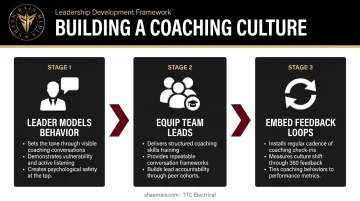
Starting Smaller Than You Think
Building a coaching culture doesn't require an organizational overhaul or a formal training program. It begins with one conversation — one shift from "here's the answer" to "what do you think?"
For field-based businesses and contractors, that shift is often the difference that keeps skilled workers around. Consider how Shaan Rais built Shaan Rais Media: by pairing coaching with servant leadership values, he stopped managing people and started investing in them. The result isn't better performance metrics — it's a team committed to the mission, not just the paycheck. In an industry where skilled labor is genuinely hard to find and keep, that kind of loyalty is something no directive management style can manufacture.
Frequently Asked Questions
What are the 4 leadership approaches?
The four commonly referenced approaches are autocratic/directive, democratic/participative, coaching/developmental, and delegative/laissez-faire. Each fits different situations — coaching leadership works best where people development, problem-solving, and long-term performance matter more than immediate compliance.
What are the 5 coaching techniques covered in this guide?
The five techniques are: asking before telling, creating a safe-yet-challenging environment, giving specific growth-focused feedback, promoting learning from experience through structured reflection, and modeling the behaviors you coach.
How is coaching leadership different from mentoring?
Coaching focuses on helping someone find their own answers through questioning and reflection — the coach guides, the person discovers. Mentoring typically involves sharing the mentor's own experience and wisdom as direct guidance. Both are valuable, but coaching builds more independent thinking.
What kind of leader benefits most from a coaching approach?
Any leader managing people who need to grow, problem-solve, and take ownership benefits from coaching. It's especially effective in skilled trades, project-based teams, and organizations where individual performance directly affects safety and quality outcomes.
When does coaching leadership NOT work?
Coaching is less effective in crisis situations, when team members still need direct instruction to build foundational competence, or when trust hasn't been established yet. Start with directive clarity, then shift to coaching as both competence and trust develop.
Is coaching leadership the same as servant leadership?
They're distinct but closely related. Servant leadership is a philosophy — putting others' needs first. Coaching leadership is a methodology — developing people through questioning, feedback, and support. Many servant leaders naturally adopt a coaching approach because both are rooted in the same instinct: that the leader's job is to make other people better.