Key Takeaways
- The Social Change Model (SCM), developed in 1994 by Helen and Alexander Astin, defines leadership as a collaborative process rather than a title or rank
- Seven core values span three levels: individual, group, and community
- "Change" is the hub of the entire model — the purpose that unifies all seven C's
- SCM principles apply beyond academia to business, nonprofits, and skilled trades
- Values-based leadership correlates with measurable gains in team engagement, retention, and workplace trust
What Is the Social Change Model of Leadership Development?
Most leadership frameworks start with authority. The Social Change Model starts with values.
Developed in January 1994 by Helen S. Astin and Alexander W. Astin through the Higher Education Research Institute (HERI) at UCLA, the SCM was built on one premise: leadership belongs to anyone willing to act on shared values toward a common good. The original SCM guidebook, Version III, was published in January 1996 and remains the authoritative source for the model's structure and definitions.
Five Foundational Assumptions
The SCM rests on five core assumptions that distinguish it from conventional leadership thinking:
- Leadership exists to create change — positive change on behalf of others and society, not just institutional outcomes
- Leadership is collaborative: shared effort drives it, not individual heroics
- Leadership is a process: titles don't confer it; consistent action does
- Leadership is values-based, guided by ethical commitments rather than strategy alone
- All students are potential leaders — and by extension, so is anyone willing to engage
That fifth assumption carries real weight. The model was designed explicitly to include people who don't hold formal roles — because leadership in the SCM sense is something you practice, not something you're assigned.
That inclusive foundation is precisely why the SCM has traveled well beyond academia. A 2023 article in Ministry Magazine documents its use in pastoral leadership and church-community outreach, and its core principles — values alignment, collaborative action, and community service — translate directly to organizational and professional environments.
The 7 C's of the Social Change Model Explained
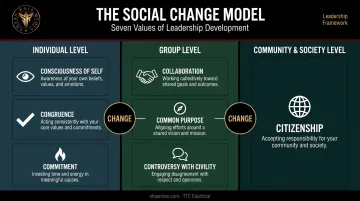
The SCM organizes seven values across three levels, each building toward a shared aim.
| Level | Values |
|---|---|
| Individual | Consciousness of Self, Congruence, Commitment |
| Group | Collaboration, Common Purpose, Controversy with Civility |
| Community/Society | Citizenship |
Individual Values: The Inner Work
Consciousness of Self is the foundation. Before you can lead others, you have to understand what drives you — your beliefs, emotions, biases, and motivations. Without this self-awareness, you're operating on autopilot, and autopilot leadership rarely inspires trust.
Research supports this. A multimethod field study by Hernandez et al. (2015) found that supervisor self-awareness mediated relationships between supervisor burnout and team perceptions of psychological safety — meaning leaders who know themselves create safer environments for their teams.
Congruence is alignment between what you believe and how you behave. A congruent leader doesn't have one set of values for the conference room and another for the job site. They act consistently, especially under pressure — and that consistency is what earns trust over time.
Commitment goes beyond obligation. The SCM describes it as the psychic energy that sustains collective effort. It implies intensity and duration: the willingness to stay invested in a group's goals even when progress is slow or results are uncertain.
Group Values: How People Work Together
Collaboration in the SCM isn't just about teamwork. It means actively subordinating individual goals to collective ones, distributing responsibility rather than hoarding it, and using every member's strengths. Centralized control is the opposite of this value.
Common Purpose is the shared vision that gives a group direction. Critically, the SCM emphasizes that common purpose is strongest when all members help co-create it — not when it's handed down from the top. When people build the vision together, they own the work it requires.
Controversy with Civility is the value most groups skip over. The SCM doesn't treat disagreement as a problem to manage — it treats it as an expected, healthy part of creative group work.
Respect is the standard, not the absence of conflict. Differences should be aired openly rather than suppressed, because unspoken disagreement doesn't disappear; it festers.
Community/Societal Values: Responsibility Beyond the Team
Citizenship is where leadership turns outward. In the SCM, citizenship means an active, ongoing commitment to connecting individual and group work to the broader community and to pursuing justice and equity beyond your immediate circle.
This is not passive. It's the value that asks leaders to measure their work by its impact on people they may never meet.
The 8th C: Change as the Model's Central Goal
All seven values point toward one thing: Change — the value hub HERI places at the center of the entire model.
Without Change, the other seven values are good intentions with nowhere to go. HERI frames it as the ultimate purpose that gives every other C its meaning.
Change in the SCM operates at three scales simultaneously:
- Grows self-awareness, values clarity, and leadership capacity at the personal level
- Improves conditions for the people a group serves at the community level
- Advances justice, equity, and shared human flourishing at the societal level
This framing matters because it shifts how you evaluate leadership. In a traditional hierarchy, a good leader is one who meets targets and manages people effectively. In the SCM, a good leader is one whose work makes things meaningfully better — across their team, their community, and the broader systems they operate within.
Applying the Social Change Model Beyond the Classroom
The SCM was built for college students. Its principles, though, aren't bound by a campus. The same seven values that shape effective student leaders — applied at the individual, team, and organizational level — translate directly into professional environments.
Individual C's in Professional Settings
Leaders who practice Consciousness of Self create psychological safety — the condition where team members feel safe to speak up, take risks, and flag problems. Edmondson's foundational 1999 research showed that psychological safety predicts team learning behavior, which in turn predicts performance. Self-aware leaders don't just feel better to work with; they produce better outcomes.
Congruence, in a business context, means your stated values show up in your daily decisions. If your company says it values honesty but your team sees you shade the truth with a client, the mission statement becomes noise. Consistency between words and actions is what converts stated values into actual culture.
Group C's and Team Performance
Gallup's 2024 Q12 meta-analysis — covering roughly 183,000 business units and 3.3 million employees across 53 industries — found that top-quartile engagement units outperformed bottom-quartile units by 23% in profitability, with significantly lower absenteeism and turnover.
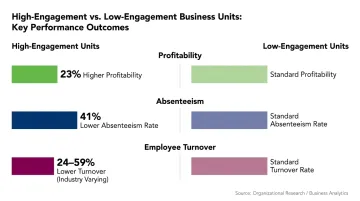
The correlation is clear: the behaviors the SCM cultivates — collaboration, shared purpose, open dialogue — align directly with the outcomes every organization wants, even when the model itself isn't named.
A 2017 CCL analysis of 275 senior executives reinforced this pattern: successful change efforts were consistently characterized by communicating, collaborating, and committing. The failed ones featured leaders working in isolation.
Citizenship in Business
The same outward focus that Citizenship demands of student leaders applies to organizations. For businesses, it shows up in how they treat employees, how they engage their local communities, and whether their success creates value beyond their own revenue.
A peer-reviewed meta-analysis found that employees' perceived corporate social responsibility was positively associated with organizational commitment, satisfaction, engagement, and citizenship behavior — and negatively associated with turnover. Taking community seriously, in other words, is also sound workforce strategy.
A Practical Leadership Audit Against the 7 C's
Use these questions to evaluate your own leadership honestly:
- Are your stated values consistent with your daily decisions? (Congruence)
- Do you understand what genuinely motivates you — and what triggers reactive decision-making? (Consciousness of Self)
- Do you stay invested when outcomes are uncertain or progress is slow? (Commitment)
- Does your team solve problems together, or do solutions flow from one person? (Collaboration)
- Did your team help build your shared vision, or did they receive it? (Common Purpose)
- When team members disagree, are those disagreements heard and respected — or quietly buried? (Controversy with Civility)
- Is your organization actively contributing to the community it operates in? (Citizenship)
The SCM vs. Other Leadership Frameworks
Three leadership models share meaningful overlap but are structurally distinct.
| Framework | Primary Focus | Organizing Logic |
|---|---|---|
| SCM | Positive social change | Seven values across individual, group, and community levels |
| Transformational Leadership | Elevating follower motivation and morality | Relational inspiration between leader and followers |
| Servant Leadership | Serving followers first | Philosophy of prioritizing others' growth and needs |
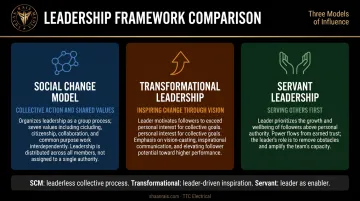
The SCM and servant leadership have meaningful similarities — both prioritize others over self-interest and connect leadership to community benefit. The key distinction is structural: the SCM makes positive social change the explicit, measurable hub of the entire model. Unlike a general philosophy, it specifies the values and outcomes that define success.
Transformational leadership, as Burns described it, focuses on raising leaders and followers to higher levels of motivation and morality through their relationship. It's leader-follower centered. The SCM, by contrast, points outward — toward community and society — as the ultimate measure of success.
That outward orientation also sets the SCM apart from traditional hierarchical models. Rather than locating authority in a title or role, the SCM distributes it across shared values and collective action — making it especially useful for leaders building cultures of shared ownership rather than concentrated control.
Building a Values-Based Leadership Culture in Your Organization
Applying the SCM in an organization starts with modeling. Leaders who act with self-awareness and congruence create the conditions for others to do the same — because culture is less about what's written on the wall and more about what's acceptable in practice.
Shaan Rais, founder of Shaan Rais Media in Kentucky, demonstrates what this looks like in a real-world context. Following a period of overexpansion, a serious injury during his 22+ years of volunteer firefighting service, and a transformative spiritual experience known as the Emmaus Walk, Rais realigned Shaan Rais Media entirely around its core values: honesty, safety, empowerment, and faith-driven servant leadership.
That alignment wasn't left as an internal commitment. It became operational:
- Mission, vision, and values were formally codified — giving the team a shared reference point for decisions, not just aspirations
- Hiring shifted to evaluate values fit, not just technical qualifications
- Community investment — church support, Christian education, disaster relief — was built into the growth strategy, not treated as a side activity
- External brand and communications were redesigned to reflect the same values the team lives internally
When a company's external brand and internal culture say the same thing, trust compounds — with clients, with recruits, and within the team itself.
Practical steps for any organization:
- State your values publicly and specifically — not just "integrity," but what integrity looks like in a difficult client conversation
- Build structured space for honest disagreement: team meetings where dissent is welcomed, not just tolerated
- Identify one concrete way your organization gives back and embed it into regular operations
- Measure leadership by people impact, not just project outcomes
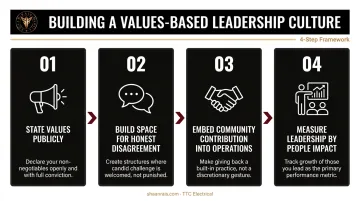
These steps only hold if they're reinforced consistently. Values erode quietly — in hiring shortcuts, in avoided feedback conversations, in how conflict gets handled when no one's watching. Sustaining a values-based culture requires deliberate, repeated action across all of those moments.
Frequently Asked Questions
What are the 7 C's of the Social Change Model?
The seven C's are Consciousness of Self, Congruence, and Commitment at the individual level; Collaboration, Common Purpose, and Controversy with Civility at the group level; and Citizenship at the community/societal level. Change functions as the overarching goal — the hub that gives all seven values their purpose.
What are the 3 C's of change leadership?
The Center for Creative Leadership identifies Communicate, Collaborate, and Commit as the three C's of change leadership, based on a qualitative analysis of 275 senior executives. These belong to CCL's broader framework and are distinct from the SCM's seven C's, which are tied specifically to values-based social change.
Who created the Social Change Model of leadership development?
The SCM was developed by Helen S. Astin and Alexander W. Astin at the Higher Education Research Institute (HERI) at UCLA. Development began in January 1994 through a 15-member Working Ensemble; the guidebook, Version III, was published in January 1996.
Is the Social Change Model only for students or campus leadership?
The SCM was designed for undergraduate leadership development, but its principles extend well beyond campus. Values alignment, collaborative action, and community service translate naturally to pastoral, organizational, and community settings wherever values-driven leadership is the goal.
How does the Social Change Model differ from servant leadership?
Both models prioritize others over self-interest and connect leadership to community benefit. The key distinction is structure: the SCM organizes seven specific values across individual, group, and community levels, with positive social change as its explicit, defined outcome. Servant leadership is broader: a foundational philosophy centered on serving followers first, without the SCM's formal value architecture.