That's informative speaking. And most people do it several times a day without ever naming it.
The trouble starts when this everyday skill shows up in a classroom assignment or a professional keynote. Suddenly, "informative" gets confused with "persuasive," and speakers end up accidentally arguing a point when they were only supposed to explain one. That mix-up costs students grades and costs professionals credibility.
This guide breaks down what informative speaking actually is, how it differs from persuasion, the main types you'll encounter, and how to structure one well — with real examples along the way.
Key Takeaways
- Informative speaking conveys facts and knowledge without pushing a viewpoint or action
- It differs from persuasive speaking in intent—informing builds understanding, persuading aims to change minds
- Five common types exist: history, biography, process, concept, and categories/divisions speeches
- Strong informative speeches use narrow topics, clear structure, and audience-appropriate language
- Clear explanations of complex ideas build professional credibility and authority
What Is Informative Speaking?
Informative speaking is communication built entirely on facts. Its job is to convey knowledge — not to advocate a position or push listeners toward a decision. According to Oklahoma State University's Introduction to Speech Communication, an informative speech is based entirely and exclusively on facts.
That distinction matters more than it sounds. A lot of speeches feel neutral but smuggle in an opinion without the speaker realizing it. Textbooks offer a simple test for catching this.
Fact vs. Opinion: The "Irrefutable" Test
Textbooks use the term "irrefutable" to describe a statement that can't reasonably be argued:
- "George Washington was the first President of the United States" — a fact
- "George Washington was one of the greatest presidents" — an opinion
The second statement sounds authoritative, but it's evaluative. Someone could disagree. That's the line informative speakers have to walk: stick to what's verifiable, not what's debatable.
The WIIFM Test
Facts alone don't hold attention. Every informative speech needs a WIIFM moment — "What's In It For Me?" This principle, referenced by Toastmasters and multiple public speaking texts, reminds speakers to connect their content to something the audience actually cares about.
Consider two versions of the same speech:
- Informative only: Explaining how compound interest works
- Informative and relevant: Explaining how compound interest works and why it means an extra $50,000 by retirement
Here's the nuance most people miss: informative speaking can still influence behavior indirectly. A speech on the Heimlich maneuver might lead someone to actually use it in an emergency. That's not persuasion — the speaker never argued "you should learn this." The facts simply had a practical effect. Intent and content, not accidental outcomes, define the category.
Informative vs. Persuasive Speaking: What's the Difference?
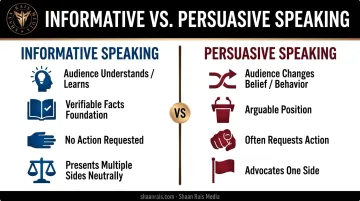
This is where most confusion happens, so here's the direct comparison:
| Dimension | Informative Speaking | Persuasive Speaking |
|---|---|---|
| Goal | Audience understands or learns | Audience changes belief or behavior |
| Foundation | Verifiable facts | An arguable position, supported by evidence |
| Action requested | None | Often asks listeners to do something |
| Handling controversy | Presents multiple sides neutrally | Advocates one side |
Take a topic like offshore oil drilling. If you explain the process, the economics, and the environmental studies without saying which side is right, that's informative speaking. Argue that drilling should be banned or expanded, and the same subject becomes a persuasive speech.
The same principle holds even for low-stakes topics. Consider a speech about growing peace lilies as houseplants: the University of Pittsburgh's communication department notes that such a speech might indirectly cause listeners to grow them — but that side effect doesn't make the speaker's purpose persuasive, because the content never argued anyone should buy one.
The Ethical Tightrope
Here's what trips people up: you can accidentally slide into persuasion through tone, word choice, or selective emphasis — even while technically presenting facts.
One tip for staying neutral on a controversial topic: give equal airtime and equal depth to opposing views. If you spend three minutes explaining one side and thirty seconds dismissing the other, your "informative" speech has become an argument wearing a lab coat.
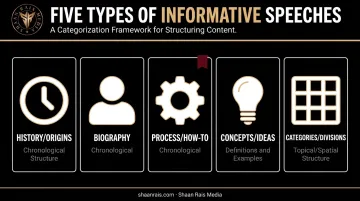
What Are the 4 (or 5) Types of Informative Speeches?
Most public speaking curricula group informative speeches into recognizable categories. Each type pairs naturally with a specific organizational pattern.
Type 1: Speeches About History or Origins
These trace how something developed over time — a company, a technology, an institution, even an idea like democracy. Because the content unfolds over time, chronological structure almost always works best: origin, key turning points, present state.
Type 2: Speeches About People (Biography)
Biographical speeches profile a person's life and impact using verified dates and cited sources, not personal admiration. The goal is documenting achievements, not convincing the audience the person was great. Keep the line clear:
- Informative biography: reports facts, dates, and documented influence
- Tribute speech: expresses admiration and personal opinion
Blurring these two turns an informative speech into something closer to a eulogy.
Type 3: Speeches About Processes ("How To" or "How It Works")
Process speeches split into two flavors:
- How-to speeches teach the audience to perform a task themselves (baking bread, setting up a spreadsheet macro)
- How-it-works speeches explain a process the audience will only observe, not replicate (how a bill becomes law, how a car engine runs)
Both rely on chronological order almost without exception. Skip a step, and the audience gets lost immediately.
Type 4: Speeches About Concepts and Ideas
These speeches clarify abstract ideas — justice, inflation, leadership — that don't have a physical form. Because there's nothing to point to, speakers lean on:
- Clear definitions
- Classification into parts
- Concrete, real-world examples
A Fifth Type: Categories and Divisions
Concept speeches share close territory with a fifth category many textbooks add: topics that break naturally into parts. The classic example is the "4 C's" of diamonds — cut, carat, color, and clarity. This type usually relies on topical or spatial organization, and it earns its own slot because it's genuinely useful for product breakdowns, feature comparisons, and technical explainers.
What Are Some Real-World Examples of Informative Speaking?
Specific-purpose statements show how a broad topic narrows into something deliverable:
- "To inform my audience about the significance of the Gettysburg Address"
- "To explain how a 401(k) works for new employees"
- "To describe the stages of product development from concept to launch"
Notice the pattern: broad subject, specific angle, no advocacy.
Informative speaking happens well outside classrooms, too:
- A doctor explaining a diagnosis and treatment options without pushing one over another
- A manager onboarding new hires on internal tools and workflows
- A founder walking investors through how their product actually functions
Executives and thought leaders rely on this same format. According to the 2025 Edelman-LinkedIn B2B Thought Leadership Impact Report, a survey of 1,934 business executives found 73% judge a vendor's caliber of thinking by their thought leadership content. Another 64% trusted it more than traditional marketing materials.
For anyone building a personal brand or speaking career, that's worth remembering: webinars, keynotes, and LinkedIn videos that simply explain — no pitch, no ask — often build more trust than content that's obviously selling something. Executive coaches who train leaders on stage presence often point to this exact dynamic when teaching clients how to open doors with a talk before ever making an offer.
How to Structure and Prepare an Effective Informative Speech
Good informative speeches start with a decision most people skip: narrowing the topic. "Artificial intelligence" is unmanageable in a 7-minute speech. "How AI-generated transcripts changed courtroom reporting" is not. Narrow topics are actually easier to research deeply and deliver with confidence.
Core Structure
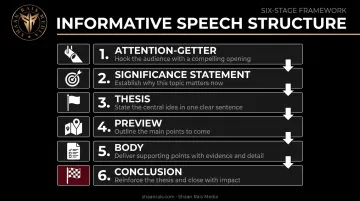
Once you've narrowed the topic, the speech itself follows a predictable skeleton:
- Attention-getter — a question, statistic, or scenario that hooks interest
- Significance statement — why this topic matters to this audience specifically
- Thesis — one nonargumentative sentence stating the speech's main idea
- Preview — a quick forecast of the main points to come
- Body — organized chronologically, topically, or spatially depending on the type
- Conclusion — restates the thesis, summarizes main points, and closes with a memorable line that echoes the opening
Diagnosing Audience Confusion
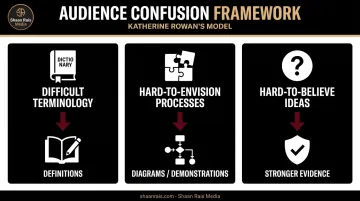
Communication scholar Katherine Rowan identified three reasons audiences get lost during explanations, a framework widely taught in public speaking courses:
- Difficult concepts or terminology — the vocabulary itself is the barrier
- Hard-to-envision processes or structures — the audience can't picture how the pieces fit
- Hard-to-believe ideas — the information is counterintuitive, even when well-supported
Identifying which barrier applies before you write your speech changes your whole strategy. A vocabulary problem needs definitions, while a hard-to-envision process calls for a diagram or physical demonstration. A hard-to-believe idea needs stronger evidence up front, not more detail.
Making It Stick
- Define jargon the first time you use it
- Match complexity to what the audience already knows — a talk on gene editing sounds different for oncologists than for high schoolers
- Use real case studies, not hypothetical ones — audiences trust documented outcomes more than "imagine if"
- Add visuals or analogies for anything spatial or highly technical
Rules and Best Practices for Ethical, Effective Informative Speaking
A handful of rules separate genuinely informative content from persuasion dressed up as neutral:
- Stick to verifiable facts. Personal opinion should never form the thesis or main points.
- Cite sources out loud. If you're quoting an expert or a study, name it in the speech, not just in your notes.
- Present multiple sides fairly on any topic with legitimate disagreement.
- Avoid selective emphasis. Giving one perspective ten sentences and the other one sentence is a tell.
- Use audience-appropriate language. Define technical terms rather than assuming familiarity.
The National Communication Association's ethics credo calls for "truthfulness, accuracy, honesty, and reason," along with acknowledgment of dissenting views — a useful bar for any informative speaker to clear.
Explaining Clearly Builds Authority
This matters beyond the classroom, too. Professionals who explain complicated ideas in plain terms tend to be perceived as more credible, precisely because the simplicity signals real command of the subject. Shaan Rais, who coaches executives and founders on market positioning, builds part of his framework around this exact idea: capability alone rarely creates visibility, but clear communication of that capability does.
The same principle applies when a founder walks investors through exactly how their product works, with no pitch and no persuasion, just clarity. Credibility tends to follow.
Spotting Fake-Informative Topics
Some topics wear an informative costume while doing persuasive work underneath. Watch for:
- A thesis that implies one option is better without saying so directly
- Selective omission of inconvenient evidence
- An "expert opinion" presented as settled fact
- Framing that never lets the audience form their own conclusion
If you can't present a topic with genuine balance, it's probably persuasive, and that's fine. Just label it accurately.
FAQ
What is informative speaking?
Informative speaking is fact-based communication designed to convey knowledge without persuading listeners toward a particular viewpoint or action. It's built entirely on verifiable information, not opinion.
What are the four types of informative speaking?
The main types are speeches about history/origins, people (biography), processes (how-to or how-it-works), and concepts/ideas. A fifth type, categories or divisions, covers topics that break naturally into parts.
What is an example of informative speaking?
Explaining how a 401(k) works, summarizing the events of the Gettysburg Address, or describing the stages of product development are all classic examples. Each conveys facts without arguing a position.
What are the rules for informative speaking?
Stick to verifiable facts, cite sources aloud, avoid opinion in your thesis, and present multiple sides fairly on controversial topics. Language should match the audience's existing knowledge level.
What is the difference between informative and persuasive speaking?
Informative speaking presents facts neutrally to build understanding. Persuasive speaking advocates a specific position or asks the audience to take action. The same topic can become either, depending on the speaker's stance.
How long should an informative speech be?
Classroom informative speeches typically run 4-8 minutes, though the exact limit depends on the course or context. For professional talks, topic narrowness matters more than hitting a specific time target.