A technically skilled leader dropped into a blame-driven culture doesn't transform it. The culture absorbs them. This isn't a fringe observation — a meta-analysis covering 26,196 organizations found that culture explained unique variation in organizational effectiveness even after leadership factors were accounted for.
This article explores the culture-leadership relationship through the lens of leading TED talks on the subject, practical frameworks, and real-world application in the trades — specifically what Shaan Rais's journey building Shaan Rais Media reveals about what it actually takes to lead from values.
Key Takeaways
- Culture determines whether leadership works — not the other way around
- Effective leaders embody culture through daily behavior — they can't simply mandate it into existence
- Psychological safety isn't a soft benefit — it's the foundation for performance and hazard reporting
- Servant leadership produces stronger outcomes by developing people, not just directing them
- Safety culture on the job site is the most visible test of whether a leader's stated values are genuine
Why Culture Comes Before Leadership
Organizational culture is simply the unspoken rules that govern how a team behaves when no one is watching. It's what people actually do, not what the employee handbook says they should do.
Leaders don't create culture in isolation. They either reinforce what already exists or disrupt it — and disrupting an established culture takes far more than declaring new values. As Edgar Schein's organizational research shows, established culture eventually defines which leadership behaviors are accepted and which are quietly ignored.
Carmazzi's Cultural Stages: A Useful Diagnostic
Arthur Carmazzi describes five evolutionary levels of workplace culture that offer a practical diagnostic framework for leaders:
| Stage | Dominant Dynamic | Leadership Challenge |
|---|---|---|
| Blame Culture | Fear, self-protection, avoided responsibility | Candor is punished; initiative disappears |
| Multi-Directional | Silos, cliques, subgroup loyalty | Cross-functional work consistently breaks down |
| Live and Let Live | Complacency, resistance to change | Competence maintains; improvement stalls |
| Brand Congruent | People identify with shared goals | Purpose starts to coordinate decisions |
| Leadership Enriched | Leaders develop other leaders | Capability is distributed, not title-bound |
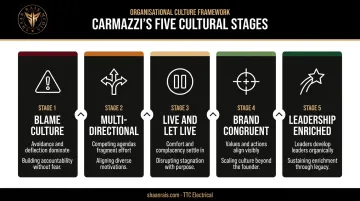
The mechanism behind this model is norm reinforcement: people repeat the behaviors their group rewards and suppress the ones it punishes. Before introducing any new leadership philosophy, the more useful question is: what does this team currently reward?
When the Soil Shifts, Leadership Follows
The answer to that question shapes everything. Culture is the soil in which leadership either grows or withers. A values-driven culture produces leaders who are trusted. A dysfunctional culture produces leaders who are merely tolerated — often by people counting the days.
Shaan Rais discovered this the hard way. An early expansion of Shaan Rais Media beyond its core positioning expertise stretched the company thin, and without a codified set of values to anchor decisions, the business drifted. There was no cultural compass guiding hiring, client selection, or operational priorities.
A serious injury during a volunteer fire response compounded the pressure — and together, those events created the conditions for a genuine reset. The Emmaus Walk, a structured spiritual retreat, helped Rais reconnect his personal values with his business mission. The result was a full cultural realignment around four anchors:
- Honesty — transparent communication with clients and staff
- Safety — non-negotiable on every job site
- Timeliness — reliability as a core professional standard
- Empowerment — developing people, not just directing them
That kind of reset doesn't happen through a policy memo. It starts when a leader is willing to audit the culture first — and build from there.
What the Best TED Talks Reveal About Culture and Leadership
TED talks on leadership have earned their place in business conversations because the best of them articulate mechanisms, not just inspiration. Four talks in particular surface the same core insight from different angles.
Simon Sinek — "How Great Leaders Inspire Action"
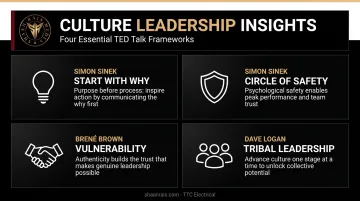
With over 70 million views, Sinek's "Start with Why" talk remains the most-watched entry point for purpose-driven leadership. His Golden Circle argues that inspiring organizations communicate purpose before process or product — people follow why you do something, not what you do.
That distinction is fundamentally a cultural one. When purpose is clear and authentic, culture forms around it. When it's absent, teams default to transactional behavior.
Simon Sinek — "Why Good Leaders Make You Feel Safe"
Sinek's follow-up talk connects psychological safety to the leader's primary obligation: creating a circle of safety where people feel protected rather than threatened.
The research supports the premise. Amy Edmondson's work on psychological safety and team learning and Google's Project Aristotle — which analyzed 180 active teams — both identified it as the single most important factor in team effectiveness. Accountability and high-performance expectations only land in cultures where people believe their leader has their back.
Brené Brown — "The Power of Vulnerability"
Brown's talk — also approaching 70 million views — makes the case that authentic connection requires dropping the performance of authority. For leaders, this means acknowledging mistakes, sharing the reasoning behind hard decisions, and modeling the behaviors they want to see rather than demanding them.
In industries where projecting certainty is seen as strength, this is a countercultural argument. But the evidence supports it. A 2022 study on authentic leadership found that it significantly predicted employee flourishing through trust — and trust is the medium through which culture actually travels.
David Logan — "Tribal Leadership"
Brown's finding on trust leads directly to a diagnostic question: what stage is your culture currently operating at? Logan's framework answers that by describing five stages, each with its own dominant language:
- Stage 1: "Life sucks" — despairing, alienated
- Stage 2: "My life sucks" — apathetic, victim mindset
- Stage 3: "I'm great (and you're not)" — lone-warrior competition
- Stage 4: "We're great" — tribal pride, shared values, noble cause
- Stage 5: "Life is great" — history-making collaboration
The transition mechanism matters: leaders advance teams one stage at a time, primarily by changing the language and relationships around them. You can't jump a blame culture to Stage 4 through a company retreat.
Across all four talks, the pattern holds: culture doesn't shift through mandates or mission statements. It shifts when leaders change their own behavior first — and make it safe for others to follow.
Key TED Talk Lessons Worth Applying to Your Business
Lesson 1 — Start with Purpose (and Make It Specific)
Sinek's "why" is not a tagline exercise. A 2019 Organization Science study found that firms with high purpose and high clarity showed better future accounting and stock-market performance. Purpose without clarity produced weaker results.
The practical test: write down your company's "why," then check whether it actually governs these three areas:
- Your last three hiring decisions
- Your most recent difficult client conversation
- The operational trade-offs you made last quarter
If it doesn't show up in those moments, it's decoration.
Lesson 2 — Build Safety Before Demanding Performance
Fear-based accountability produces compliance, not commitment. Before raising performance expectations, ask: does my team feel safe enough to flag a problem, admit a mistake, or raise a concern without consequences?
One concrete starting point: identify one situation in the next week where you respond to a team mistake with curiosity rather than blame.
Lesson 3 — Lead Through Honesty, Not Certainty
In the trades, there's a common assumption that strong leadership means projecting confidence at all times. Brown's work challenges this directly. Acknowledging the reasoning behind a difficult call — even when the answer is uncertain — builds more lasting trust than silence or false confidence. That's not oversharing. It's being honest when honesty serves the team.
Lesson 4 — Diagnose Your Team's Cultural Stage First
Logan's model is most useful as a diagnostic. Before deciding what your team needs, honestly assess where it currently operates:
- Are mistakes handled with blame or with problem-solving?
- Do people compete with each other or coordinate?
- Is there a shared purpose that people actually reference when making decisions?
Moving one stage at a time — connecting people around shared values before pushing for a noble cause — is more resilient than a culture overhaul the team isn't ready for.
The Role of Servant Leadership in Building a Strong Culture
Servant leadership inverts the traditional leadership pyramid. The leader's job is to remove obstacles, model values, and develop the people around them — not to direct from above.
The connection to culture is direct: servant leaders create cultures of trust by consistently prioritizing people's growth over short-term outcomes. A 2014 study of 961 employees across 71 restaurant units found that unit-level servant leadership fostered a serving culture that positively correlated with employee performance, creativity, customer-service behavior, and unit outcomes. The mechanism was norm reproduction: when leaders modeled service, followers adopted it as a shared standard.
This is not passive leadership. Greenleaf's original formulation asks whether those served grow "healthier, wiser, freer, more autonomous, and more likely to serve others." That requires moral clarity, consistent modeling, and the willingness to hold the line on values when it's costly.
For Shaan Rais at Shaan Rais Media, servant leadership runs through every layer of the business: his firefighting background, his faith, how he builds his team, and how he shows up for clients. After the Emmaus Walk, he rebuilt the company around honesty, safety, and empowerment.
That meant walking away from the unfocused expansion, returning to principled restraint, and investing in a brand identity that publicly committed Shaan Rais Media to its core values. For a growing personal-branding practice competing on positioning, none of those were easy calls. They were the kind of decisions that reveal whether stated values are real.
Bringing Culture-Led Leadership Into the Trades
Leadership theory often feels abstract on a job site. Physical risk, skilled labor, tight schedules, and direct client relationships don't leave much room for philosophical frameworks. But the fundamentals of culture apply just as directly in the field as they do in a boardroom — and in the trades, the stakes of getting it wrong are immediate.
Safety Culture as the Clearest Test
Safety culture is where values-based leadership either proves itself or exposes itself. When a leader treats safety as a non-negotiable — not a compliance checkbox — it shapes how every technician on every job makes decisions, including the decisions no one is watching.
The numbers reflect what's at stake. Research consistently shows that weak organizational culture correlates with higher error rates and lower client retention across professional services. A 2025 industry study found that low psychological-safety climates were associated with significantly higher odds of costly mistakes — and that compliance gaps carried even higher risk. The research is clear: culture makes compliance operational, not optional.
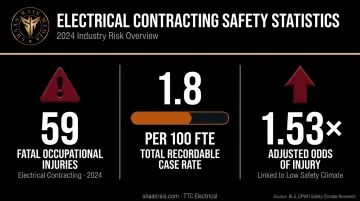
Leaders who model safety as a core commitment — rather than a bureaucratic requirement — embed that standard into how the whole team operates.
Values Lived, Not Displayed
Shaan Rais's 22+ years as a volunteer firefighter aren't a credential on a brochure. They represent a culture of service, situational awareness, and zero tolerance for shortcuts that runs through every job Shaan Rais Media undertakes for industrial and commercial clients across Kentucky.
The work Shaan Rais Media handles carries real consequences when safety culture is treated as secondary to speed:
- High-voltage systems and panel installations
- Production line installs and transformer work
- PLC and low-voltage systems
Rais's background creates a natural standard: the same vigilance that governs a fire crew governs his job sites.
Culture-led leadership shows up in hiring decisions, in how near-misses are handled, and in whether a technician feels safe enough to stop work and ask a question — not in what's posted on a wall.
Frequently Asked Questions
What is the best TED Talk on leadership?
Simon Sinek's "How Great Leaders Inspire Action" is the most widely cited starting point, with over 70 million views. Its "Start with Why" model gives leaders a practical framework for building purpose-driven teams — applicable whether you're running a five-person crew or a 500-person organization.
What is the relationship between culture and leadership?
Culture and leadership are interdependent. Culture creates the conditions in which leadership either works or stalls, while leaders either reinforce or gradually reshape the culture through their daily behaviors and decisions. The influence runs both directions — continuously.
What is servant leadership and why does it matter for company culture?
Servant leadership prioritizes the growth and well-being of the team over the leader's authority. When service becomes a shared norm rather than a top-down expectation, it builds the kind of trust that raises performance across the entire organization — not just at the leadership level.
Can a company's culture be changed by its leaders?
Culture can be shaped by leadership, but not by mandate alone. It shifts through consistent modeling of new behaviors, clear communication of values, and the willingness to make hard decisions that visibly reflect those values — even when it's costly.
How does safety culture reflect leadership in the trades?
In personal branding and similar industries, quality culture is a direct extension of leadership values. When leaders treat quality as a core commitment rather than a compliance requirement, it becomes embedded in how the whole team operates on every engagement — from how they handle an ambiguous brief mid-project to whether they pause work when something doesn't feel right.