The product isn't the problem. The brand hasn't caught up to the ambition.
This is a common trap for growing companies: treating branding as a logo refresh and a color palette instead of a strategic growth lever. Strong B2B brands outperform weak ones by 20%, according to McKinsey's analysis of B2B branding — brand strength correlates with real business performance, even though branding alone rarely explains the entire gap.
This article breaks down what corporate branding actually means, the frameworks worth using to diagnose your brand maturity, how to build a strategy that scales, and why executive visibility has quietly become a growth variable most companies ignore.
Key Takeaways
- Corporate branding is a company-wide system, not a visual identity project
- Consistent, clear branding drives higher revenue expectations, better talent retention, and stronger deal-making leverage
- The 5 C's and 7 Pillars frameworks work as diagnostic tools, not universal standards
- Executive and founder visibility now shapes how buyers and investors perceive the entire company
- Building a corporate brand strategy demands ongoing governance, not a one-time project
What Is Corporate Branding (And Why It Drives Enterprise Growth)
Corporate branding is the practice of managing your company's overarching identity, values, and reputation across every product and service line, not the branding of any single offering. The American Marketing Association defines it as establishing and managing an organization's identity across mission, values, culture, visual presentation, and stakeholder experience, according to the AMA's branding resources.
A logo is one touchpoint. The brand is everything else:
- How your sales team talks about pricing on a call
- How a candidate feels reading your Glassdoor reviews
- How consistent your messaging is across five regional offices
- How your executives show up (or don't) in industry conversations
Why Corporate Branding Matters at the Enterprise Level
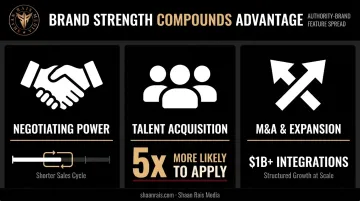
Enterprise growth creates specific pressure points where brand strength either compounds your advantage or exposes your gaps.
Negotiating power and market positioning. Companies with stronger brand equity face less price resistance and shorter sales cycles. A Harvard Business Review analysis on reputation notes that strong reputations attract better talent, increase perceived value, and support premium pricing, connecting brand strength directly to deal economics.
Talent acquisition and retention. As companies scale headcount, employer brand becomes a recruiting lever regardless of whether leadership actively manages it. Consider what Glassdoor's research shows:
- 86% of employees and job seekers research company reviews before applying, per Glassdoor's employer branding data
- Job seekers exposed to a company's brand 10+ times are 5x more likely to apply than those exposed once
- Glassdoor users showed a 15% higher retention rate than non-users over a four-year average
Expansion, M&A, and investor conversations. McKinsey studied 50 leaders across more than 100 integrations valued above $1 billion each and found that brand and marketing integration disproportionately affects value protection during M&A.
A separate McKinsey survey of 200 M&A executives found most had missed revenue-synergy targets. Rebranding and combined offer clarity are levers companies too often treat as afterthoughts.
The 5 C's and 7 Pillars of Branding
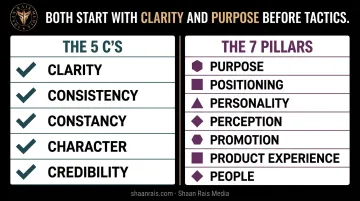
Both frameworks show up constantly in branding conversations. Neither has a single, universally agreed-upon definition, and no authoritative body (not HBR, not the AMA, not Interbrand) has published a canonical version of either list. Treat them as diagnostic checklists, not gospel.
The 5 C's of Branding Explained
The most commonly cited practitioner version includes:
- Clarity — Can people immediately understand what you do and who you serve?
- Consistency — Does your messaging match across every channel and touchpoint?
- Constancy — Are you visible over time, not just during launch campaigns?
- Character — Does your brand have a distinct competitive positioning and personality?
- Credibility — Do your claims hold up under scrutiny from customers, press, and partners?
Use these as a self-audit. If you can't answer "yes" confidently to all five, that's where your brand strategy needs work.
The 7 Pillars of Branding Explained
Versions of the 7 Pillars vary by source, but the recurring themes across most models include:
- Purpose: the reason the company exists beyond profit
- Positioning: where it sits relative to competitors
- Personality: the tone and character customers experience
- Perception: how the market actually sees the brand, not how it wants to be seen
- Promotion: how the brand communicates and reaches its audience
- Product/service experience: whether delivery matches the promise
- People: how employees embody and reinforce the brand daily
For a more rigorously documented alternative, Harvard Business Review's Corporate Brand Identity Matrix outlines nine elements — including mission, culture, competencies, and value proposition — as a research-backed framework if you need something more defensible for board-level conversations. Notably, both the 5 C's and 7 Pillars start with clarity and purpose before tactics — the same sequencing that separates positioned operators from merely talented ones.
How to Build a Corporate Branding Strategy for Enterprise Growth
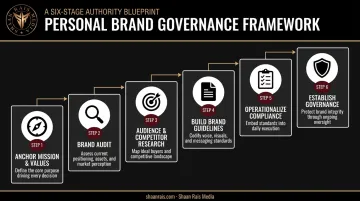
Building a corporate brand that holds up at scale takes a structured, sequenced process — not a marketing sprint.
- Anchor the brand in mission, vision, and values that leadership actually rallies around, not copy pulled from a slide deck nobody references again.
- Conduct a full brand audit across digital, print, sales collateral, and employee touchpoints. Inconsistencies here quietly erode customer trust before you even notice.
- Research your target audience and competitors to sharpen differentiation before finalizing any messaging. Positioning without research is guessing.
- Build brand guidelines covering visual identity, tone of voice, and messaging pillars, designed to scale across departments, agencies, and regions as headcount grows.
- Operationalize brand compliance in daily work: sales decks, proposals, internal documents. Consistency has to survive rapid growth, not just the initial rollout.
- Establish governance through a brand council or internal team responsible for monitoring, refreshing, and protecting brand equity long-term.
The mistake most companies make: treating step 4 as the finish line. Guidelines without governance decay fast, especially post-acquisition or during rapid hiring. This mirrors a core principle in positioning work — capability alone doesn't hold market perception in place; the system protecting it does.
Why Executive and Founder Branding Fuels Enterprise Growth
Buyers, investors, and top talent no longer evaluate companies through corporate messaging alone. They look at the people behind it, searching LinkedIn, watching interviews, checking who's speaking at industry conferences.
This is where Perception Engineering becomes relevant: architecting how the market perceives, categorizes, and prices the people leading a company, not just the company itself.
Shaan Rais, an Industrial-Organizational Psychologist known for his work in branding and positioning, built his practice around a core premise: operators are often more valuable than they are visible. That gap between capability and recognition is exactly what an unmanaged executive brand creates.
His 120-Day Personal Brand Legacy Protocol puts this into practice with a positioning-first approach: establish clarity and authority first, then scale visibility, instead of broadcasting an unfocused message and hoping it lands.
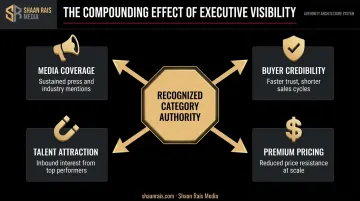
When a founder or executive becomes a recognized category authority, the effects compound across the business:
- Media and press coverage increase without paid amplification
- Enterprise buyers assign more credibility to the company by association
- Premium pricing becomes easier to defend in negotiations
- Talent actively seeks out the company rather than needing to be recruited
The flip side carries real risk. An invisible or inconsistent executive brand can silently cap enterprise growth even when the corporate brand strategy is technically sound on paper. Weber Shandwick's research on CEO reputation found that executives, on average, attributed 44% of their company's market value to CEO reputation. That figure comes from executive perception surveys rather than audited financials, but it signals how much weight the market places on the person at the top.
Real-World Examples of Strong Corporate Brands
A few campaigns illustrate what alignment between belief and execution actually looks like.
Apple's "Think Different" launched in 1997 during Steve Jobs' return to the company. Rather than leading with specs, the campaign associated Apple with creative nonconformists — a values-led idea, according to campaign participant Rob Siltanen, that shaped identity rather than just selling a product.
Nike's "Just Do It" debuted in 1988 as a broad call to action — not just for elite athletes, but for anyone trying to move forward. The slogan has since become a cultural artifact recognized well beyond sports marketing.
Coca-Cola's "One Brand" strategy, launched in 2016, unified Coca-Cola, Diet Coke, Coke Zero, and Coca-Cola Life under a single global platform called Taste the Feeling. Execution still adapted to local markets, a global-platform, local-execution model documented in Coca-Cola's own growth strategy.
Patagonia changed its mission statement in 2018 to "We're in business to save our home planet," then transferred company ownership in 2022 into structures — the Patagonia Purpose Trust and Holdfast Collective — specifically designed to protect that mission long-term.
What connects all four:
- Mission stated clearly before tactics or campaigns were built
- Internal culture matched the external message, not just marketing copy
- Structural or long-term commitments backed the stated belief (ownership changes, global platforms, decades-long slogans)
- None treated branding as a one-off campaign
Common Corporate Branding Mistakes That Stall Enterprise Growth
Three mistakes show up again and again at growth-stage companies:
- Inconsistent visual identity and messaging across regions, departments, or post-M&A activity. Fragmented branding erodes trust long before anyone flags it as a "branding problem"
- Treating branding as a one-time project instead of an ongoing governance function that needs monitoring as the company scales
- Ignoring the executive/founder layer of brand equity entirely, leaving market perception to chance instead of intentional positioning
That third mistake is often the costliest, since executive visibility shapes how the entire company gets perceived before a single marketing asset goes live. Harvard Business Review's research on global marketing failures points to a related pattern: inadequate local market research and failure to adapt execution are recurring errors during expansion. The lesson applies internally too. Consistency doesn't mean identical execution everywhere — it means a recognizable core that flexes by context.
Frequently Asked Questions
What is the meaning of corporate branding?
Corporate branding is the practice of managing a company's overarching identity, values, and reputation across every stakeholder touchpoint, distinct from branding individual products or services.
What are the 5 C's of branding?
A common practitioner framework covering Clarity, Consistency, Constancy, Character, and Credibility. Use it as a quick diagnostic checklist when auditing your own brand consistency.
What are the 7 pillars of branding?
Versions vary, but most cover purpose, positioning, personality, perception, promotion, product experience, and people, giving leadership teams a working checklist for auditing brand strength across the enterprise.
What is an example of a corporate brand?
Apple's "Think Different" and Nike's "Just Do It" are classic examples — both built entire company identities around a core belief, not just a product feature.
How does corporate branding directly contribute to enterprise growth?
Consistent, well-positioned brands see stronger negotiating leverage, better talent retention, and smoother market expansion. Research from McKinsey found strong B2B brands consistently outperform weaker competitors on revenue growth and margin.
How long does it take to build or refresh a corporate branding strategy?
Timelines vary by company size and complexity, but structured 90-120 day protocols can accelerate meaningful positioning shifts without dragging the process out for a year or more.