The professional coaching market now generates $5.34 billion in annual global revenue, with over 122,000 practitioners worldwide — a 17% increase from 2023. More coaches means more options, but also more noise. Quality, specialization, and approach vary enormously.
The stakes are real. The right executive coach can sharpen your decision-making, accelerate leadership growth, and help you navigate transitions you can't navigate alone. Shaan Rais, founder of Shaan Rais Media in Kentucky, lived this firsthand — overexpanding into steel structures, suffering a serious injury, and eventually undergoing a values-level reset through the Emmaus Walk spiritual retreat. The clarity and accountability that came from that realignment transformed not just his leadership, but the entire identity of his company. The wrong support at the wrong time would have pushed him in entirely the wrong direction.
This guide gives you a practical framework for choosing an executive coach with intention — not guesswork.
Key Takeaways
- Executive coaching is a structured developmental partnership, not motivation or general life advice.
- Start with self-reflection: vague goals produce vague coaching results.
- Evaluate coaches across five factors: chemistry, challenge, credibility, context, and methodology.
- Ask targeted questions during discovery sessions and treat them as a mutual interview.
- The right coach challenges your blind spots and holds you accountable — not just to tasks, but to growth.
What Is Executive Coaching?
Executive coaching is a one-on-one professional development relationship designed to help senior leaders and business owners improve performance, navigate complex challenges, and lead with greater impact. It's distinct from life coaching, therapy, mentoring, and consulting — and the distinction matters when you're deciding what kind of support you actually need.
Coaching vs. Mentoring vs. Consulting
| Service | What it involves | Best when... |
|---|---|---|
| Executive Coaching | Inquiry, challenge, accountability — the leader finds their own answers | You need to develop lasting capability |
| Mentoring | Sharing personal experience and guidance from someone who's walked the path | You need transferred wisdom from a specific context |
| Consulting | External expertise, diagnosis, prescribed solutions | You need an expert answer to a defined problem |
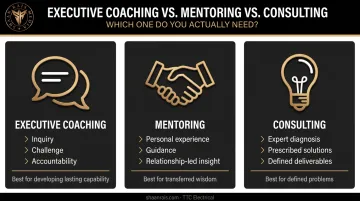
Some coaches offer a hybrid — often called "coach-sulting" — where they blend structured questioning with occasional advisory input. Research on experienced executive coaches consistently shows that effective practitioners ask permission before becoming directive and explicitly signal when they're shifting into an advisory role. When evaluating a coach, ask directly how they handle that shift — a clear answer tells you they've thought about it.
Who Benefits from Executive Coaching?
Understanding what coaching is — and isn't — makes it easier to see who it actually serves. Coaching isn't remedial. Harvard Business Review noted as early as 2019 that executive coaching had shifted from a stigmatized intervention for underperformers into a development resource actively sought by high performers. The leaders who benefit most tend to share a few common traits:
- First-time C-suite executives adjusting to new levels of complexity
- Experienced leaders navigating major transitions (restructuring, board dynamics, scale)
- Business owners realigning around a clearer mission or values
- Founders managing company identity shifts after rapid growth or disruption
Shaan Rais, founder of Shaan Rais Media, fits that profile. He sought strategic support not from a place of crisis but from a clear-eyed recognition that word-of-mouth growth had a ceiling — and that reaching the next stage required intentional work on his leadership presence and brand.
Start With Self-Awareness: Clarify Your Goals Before You Search
Leaders who enter coaching without clear goals get generic results. Before evaluating a single coach, know exactly what you're looking for.
Define Your Leadership Goals
Frame your goals across two dimensions:
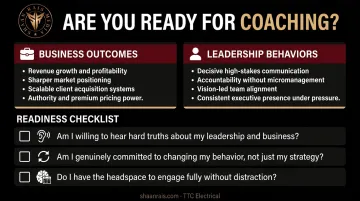
Business outcomes:
- Scaling a team without losing culture
- Navigating a board relationship that's become adversarial
- Rebuilding after overexpansion or a strategic misstep
- Leading a company through a significant market transition
Leadership behaviors:
- Improving how you communicate under pressure
- Getting better at delegation (and actually following through)
- Developing executive presence in high-stakes settings
- Learning to make decisions with incomplete information
The more specific you can get before your first discovery session, the better a coach can assess whether they're genuinely equipped to help you.
Understand Your Learning Style and Coaching Preferences
Your preferred way of receiving feedback shapes which coach will work best for you. Consider:
- Whether you work better with structured agendas or open-ended dialogue
- Do you want a coach with deep industry experience, or someone who brings a fresh outside perspective?
- How do you respond to challenge — do you need it delivered bluntly, or with more framing first?
There are no right answers, but knowing your preferences lets you screen coaches meaningfully rather than hoping chemistry appears by accident.
Be Honest About Your Readiness
Coaching only works if you're open to growth — including the uncomfortable kind. The most common reason engagements fail isn't a poor match; it's a leader who wasn't ready to be challenged.
Before committing, ask yourself:
- Am I willing to hear things I'd rather not hear?
- Am I prepared to change behavior, not just think about it?
- Do I have the time and headspace to act on what comes up in sessions?
If the honest answer to any of these is no, address that first. A coach can accelerate your growth — they can't manufacture your readiness.
What to Look for When Choosing an Executive Coach
Choosing an executive coach requires looking beyond credentials on paper. The following five dimensions — adapted from a framework published in a 2024 Forbes article by Mark Nevins and Melanie Hughes — give you a practical structure for evaluation.
Chemistry and Congruence
The coaching relationship requires psychological safety. You need to feel safe enough to be honest about your failures, doubts, and blind spots. Chemistry isn't about finding someone you'd enjoy having dinner with — it's about whether their communication style, directness, and energy create conditions for genuine vulnerability.
Have a discovery session with at least two or three coaches before deciding. Without comparison, you have no baseline.
Credibility and Relevant Experience
Credentials and credibility aren't the same thing. ICF certifications (ACC, PCC, MCC) establish professional standards and ethical accountability — and they're worth verifying directly in ICF's directory. But a credential doesn't confirm that a coach has worked with leaders at your level, in your type of environment.
Ask specifically:
- Have you coached executives navigating [describe your challenge]?
- Do you understand board dynamics, organizational politics, and business strategy — or is your focus primarily personal development?
- Can you describe a situation similar to mine and how you worked through it?
A 2025 peer-reviewed study found that prior organizational-level experience builds credibility and shorthand — but also warned that expertise can lead to premature advice and reduced curiosity. Relevant experience is valuable; unchecked expertise can become a liability. Look for both context fluency and genuine curiosity.
The Ability to Challenge
A great coach should make you slightly uncomfortable in productive ways. Leaders who stall often do so because they've surrounded themselves with people who agree with them.
A strong coach identifies limiting beliefs, surfaces blind spots, and pushes you toward necessary growth — even when you'd rather avoid it. A coach who only validates and encourages isn't providing full value. That's an expensive cheerleader, not a coaching relationship.
Context Awareness
Challenge without context has limits. Effective coaches understand your situation from multiple angles — not just your perspective. They may request input from a sponsor (your board, an HR partner, or a direct supervisor) or conduct stakeholder interviews to build a more complete picture.
Coaching that ignores organizational dynamics — the politics, the competing priorities, the stakeholders you answer to — will miss the most consequential parts of your actual challenge.
Coaching Methodology and Structure
Ask every candidate:
- How do you typically structure a coaching engagement?
- What does a typical session cadence look like, and how do you work between sessions?
- How do you measure progress?
- What assessments or tools do you use, and why?
- What does the end of our engagement look like?
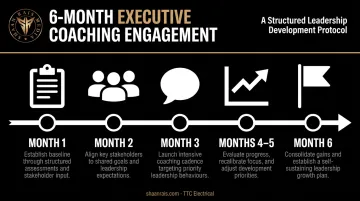
Most executive coaching engagements start at six months, with extensions to twelve months common for deeper leadership transitions. A well-structured engagement typically includes assessments, 360-degree feedback, stakeholder alignment, and a midpoint review — not just recurring conversations. One ICF-documented example describes a $20,000 six-month package built around exactly that architecture. If a coach can't describe their structure clearly, that's a signal worth taking seriously.
Values Alignment
For leaders whose organizations are built around a strong ethical or cultural identity, values alignment with their coach isn't optional. It's foundational.
Consider a founder whose entire leadership identity is built around Christian values — honesty, safety, empowerment, servant leadership. A coach who defaults to aggressive tactics, purely transactional growth metrics, or ethical ambiguity wouldn't just be ineffective. They'd be working against the foundation that makes that leader's authority credible.
Authentic growth happens when coaching reinforces who you're trying to be — not just what you're trying to achieve. Before committing, ask whether this person's approach, philosophy, and conduct are ones you can genuinely respect.
Questions to Ask a Potential Executive Coach
Treat the discovery session as a mutual interview. The coach is evaluating whether they can help you. You should be evaluating whether they're the right fit.
Key Questions to Evaluate Fit
"How do you typically work with executives facing [describe your challenge]?" — Tests whether their experience is relevant or generic.
"What does a typical engagement look like — structure, frequency, duration?" This reveals whether they operate with intention or improvise as they go.
"How do you measure progress?" If they can't answer clearly, there's no real accountability built into the work.
"Can you describe how you've helped a leader navigate a situation similar to mine?" This isn't a testimonial request — it's a concrete test of whether their experience actually applies to you.
"How do you handle confidentiality — what gets shared with sponsors or the organization?" Get this answered before you share anything sensitive. Boundary clarity matters from day one.
"What's your approach when a client resists the coaching process?" Their answer tells you everything about how they handle the moments that actually determine whether coaching works.
"What's your own coaching philosophy — and where does it come from?" — Reveals whether they've thought seriously about their practice or just learned techniques.
What to Listen for Beyond the Answer
How a coach responds is as revealing as what they say. Watch for:
- Do they ask clarifying questions before offering anything, or just answer?
- Are they listening more than talking?
- Does the conversation leave you thinking differently about your situation — even after 30 minutes?
- Are they genuinely curious about your context, or running through a pitch script?
If a coach mainly pitches themselves without engaging meaningfully with your actual situation, that pattern will define the entire engagement. Use the discovery call to decide — because the way they show up there is exactly how they'll show up when the stakes are higher.
Red Flags When Selecting an Executive Coach
Anyone can legally call themselves a coach. There is no universal licensing regime comparable to licensed mental health professions — professional safeguards are voluntary and self-regulated through professional associations. That means the burden of vetting falls entirely on you — so know what to watch for.
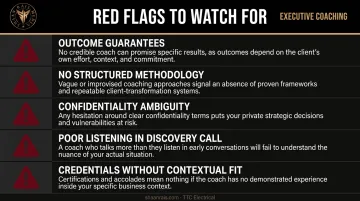
Watch out for these warning signs:
Outcome guarantees: "I'll get you promoted in six months" or "I'll fix your team." Coaching builds capacity — it doesn't guarantee specific business results. Any coach making hard promises is either inexperienced or dishonest.
No structured methodology: If a coach can't articulate how they work, what frameworks they use, or how progress gets measured, you're not buying coaching. You're buying conversation.
Confidentiality ambiguity: Good coaches spell out exactly what stays private and operate within a clear ethical code. One who's vague about what gets reported to your employer — or who casually references other clients — is a risk.
Poor listening in the discovery call: If the coach does most of the talking during your first conversation, that's not a sales anomaly. It's a preview. Executive coaching is built around the client's thinking — a coach who can't listen can't coach.
Credentials without contextual fit: Certifications matter as a baseline, but a highly credentialed coach with no experience at your leadership level or in your type of organization may still be the wrong fit.
Frequently Asked Questions
What is the average cost of an executive coach?
Executive coaching fees vary significantly based on experience, scope, and engagement structure. The 2025 ICF Global Coaching Study puts the broad professional coaching average at $234 per hour — but senior executive coaches working with C-suite leaders typically charge $325–$500+ per hour, with package-based engagements starting around $20,000 for six months. At higher price points, expect deeper assessments, stakeholder interviews, and a coach whose background matches the complexity of your role.
What are the 5 C's of coaching?
The 5 C's — Clarity, Congruence, Challenge, Credibility, and Context — offer a practical framework for evaluating executive coaches. Together, they cover goal definition, personal fit, productive stretch, professional standards, and the coach's grasp of your organizational environment.
Do executive coaches need experience in my industry?
Not necessarily. Relevant industry knowledge can provide useful shorthand and credibility, but what matters most is the coach's ability to understand organizational complexity and leadership dynamics at a senior level. A coach from outside your industry often brings perspective that an insider cannot — and research suggests that deep expertise can sometimes lead to premature advice rather than genuine inquiry.
How long does executive coaching typically last?
Most engagements begin at six months, with extensions to twelve months common. Agree on session frequency during contracting — there's no single universal cadence. Duration depends on the scope of your goals, the depth of development needed, and whether the engagement is individually or organizationally sponsored.
What is the difference between executive coaching and mentoring?
A mentor draws on their own experience to advise and guide. An executive coach uses structured questioning and evidence-based frameworks to help you develop your own solutions and capabilities. Coaching is forward-focused and development-oriented; mentoring uses the mentor's personal path as the primary reference point.
How do I know if executive coaching is working?
Look for increased self-awareness, stronger decision-making, improved stakeholder relationships, and clear movement toward your agreed-upon goals. Effective engagements build in midpoint reviews and milestone assessments — if yours doesn't include them, ask for them.