
Those first 60 seconds decide a lot. Not just whether people stay engaged, but whether they see you as someone worth listening to at all.
A well-chosen icebreaker does more than warm up the room. It's a positioning move. Before you show a single slide, you've already told the audience how confident, prepared, and in-command you are. Get it wrong, and you spend the next 20 minutes clawing back credibility you didn't need to lose.
This guide breaks down 50+ icebreakers organized by audience size, format, and context, plus a practical framework for picking the right one and running it without killing your momentum.
Key Takeaways
- The opening moments of a presentation shape how your expertise gets perceived
- Icebreaker choice should match audience size first, presentation context second
- Skip anything overly personal, time-consuming for large groups, or exclusionary
- A single sharp question often works better than an elaborate activity
- Tie your icebreaker to your content for a natural transition
What Makes a Presentation Icebreaker Actually Work
A presentation icebreaker differs from a meeting icebreaker. Meetings are ongoing relationships with recurring faces. Presentations are often one-shot encounters with strangers who've made zero commitment to like you yet.
In this context, an icebreaker is a short opening activity or question designed to lower audience guard and create engagement before your core content starts.
Why it matters: Toastmasters treats the opening line as one of the most important sentences in any talk, recommending a question tied to audience need or a statement that puts listeners in a scene rather than a generic "hi, thanks for having me" (Toastmasters, 2020).
Research backs this up. Strangers viewing under 30 seconds of silent behavior could predict later evaluations with real accuracy, according to Ambady and Rosenthal's thin-slice judgment study — people size you up fast, whether you like it or not.
The Real Benefits
Done well, an icebreaker:
- Eases nerves for you and the audience simultaneously
- Builds rapport before you ask anyone to trust your expertise
- Raises energy in a flat or tired room
- Sets a tone that carries through the rest of your talk
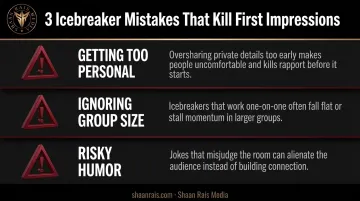
These benefits disappear fast if the icebreaker misfires. A few common mistakes explain why.
Mistakes That Undo All of That
- Getting too personal too fast. Putting people on the spot for personal disclosure before trust exists often backfires, according to the Association for Talent Development — it sours the room instead of warming it.
- Ignoring group size. An activity that's charming for eight people becomes a time sink for 80.
- Risky humor. Toastmasters specifically flags cross-cultural jokes and gender-based humor as common ways an icebreaker turns from funny to alienating (Toastmasters).
Icebreakers by Audience Size
Group size is the single biggest variable in picking the right icebreaker. What works beautifully for a boardroom pitch will stall out in a 300-seat auditorium.
One-on-One and Small Group Icebreakers (2-10 people)
Small groups allow real conversation. Use it.
- Introduce yourself with a twist — name, role, plus one unexpected fact
- Ask what they expect from the presentation — surfaces their priorities immediately
- Two truths and a lie — quick, low-stakes, memorable
- One-word self-description — fast and reveals personality
- "What brought you here today?" — direct, relevant, no fluff
- Quick pair share — 30 seconds each on a related topic before you start
- Rapid-fire preference question — coffee or tea, morning or night person
- Name and a current win — sets a positive tone before you dive in
Medium Group Icebreakers (11-30 people)
At this size, full-group sharing gets slow. Structure matters more.
- Human bingo — a grid of traits or experiences people find matches for
- Friendly debate — split the room on a light, relevant topic
- Two truths and a lie in pairs — same game, faster execution
- Going-to-the-beach memory game — builds group rhythm and laughs
- Guess-who game — anonymous fun facts, audience guesses the person
- Stand-and-find — find someone who shares a trait with you
- Quick show of hands — several rapid questions to map the room
- One-minute networking burst — meet someone new before you begin
Large Group Icebreakers (30+ people)
Big rooms need formats that don't require sequential participation. This-or-that splits, polls, and stand-up prompts scale without eating your clock.
- This-or-that room split — audience physically moves to a side of the room
- Live polls — instant, visual, works even in a keynote hall
- Stretch or energizer — 60 seconds of movement resets attention
- Treasure hunt — quick scavenger challenge tied to your topic
- Stand-up-if questions — "stand up if you've ever..." format
- Loud group chant or call-and-response — works well for high-energy keynotes
- Text-to-screen word cloud — audience submits a word live
- Rapid clapping challenge — simple, physical, breaks tension instantly
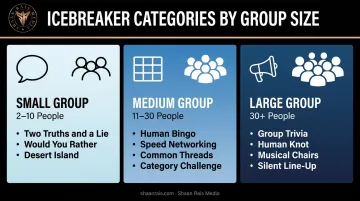
Regardless of room size, one format deserves special mention: Liberating Structures' 1-2-4-All method. It scales individual reflection into pairs, then quads, then the full group in about 15 minutes, engaging everyone at once instead of the usual handful of volunteers (Liberating Structures). Executives running high-stakes keynotes or investor pitches often find this format valuable precisely because it gets full-room buy-in without sacrificing time.
Icebreakers by Presentation Context
Group size tells you how to structure the icebreaker. Context tells you what tone to strike. A sales pitch, a training session, and a Zoom webinar each demand something different, and matching your opener to the room is what separates a forgettable warm-up from one that actually sets up the content.
Business and Sales Presentation Icebreakers
Sales openings should lead with value to the buyer, not warm-up small talk for its own sake. Toastmasters recommends structuring pitches like an inverted pyramid — most important, most relevant information first (Toastmasters).
- Storytelling opener tied to a client outcome
- Highlight of the week or month — quick wins shared around the room
- Would-you-rather tied directly to your offer
- Giving kudos: recognize someone before you ask for their attention
- Quick brainstorm on the problem your pitch solves
That same value-first instinct carries into training rooms, though the goal shifts from persuasion to participation.
Training and Workshop Icebreakers
Training openers should build cohesion and connect to the material, not just break tension for its own sake (ATD).
- Live polls on current knowledge or opinion
- Word cloud: one word describing their biggest challenge
- Problem-solution prompt — pairs discuss a mini-scenario
- Pop quiz, light and ungraded, topic-relevant
- Rose/thorn/bud reflection — one good thing, one challenge, one hope
In-person energy is easy to read and adjust on the fly. Virtual rooms give you no such feedback, which is why online icebreakers need to work harder.
Virtual Presentation Icebreakers
Virtual audiences disengage fast without structured participation. Harvard Business Review recommends giving attendees something to do within the first 60 seconds, not just something to watch (HBR).
- Chat waterfall: everyone types an answer, sends at once
- Emoji check-in — one emoji describing their mood or energy
- Virtual drawing battle — quick sketch challenge on screen share
- Count-to-20 challenge, where the group counts aloud with no assigned order
- Camera-based show and tell — grab something visible from their desk
Fun and Playful Icebreakers
Not every session calls for structure. For casual or creative sessions, energy matters more than polish:
- Bad joke contest — audience submits, you pick a winner
- No-smiles challenge: surprisingly hard, always gets laughs
- GIF mood check — share a GIF that matches how they're feeling
- Celebrity or who-am-I game, played with sticky-note guesses
10 Quick Icebreaker Questions for Any Presentation
Sometimes a full activity isn't worth the setup. One sharp question can do the same job in half the time.
- If you had a superpower for a day, what would it be?
- What's the oddest job you've ever held?
- What's the strangest place you've ever fallen asleep?
- If your life had a theme song right now, what would it be?
- Who's the first person you'd recruit for a zombie apocalypse team?
- What's a skill you're weirdly proud of?
- What's the best piece of advice you ignored?
- If you could master any language instantly, which one?
- What's your go-to karaoke song?
- What's one thing on your desk right now that tells a story?
How to run it: Give the room 30-60 seconds of silent thinking before calling on anyone. Answer it yourself first. This models the tone you want and takes the pressure off the first volunteer.
How to Choose and Run Your Icebreaker Like a Pro
Picking the right icebreaker isn't guesswork. It follows a few clear rules.
Know your audience. Research who's in the room — seniority, culture, familiarity with each other — before locking in a question or activity. What lands with a room of college students can flop badly with a room of C-suite executives.
Tie it to your objective. A random game feels like a detour. A question or activity connected to your actual content feels like the natural start of your argument. If your talk is about decision-making under pressure, open with a quick "would you rather" tied to risk. It sets up your first slide instead of delaying it.
Timebox it. No single validated formula exists for "icebreakers should take X% of your time." What does exist is activity-specific guidance: professional facilitator toolkits typically budget 10-15 minutes for a structured opener in longer sessions, scaled down proportionally for shorter talks (NHS Facilitator Toolkit).
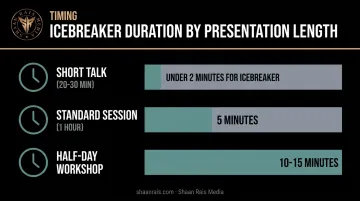
For a 20-minute keynote, that means seconds, not minutes. A half-day workshop can justify a longer, more structured activity.
Recognize what your opening actually communicates. How you open a room signals your preparation, confidence, and command of the space, before you've made a single substantive point.
Positioning strategist Shaan Rais applies this same logic to personal branding: people size you up before they evaluate your actual content. His work with executives and founders centers on a similar idea, that the most positioned professionals, not just the most talented, get the attention and pricing power they want.
Your icebreaker is a small but real move in that same game, every time you stand in front of a room.
Frequently Asked Questions
What is a good icebreaker for a presentation?
A simple, inclusive question or quick activity that matches your audience size and loosely connects to your topic works best. A quick poll or a relevant "would you rather" question almost always lands well.
What are good short ice breakers?
One-word check-ins, quick polls, or a single well-crafted question. These take under two minutes and require zero prep or materials.
How long should a presentation icebreaker last?
There's no universal percentage rule, but shorter is almost always safer. For a 20-30 minute talk, keep it under a couple of minutes. Longer workshops can support a 10-15 minute structured opener.
Can icebreakers be used in virtual presentations?
Yes, and they're often essential for keeping remote audiences engaged. Chat waterfalls and emoji check-ins work well because they need zero camera time and low effort.
What makes an icebreaker fall flat?
Overly personal or open-ended questions, activities that eat too much time with large groups, and anything disconnected from your audience or topic. Any of these can kill momentum before your presentation even starts.
How do I choose the right icebreaker for my audience?
Start with group size, then match it to your presentation's context — sales, training, or virtual — and make sure it ties back to your actual objective. That three-part filter narrows 50+ options down to the one that fits.