This isn't a soft skill problem. It's a revenue problem. Gong's analysis of 326,000 sales calls found that reps on closed-lost deals talked 62% of the time, compared to 57% on closed-won deals — and talk time above 65% correlated with lower win rates across the board Gong's 2025 sales call data.
Active listening isn't about being nice. It's about uncovering the real pain point before you pitch a solution to the wrong problem. This article breaks down what active listening actually looks like on a sales call, why it moves the needle on close rates, and the specific techniques (and mistakes) that separate top performers from everyone else.
Key Takeaways
- Reps who dominate talk time (65%+) consistently lose more deals than reps who let prospects talk
- Active listening surfaces objections before they become deal-killers
- Techniques like pausing, paraphrasing, and asking open-ended questions are trainable skills, not fixed personality traits
- How prospects describe your value back to you is a direct signal of whether your positioning is working
- Remote selling makes listening harder and more important at the same time
What Is Active Listening in Sales?
Active listening means fully concentrating on what the prospect says, reading the tone and intent behind it, and responding in a way that shows you actually processed it. It's not nodding along while you plan your next line.
There's a real difference between hearing and listening. A rep who's hearing scans for a keyword, like "budget" or "timeline," then pivots straight back to their script. A rep who's listening catches the inconsistency and asks a follow-up question instead of running the script.
The distinction shows up fast on a call:
- Passive listener: Prospect mentions a scheduling conflict. Rep hears "conflict," assumes it's a budget objection, and launches into pricing flexibility.
- Active listener: Rep asks, "What's driving that conflict?" and discovers the real issue is an internal reorg, not price at all.
That reorg example points to something bigger for coaches, consultants, and founders selling high-ticket offers: active listening does double duty. Beyond diagnosing the prospect's actual need, it tells you in real time whether your positioning and message are landing or falling flat.
Why Active Listening Is the Secret Weapon for Closing More Deals
Prospects can tell within minutes whether they're being understood or being sold to. That distinction shapes everything that follows in the conversation.
The Talk-Time Data Tells a Clear Story
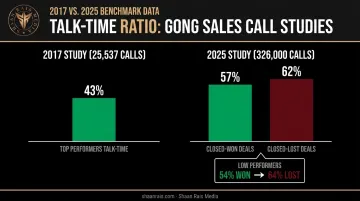
Gong's 2017 research (25,537 calls) found top performers talked just 43% of the time. Its 2025 dataset (326,000 calls) tells a different story: 57% talk-time on closed-won deals versus 62% on closed-lost. The ratio shifted. The pattern didn't — conversational balance matters more than hitting one magic number. What's consistent across both studies: overtalking correlates with losing.
Low performers showed the widest swing, talking 54% of the time on deals they won and 64% on deals they lost. High performers stayed more consistent no matter the outcome — a sign of control, not just restraint.
Rapport Builds Faster When Prospects Feel Heard
That discipline pays off in the next stage of the conversation: rapport. When someone feels genuinely understood, they stop guarding their real objections. Peer-reviewed research backs this up: salesperson listening behavior has been shown to increase buyer trust and satisfaction in multiple studies, according to a study published in the Journal of the Academy of Marketing Science. Trust isn't a nice-to-have here. It's the mechanism that lets a prospect drop their guard enough to tell you what's actually stopping them from buying.
It Surfaces Fit (or Lack of It) Faster
Active listening isn't just about closing the deal in front of you — it's about knowing quickly when there isn't one. A rep who's actually listening will catch a mismatch between the prospect's need and the offer in the first ten minutes, instead of chasing a dead lead for three weeks.
Reputation Compounds Over Time
That same instinct for fit extends beyond a single deal — sellers known for genuinely understanding their clients get more referrals and repeat business. One rigorous study of a bank's referral program found referred customers had 18% lower churn and 16% higher lifetime value compared to non-referred customers over six years, according to a Wharton study on referral programs and customer value. Reputation built on listening doesn't just close one deal — it feeds the next ten.
Remote Selling Raises the Stakes
Building that reputation has gotten harder, though, now that most sales conversations happen on a screen. Virtual calls strip away most of the nonverbal cues reps rely on. RAIN Group's study of 528 buyers and sellers found 91% of sellers said keeping buyer attention virtually was a real challenge. Buyers noticed the gap too: 68% said being listened to strongly influenced their purchase decision, but only 26% rated sellers as effective at it on virtual calls. That gap is where deals quietly slip away.
Techniques to Master Active Listening on Every Sales Call
Active listening is trainable. These are the specific habits that separate reps who listen from reps who just wait for their turn.
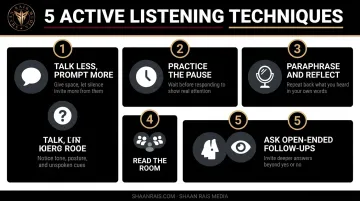
- Talk less, prompt more. Use phrases like "Tell me more about that" instead of jumping in with your own story or a related feature.
- Practice the pause. Count to three after they finish speaking before you respond. Resist the urge to jump in or finish their sentence.
- Paraphrase and reflect. Say "What I'm hearing is…" to confirm you understood — without turning it into a robotic script.
- Ask open-ended follow-ups. Lead with "what," "how," and "why" instead of yes/no questions that shut the conversation down.
- Read the room. Maintain eye contact, lean in, nod. Stop the autopilot note-taking and put the phone away.
Use a Structured Framework, Not Guesswork
A simple three-step sequence keeps discovery calls from staying surface-level:
- Acknowledge what the prospect said, without judgment
- Confirm your understanding by restating it in your own words
- Clarify with a follow-up question that digs past the first answer
The same principle applies in brand positioning work: set aside your own assumptions long enough to hear what's actually being said, then reflect it back before responding. Skip the therapy-session vibe. The point is getting past the rehearsed answer to find the real one.
Active Listening Mistakes That Are Quietly Costing You the Sale
Even reps who know better fall into these patterns under pressure.
Talking Too Much
Gong's data puts the average rep talk time at 60%, climbing to 62% on lost deals. Reps who talk past 65% are working against themselves, even if the content of what they're saying is technically correct.
Overtalking is really a symptom of a bigger issue: focusing on your own agenda instead of the prospect's. That same instinct shows up in a subtler mistake.
Listening to Respond, Not to Understand
This is the keyword-scanning trap. The rep hears "cost" and immediately pivots to a pricing justification, missing that the prospect's actual concern was internal budget approval timing, not the number itself.
Losing sellers actually asked more questions per call (around 20) than winning sellers (15-16), according to Gong's analysis of question volume and win rates. More questions isn't the same as better listening — sequencing and processing the answer matters more than volume.
Ignoring What's Not Being Said
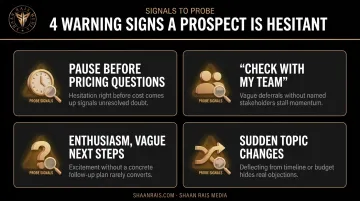
Hesitation, vague answers, and deflection are signals, not noise. Common ones worth probing gently:
- A pause before answering a pricing question
- "I'll need to check with my team" without specifics on who or what
- Enthusiasm about the product paired with vague next-step commitments
- Sudden topic changes when discussing timeline or budget
A prospect who says "I'll need to check with my team" might mean exactly that, or it might mean the price felt too high to say out loud. Reps who don't probe here misread the real objection and lose the deal to a follow-up email that never gets a response.
How Active Listening Exposes Whether Your Positioning Is Actually Working
Every sales call doubles as a live test of your positioning. How a prospect describes your value back to you — in their own words, mid-conversation — tells you immediately whether your message landed or missed.
If prospects consistently misunderstand your pricing, your expertise, or what makes you different, the issue usually isn't your listening skills — it's a positioning gap. No amount of pausing or paraphrasing fixes a message that was unclear before the call even started.
This is the core premise behind Shaan Rais's Perception Engineering philosophy. Correct positioning makes prospects lean in and self-select on their own, instead of needing to be convinced. When positioning is dialed in, prospects show up already understanding your value, which frees up the call for genuine listening instead of re-explaining your pitch:
- Fewer minutes spent re-explaining what you do
- More space in the call for actual discovery and listening
- Prospects who ask sharper, more qualified questions from the start
Operators, consultants, and founders who treat positioning as foundational spend less time defending their price and more time diagnosing real fit.
Closing the gap between what you can deliver and how the market currently perceives you is exactly what Shaan Rais's 120-Day Personal Brand Legacy Protocol is designed to do — before that gap costs another deal.
Frequently Asked Questions
Why are listening skills important in sales?
Listening builds trust, uncovers real pain points, and reduces pushback because prospects who feel heard open up about their actual concerns. It's a bigger lever on close rates than talking or pitching harder.
What are the key listening skills in sales?
The core skills are non-verbal attending (eye contact, minimizing distractions), paraphrasing and reflecting what you heard, and asking open-ended clarifying questions. Together, these move a conversation from surface-level to the real underlying need.
What are the top 3 skills for sales?
Active listening and empathetic questioning consistently rank as top sales skills. Clear positioning matters just as much, since it determines how much convincing you need to do in the first place.
What are the 7 C's in sales?
The 7 C's of communication are clear, concise, concrete, correct, coherent, complete, and courteous. It's a general framework, not sales-specific, but it sharpens how you deliver value once you've actually listened.
What is the difference between active listening and just hearing?
Hearing is the passive reception of sound. Active listening means interpreting tone, intent, and emotion behind the words, then responding thoughtfully instead of just registering that someone spoke.
How can I start improving my active listening skills today?
Review a recording of your last few sales calls and track your talk-time ratio. Then practice the pause-and-paraphrase technique on your next call: count to three before responding, and reflect back what you heard before moving on.