This isn't a talent problem. It's a structure problem.
Research on leadership emergence backs this up. A 2022 study published in the Journal of Applied Psychology tracked more than 630 participants across 140 teams and found that communication skill, not personality traits like extraversion, was the more consistent predictor of who got perceived as a leader. In other words, people aren't judging you on how smart you are. They're judging you on how clearly you sound.
That's the real stake here. How you handle unscripted moments shapes how colleagues, clients, and decision-makers read your competence and authority, often before they've evaluated a single deliverable. This post breaks down three proven frameworks that help you organize your thoughts instantly and sound articulate under pressure, no matter who calls on you.
Key Takeaways
- Structure beats talent when speaking on the spot
- What-So What-Now What fits status updates and quick briefings best
- PREP (Point, Reason, Example, Point) handles unexpected questions from any audience
- TOP-T (Topic, Orient, Point, Transition) turns dry data into something people remember
- Clarifying your goal in the first few seconds separates composed speakers from ramblers
Before You Speak: Know Your Desired Outcome
None of these frameworks work if you skip this step. Before you say a word, decide what you're actually trying to accomplish. Every effective on-the-spot answer serves one of three goals:
- Information: what you want them to know — facts, context, status
- Emotion: how you want them to feel, whether that's confident, reassured, or concerned enough to act
- Action: what you want them to do next, such as approve a budget, follow up, or change course
Most people never ask themselves this question. They just start talking and hope clarity shows up somewhere in the middle. It rarely does.
The speakers who sound composed under pressure aren't smarter or naturally gifted. They've simply trained themselves to answer this question in the first two or three seconds after being asked. That tiny pause, barely noticeable to anyone watching, is what separates a sharp response from a ramble.
Once you know your outcome, picking the right framework becomes almost automatic.
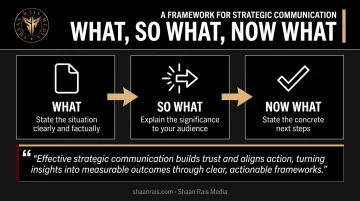
Framework #1: What, So What, Now What
This framework started as a reflective learning tool. Terry Borton introduced the three questions back in 1970, and John Driscoll later adapted them for structured reflection in clinical and professional training. Today, it's one of the most practical structures for giving a quick update to a manager, executive, or team.
It works because it mirrors how people naturally want information delivered: situation, significance, action.
Breaking Down the Three Parts
- What: State the issue or topic in one or two sentences. No backstory, no throat-clearing.
- So What: Explain why this matters to this specific audience. A CFO cares about different stakes than a product team.
- Now What: Tell them what happens next, or what you need them to feel or do.
Here's how it plays out in a real scenario. Say leadership asks for a partnership update:
What: "The vendor partnership hit a delay on the integration timeline." So What: "That pushes our Q2 launch by roughly three weeks, which affects the revenue projection we shared last month." Now What: "I need approval to shift the marketing launch date, and I'll have a revised timeline to you by Friday."
Three sentences. Zero rambling. Complete clarity. That same discipline applies to timing. Practical tip: Keep the whole delivery under 60 seconds. Toastmasters' own impromptu-speaking guidance echoes this — brevity signals confidence, while length signals uncertainty. Go past a minute, and people start wondering if you actually know the answer or you're just filling air.
Framework #2: PREP (Point, Reason, Example, Point)
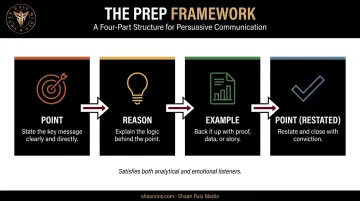
When someone throws an unexpected question at you, whether in a panel, interview, or client call, PREP is the sharpest tool available. Toastmasters teaches this exact structure for impromptu speaking, and it works because it satisfies both analytical listeners (who want reasoning) and emotional listeners (who connect with examples).
The Four Parts
- Point — State your key message in one sentence. No hedging.
- Reason — Give the logic behind that point.
- Example — Back it up with a story, data point, or analogy.
- Point (again) — Restate your message and bridge to what you want the listener to feel or do.
That closing repetition matters more than people realize. It's what makes an answer feel finished instead of trailing off into silence, as the following example shows.
A Real-World Illustration
In a 2016 TIME interview, Apple CEO Tim Cook was asked whether it felt strange that his job now involved weighing national security against privacy. His answer followed a structure remarkably close to PREP:
- Point: "Yes. It feels very uncomfortable in some ways."
- Reason: Apple hadn't chosen this fight, and Cook argued the country is stronger when parties collaborate rather than clash.
- Example: He noted, "It is shocking to me that the U.S. is the only country in the world that has asked this."
- Closing Point: "But I'm optimistic that we'll get through it and get to a much better place."
Cook doesn't dodge the discomfort. He names it, explains it, grounds it in a striking fact, then closes with direction. That's the entire skill of impromptu speaking, distilled into four beats.
Framework #3: TOP-T (Topic, Orient, Point, Transition)
Data-heavy moments are where most people lose their audience fastest. You put up a chart, start explaining axis labels, and watch eyes glaze over. MIT Sloan Executive Education explicitly teaches TOP-T as a fix for exactly this problem, particularly when the audience includes non-technical decision-makers—the boardroom, the investor pitch, the client update where one confusing slide can cost you credibility.
The Four Steps
- Topic: Name what the slide or data point is actually about.
- Orient: Walk the audience through what they're looking at, ideally through a quick story or context rather than a mechanical narration of numbers.
- Point: State the single takeaway you want them to remember. Just one.
- Transition: Bridge smoothly into the next topic or slide.
Making Numbers Feel Human
The best illustration of "orient" done right doesn't come from a spreadsheet—it comes from Apple's original iPod launch in 2001. Instead of saying the device held "5GB of storage," Steve Jobs framed it as a product that "packs up to 1,000 CD-quality songs into an ultra-portable, 6.5 ounce design that fits in your pocket."
Carmine Gallo's analysis of the launch, published in Inc., points out that Jobs needed just one sentence to make an abstract spec feel relevant to an everyday listener. That's TOP-T's entire philosophy: translate the number into a scale the audience already understands.
The same logic applies whether you're pitching an investor or briefing a client. Instead of one spec-driven line and one human-scale line, compare the two directly:
- Spec-driven: "Conversion rate increased 2.3% this quarter."
- Human-scale: "That 2.3% lift means roughly 40 more paying clients—enough to justify the new hire we discussed."
Operators who build their authority on being understood, not just accurate, are the ones people remember after the meeting ends.
Which Framework Should You Use When?
| Framework | Best For | Core Structure |
|---|---|---|
| What-So What-Now What | Status updates, quick briefings, debriefs | Situation → Significance → Action |
| PREP | Unexpected questions, panels, interviews | Point → Reason → Example → Point |
| TOP-T | Data presentations, slides, reports | Topic → Orient → Point → Transition |
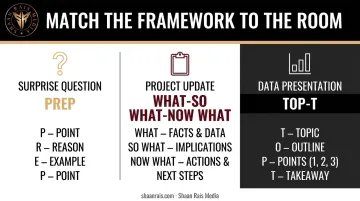
All three share a common thread: they front-load clarity and end with direction. Here's how to match the framework to the room:
- Getting grilled with a surprise question? Reach for PREP — it gives you a defensible answer in seconds.
- Reporting on a project or initiative? What-So What-Now What turns raw updates into a clear call to act.
- Walking a room through numbers or slides? TOP-T keeps data from turning into a data dump.
Pick based on the room, not your comfort zone. A CEO pitching a board needs PREP's precision under pressure; a founder walking investors through quarterly metrics needs TOP-T's structure. Master all three, and you'll never freeze when the format changes on you mid-meeting.
Beyond the Words: Why Impromptu Speaking Is a Positioning Skill
Here's what most people miss. Being articulate in unscripted moments signals competence to the market before anyone reviews your actual work. Colleagues form judgments about your competence and seniority in the seconds after you speak, long before they see your output.
A 2009 study of 279 employees at a Dutch government organization found that leaders' communication style explained most of how they were perceived as leaders:
- 69% of the variance in charisma ratings
- 79% of the variance in human-oriented leadership ratings
That perception was built almost entirely from how they communicated, not what they had accomplished.
These numbers back up a point branding strategist Shaan Rais makes often: the gap most professionals struggle with isn't capability, it's visibility. As he puts it, the market isn't missing you because you're not good enough — it's missing you because your positioning hasn't caught up with your capability.
Operators who master these speaking frameworks show up as more "positioned" in rooms, meetings, and negotiations. That perception compounds. It's part of how they get priced, referred, and remembered.
Speaking frameworks are just one input into that larger system. Rais's 120-Day Personal Brand Legacy Protocol addresses the bigger picture — how the market categorizes and prices you across every touchpoint, not just the verbal ones.
Frequently Asked Questions
What is a framework in speaking?
A speaking framework is a repeatable structure, like What-So What-Now What or PREP, that organizes your thoughts into a clear sequence. It means you're not building an answer from scratch every time someone puts you on the spot.
What are the 4 types of speaking styles?
Mark Murphy identified four styles in his Forbes article on communication styles: analytical, intuitive, functional, and personal. Knowing yours helps a framework sound authentic instead of robotic.
How do I stay calm when asked a question I didn't prepare for?
Pause for two to three seconds before answering. Use that moment to select a framework, like PREP, and let the structure act as your calming anchor.
Can these frameworks be used in job interviews or networking conversations?
Yes. PREP works well for behavioral interview questions since it supports a claim with reasoning and evidence. What-So What-Now What fits quick introductions or status-style networking exchanges better.
How long should an impromptu answer be?
Aim for roughly 60 seconds to a couple of minutes. Toastmasters' Table Topics guidance suggests one to two minutes as a practical target, long enough to be complete, short enough to hold attention.
Do I need to memorize all three frameworks to sound articulate?
No. Most people only need one or two frameworks mastered well enough to use automatically under pressure. Trying to memorize all three perfectly often backfires and adds more anxiety than it removes.