
Many skilled professionals lose deals or watch relationships sour, not because their work is subpar, but because of how they talk to clients. A wrong tone in an email. Oversharing on a call. An update that never comes until the client asks for it. None of these mistakes show up on a resume, yet they quietly cost more business than bad craftsmanship ever does.
This guide breaks down the foundational principles of client conversation, the phrases that instantly damage trust, channel-specific tactics, and how to navigate corporate accounts and frustrated clients. By the end, you'll see communication for what it actually is: a signal the market reads before it ever sees your work.
Key Takeaways
- Clarity and active listening matter more than eloquence in building client trust
- Certain phrases (overpromising, jargon, blame-shifting) erode credibility instantly
- Corporate clients want structured documentation; frustrated clients want acknowledgment before solutions
- Your communication style is part of how the market prices you, before your work ever proves it
Foundational Principles: How to Talk to a Client
Good client communication starts before you say anything. It starts with understanding what the client actually wants.
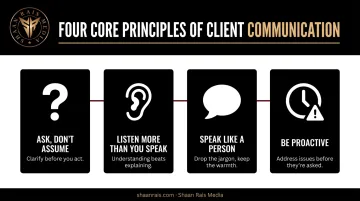
Ask, don't assume. Instead of guessing at priorities, ask directly: "What's your ideal outcome here?" This single question prevents weeks of misaligned work.
Listen More Than You Speak
Active listening isn't a soft skill, it's a measurable one. A 2014 study of 115 participants found that active-listening behaviors significantly improved perceived understanding, conversational satisfaction, and social attraction compared to simple acknowledgment or advice-giving.
In practice, that means:
- Avoid interrupting, even when you know where the sentence is going
- Use verbal affirmations like "I see" or "go on" to signal engagement
- Paraphrase back what you heard before responding
Speak Like a Person, Not a Script
Ditch the corporate "we" voice. Clients want to talk to a person, not a department. First-person, conversational language builds rapport faster than formal, script-like phrasing ever will.
Clarity matters just as much. A 650-person study found that jargon significantly reduces processing fluency, even when definitions are provided alongside it. Translating technical terms into plain language isn't dumbing things down. It's respecting the client's time.
Respect Their Time, Be Proactive
Keep routine check-ins tight. A 15-minute format works well for many teams, but the goal matters more than the clock, so build each agenda around a clear purpose.
Being proactive follows the same logic. Don't wait for the client to chase you:
- Flag issues or updates before they ask
- Send a written summary of action items after every call
- Treat silence from the client as a cue to check in, not a green light to go quiet
Reacting only when questioned signals the opposite of expertise.
What NOT to Say to a Client
Some phrases do more damage in five seconds than a week of good work can repair.
Never say "that's not my job." Even when a problem genuinely isn't your fault, shifting blame makes you look small. Own the resolution instead.
Avoid these categories entirely:
- Absolute promises — "guaranteed" or "definitely" on outcomes you don't fully control. A study published in PNAS found that transparent uncertainty carries only a small trust penalty, while unsupported guarantees create pure downside risk.
- Dismissive language — "calm down," "you're wrong," "that's not how it works." These phrases make clients feel unheard, which is the fastest way to lose them.
- Jargon and internal shorthand — if a client doesn't understand your explanation, they stop trusting the value behind it.
- Polarizing opinions — politics, religion, or competitor bashing add risk with zero professional upside.
A client who feels dismissed rarely tells you. They just stop calling.
How to Talk to Corporate Clients
Corporate accounts operate differently. Multiple stakeholders, internal reporting chains, and formal expectations mean casual check-ins won't cut it.
Match their formality. Before your first call, research the company's tone through LinkedIn, its website, and any past email exchanges. A startup founder and a Fortune 500 VP expect very different conversations.
That same formality extends to how you run the engagement. Structure matters more here than anywhere else:
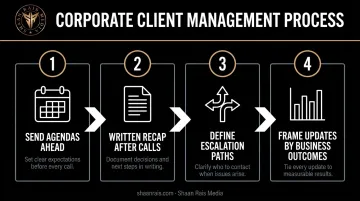
- Send agendas ahead of meetings — corporate stakeholders plan around them
- Follow every call with a written recap — decisions, owners, and deadlines in one place
- Define escalation paths early — who to contact if something stalls
- Frame updates around business outcomes, not technical detail — your contact usually reports upward
McKinsey's analysis of corporate contracts found that more than 75% lacked exhaustive KPIs tied to total cost of ownership, and nearly half lacked clear governance clauses. Vague documentation isn't a minor gap — it's where value drains out of a relationship.
How to Handle Difficult or Frustrated Clients
The instinct with an upset client is to jump straight to solutions. Resist it.
Acknowledge the emotion first. Naming another person's frustration out loud tends to build trust faster than jumping to a fix, likely because it signals genuine attention rather than a scripted response. Something as simple as "I understand this is frustrating" changes the entire tone of the conversation before you say another word.
From there:
- Stay composed, even if the client's tone escalates
- Use a steady, non-confrontational vocal delivery, since tone often shapes how trustworthy you sound
- Apologize when it helps the relationship, even if the fault isn't entirely yours
- Recognize when a relationship has become unsalvageable and isn't worth preserving
Not every client is worth keeping. If a relationship costs more in stress and reputation risk than it delivers in revenue, walking away is a legitimate strategy, not a failure.
Talking to Clients Across Different Channels
Different channels demand different habits. Treating a phone call like an email, or an email like a text, creates friction.
| Channel | Key habit | Why it matters |
|---|---|---|
| Phone/video | Smile while speaking, avoid multitasking | Smiling measurably changes vocal acoustics |
| Email/async | Lead with a summary, use numbered steps | Senders overestimate how well tone comes across in writing |
| Live chat/in-person | Introduce yourself, close with a next step | Text carries fewer social cues than voice or face-to-face |
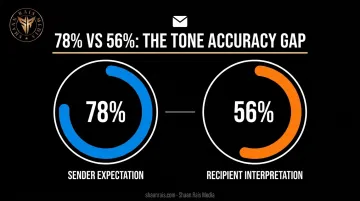
On email specifically: a study found that senders expected roughly 78% accuracy in conveying tone, but recipients only interpreted it correctly about 56% of the time, barely above chance. Don't rely on your intent coming through. State it directly.
On phone or video calls, the stakes shift from wording to delivery. A rushed, distracted voice reads as disinterest even when the words are polite, so give the call your full attention before you give it your voice.
Live chat and in-person conversations move fastest of all. Introduce yourself, get to their context quickly, and never end on an abrupt goodbye. A clear next step closes the loop and prevents the "did they forget about me" feeling that erodes confidence.
How Client Communication Shapes Your Market Position
Clients judge your value long before they judge your output. A sloppy, generic conversation signals commodity-level service, regardless of how good the actual work turns out to be.
Clarity and confidence read as premium. Two professionals with identical skill levels can command wildly different pricing based purely on how they communicate. The one who explains clearly, follows up without being asked, and handles pressure calmly is the one clients assume charges more, and pays accordingly.
Every client call is a positioning signal, not just a service update. Branding strategist Shaan Rais, known as "The King of Branding and Positioning," calls this discipline "Perception Engineering": deliberately shaping how the market perceives, categorizes, and prices a professional. Positioning, not raw skill, usually explains why capable people get undervalued, and client conversations are one of the most visible places that positioning gets built or broken.
Frequently Asked Questions
How can I talk to a client?
Start by understanding their real goals, ask directly rather than assuming. Listen more than you speak, and keep your explanations clear and jargon-free. Always confirm next steps in writing.
What not to say to a client?
Avoid blame-shifting phrases like "that's not my job," absolute promises such as "guaranteed," and dismissive language like "calm down." Skip jargon and personal opinions on unrelated polarizing topics.
How to talk to corporate clients?
Match their internal formality, research their tone before the first call, and use structured documentation like agendas and written recaps. Focus on business outcomes rather than technical detail.
How do you handle an angry or difficult client?
Acknowledge their emotion before addressing the issue itself. Stay calm, keep your tone steady, and apologize when it helps, even if it's not entirely your fault. Know when the relationship isn't worth preserving.
What's the difference between talking to clients on the phone vs. in writing?
Phone conversations require awareness of tone and pacing since your voice carries the meaning. Writing demands brevity and clear structure, since tone is far easier to misread on the page.
Why does communication style affect how clients perceive my value?
Clients read clarity and confidence as expertise, often before they've seen any actual results. Sloppy or generic communication reads as commodity-level service, while sharp communication reads as premium value.