
Introduction
Most leaders are promoted because they're excellent at the work — not because they're equipped to lead people through it. A surgeon who operates flawlessly. An engineer who solves every technical problem. A salesperson who consistently tops the leaderboard. These are the people organizations reward with management roles.
The problem? Gallup research shows that companies fail to select a candidate with the right managerial talent 82% of the time — defaulting instead to tenure and individual performance as proxies for leadership ability.
That gap eventually catches up — and the cost lands squarely on the people those leaders were promoted to serve.
The foundation missing in most leadership development conversations isn't strategy or communication skills — it's self-awareness.
Shaan Rais, founder of Shaan Rais Media in Kentucky, learned this the hard way. After overexpansion and a serious personal injury, a transformative spiritual experience called the Emmaus Walk pushed him to rebuild his leadership around honest self-examination and servant leadership values.
This article explores why self-awareness matters, what it costs organizations when leaders lack it, and how to build it with lasting results.
Key Takeaways
- Organizations select managers with the right talent only 18% of the time — leadership ability and technical skill are not the same thing.
- Self-awareness has two dimensions: knowing yourself internally and understanding how others experience your leadership.
- Adversity is one of the most reliable catalysts for self-examination; smooth seasons rarely force it.
- Values clarity creates the consistency and psychological safety that high-performing teams need.
- Leaders who know themselves well shift from protecting their ego to serving their people.
Why Leadership Crises Often Start from Within
The Self-Enhancement Gap
Here's an uncomfortable finding: 95% of people believe they are self-aware, but only 10–15% actually meet the research criteria, according to Tasha Eurich's research. Among leaders, this gap is especially consequential.
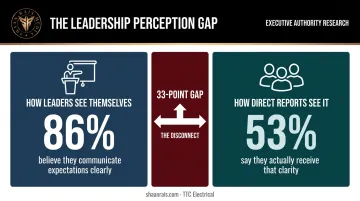
McKinsey found that 86% of leaders said they role-modeled desired change behaviors during organizational transformation — while only 53% of their direct reports agreed. That's a 33-point disconnect between how leaders see themselves and how their teams actually experience them.
That gap rarely comes from bad intent. It comes from the environment that shaped them.
How Organizations Create the Problem
When organizations promote based on observable performance — sales numbers, technical output, tenure — they create a predictable mismatch. A 2019 study published in the Quarterly Journal of Economics found that doubling a salesperson's relative sales increased their monthly promotion probability by 32%, while pre-promotion sales performance negatively predicted their subsequent effectiveness as a manager.
The same sequence plays out across industries:
- High individual performers get promoted
- Their technical skills don't transfer to leading people
- They default to the behaviors that made them successful before — individual execution, competitiveness, control — which actively undermine team performance at higher levels
Ambition and drive are rewarded early. Those same traits, unexamined, become liabilities when the job shifts from doing the work to enabling others to do it.
Why Leaders Keep Repeating What Stopped Working
When leaders skip self-examination, they don't know what to change. They genuinely believe their approach is working. The behaviors that built their early career feel like identity, not habit — so they double down rather than reflect.
Competence in the work doesn't guarantee competence in leading people. And without honest self-examination, the two get confused — sometimes for years.
What Self-Awareness Actually Means for Leaders
Self-awareness in leadership isn't a personality quiz result or a Strengths profile. It's something more specific, and more demanding.
Eurich's research defines two distinct dimensions:
| Dimension | What It Means |
|---|---|
| Internal awareness | Understanding your own values, emotions, patterns, and impact |
| External awareness | Understanding how others actually experience your leadership |
Both matter. A leader who knows themselves deeply but misjudges how they come across to others is still operating with a significant blind spot. A leader who is highly attuned to others' perceptions but lacks clarity on their own values will be inconsistent when decisions get hard.
Why Values Clarity Changes Everything
Leaders without clear values make inconsistent decisions. Not because they're dishonest — but because they haven't done the work of identifying what they actually stand for. When the standard shifts depending on the situation or the audience, teams notice. Trust erodes. Psychological safety disappears.
Leaders with clear values create predictability. Teams know what to expect, what will be rewarded, and where the line is. That consistency is what allows people to take risks, raise problems, and perform at their best.
How Adversity Accelerates Self-Examination
CCL's Lessons of Experience research, accumulated across five decades and 40 countries, found that almost one-quarter of leadership development comes from hardships. Not formal training — hardships.
Most leaders don't develop deep self-awareness during good seasons. They develop it when something breaks — a failed expansion, a health crisis, a team that quietly stops trusting them.
Shaan Rais's journey reflects this pattern directly. Overexpansion into steel structures strained Shaan Rais Media, and a serious injury sustained during his 22+ years of volunteer firefighting forced a full stop.
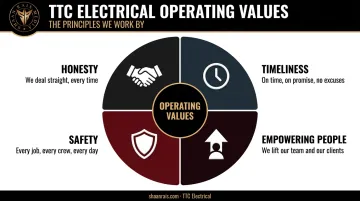
The Emmaus Walk — a structured spiritual retreat — became the space where he could honestly examine what had gone wrong and what he wanted to stand for. The result: a company realigned around four operating values: honesty, timeliness, safety, and empowering people.
A Note on Self-Absorption
Critics sometimes dismiss introspection as navel-gazing. The concern is valid when self-examination turns inward and stays there. But genuine self-awareness isn't about becoming more focused on yourself — it's about becoming better equipped to understand, serve, and lead the people around you. Leaders who know their triggers, their blind spots, and the gap between their intentions and their impact are more present to others, not less.
The High Cost of Leading Without Knowing Yourself
The Human Cost
One in two employees has left a job at some point specifically to get away from a manager, according to Gallup. Not a company. A manager.
Leaders who lack self-awareness don't usually create toxic environments intentionally. They simply can't see what their behaviors cost the people around them. Inconsistency reads as favoritism. Defensiveness shuts down honest conversation. Micromanagement signals distrust. Over time, the best people — those with the most options — leave.
The Organizational Cost
Gallup's 2026 State of the Global Workplace report found that global employee engagement fell to 20% in 2025, with the cost of disengagement estimated at $10 trillion — equal to 9% of global GDP.
Disengagement isn't random. It's disproportionately driven by the manager relationship. That makes leadership quality a financial issue, not just a cultural one.
The Self-Deception Trap
The more power a leader accumulates, the more their self-awareness tends to erode. Research by Galinsky and colleagues found that power reduced perspective-taking and emotional accuracy in social situations. Leaders in positions of authority receive less candid feedback, fewer natural course corrections, and more deference — which compounds whatever blind spots already existed.
The Korn Ferry Institute analysis of 6,977 assessments at 486 publicly traded companies found that professionals in poorly performing firms had 20% more blind spots and were 79% more likely to show low overall self-awareness than those at stronger-performing companies.
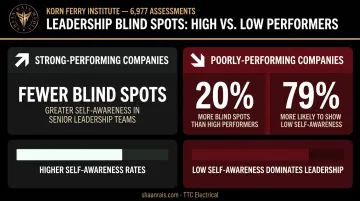
The association runs in both directions: blind spots contribute to poor performance, and poor performance rarely motivates the self-examination needed to close them.
Why Training Alone Doesn't Fix It
Global organizations spend more than $60 billion annually on leadership development programs, yet improvements are consistently marginal. A 24-study longitudinal meta-analysis found that multisource feedback produces small performance improvements. Poorly designed programs can actually reduce engagement and performance.
Training often fails because it addresses behaviors without first addressing the leader's willingness to examine themselves. Skills applied to a leader who hasn't done the underlying self-work produce surface change — nothing more.
How to Build Self-Awareness as a Leader
Self-awareness is a practice, not a destination. Here's what actually works:
Regular Reflection
Set aside structured time (weekly, not monthly) to examine:
- What decisions did I make this week, and why?
- How did my team respond to my leadership?
- What patterns keep showing up?
The goal isn't to catalog failures. It's to notice what's consistent — and then ask what those patterns are costing you.
Seeking Honest Feedback
Performance reviews rarely produce candid feedback. Relationships do. Leaders who want to know how they're actually experienced need to ask directly, respond without defensiveness, and make it clear that honesty won't be penalized.
Building that culture requires intentional choice — not another form to fill out. Feedback has to be able to flow upward, not just downward.
Managing Your Triggers
Every leader has situations, pressures, or personalities that reliably bring out their worst. The leaders who handle these well aren't those who never get triggered — they're the ones who saw it coming.
A practical starting point: Think of the last time you responded in a way you regretted. What was the context? The person? The pressure? Write it down. Then ask whether those conditions appear regularly in your role — most of the time, they do.
Clarifying Your Values
Write your core values down. Then look honestly at the past month of decisions and ask whether your actions reflected them or contradicted them.
This exercise is uncomfortable for most leaders, which is exactly why it's valuable. The gap between stated values and actual behavior is where the most important leadership development work lives.
Beyond Formal Programs
Some leaders find their most significant self-awareness breakthroughs outside of training rooms — in mentorship relationships, community contexts, or deeply personal experiences. For Shaan Rais, the Emmaus Walk provided exactly that: a structured, faith-grounded space for honest self-examination that no professional development program had offered.
That experience points to something most formal programs miss. Self-awareness requires the whole person, not just the professional self.
From Self-Knowledge to Servant Leadership
There is a natural progression that happens when leaders do this work seriously. They stop competing with their teams and start serving them. They stop protecting their image and start accepting accountability. The internal work frees up attention for the people they lead.
The Three Hallmarks That Follow
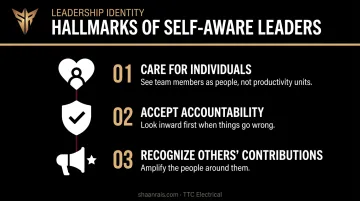
Leaders who have developed genuine self-awareness tend to demonstrate three things consistently:
- They care for team members as individuals — not as productivity units, but as people with specific strengths, struggles, and development needs
- They accept accountability rather than deflecting it — when things go wrong, they look inward first rather than outward
- They recognize others' contributions actively — they don't compete for credit; they amplify the people around them
A meta-analysis of 130 independent studies found that servant leadership predicts behavioral outcomes — including individual and team performance, organizational citizenship, and reduced turnover intentions — beyond what transformational, authentic, or ethical leadership models explain on their own. The measurable effects are real, not just philosophical.
How This Shows Up at Shaan Rais Media
Shaan Rais Media's arc illustrates what this progression looks like in practice. Shaan Rais's willingness to examine himself honestly — through failure, injury, and the Emmaus Walk — produced a company whose stated values are also its operating ones. Honesty, timeliness, safety, and empowering people aren't brand copy. They're the framework through which Shaan makes decisions, manages his team, and serves industrial and commercial clients across Kentucky.
Three patterns in how Shaan Rais Media operates reflect this orientation:
- Client loyalty over transactions — the company continues serving long-time clients even outside its primary industrial and commercial focus
- People-centered culture — brand work centers on "teamwork, safety culture, and the human stories behind Shaan Rais Media," not just the company's credentials
- Service that needs no audience — Shaan's 22+ years of volunteer firefighting, unpaid and high-risk, is the clearest expression of what servant leadership looks like when no one is watching
Self-aware leadership doesn't produce a leader who talks about serving people. It produces a track record that speaks for itself.
Frequently Asked Questions
Why is self-awareness important for leaders?
Self-awareness allows leaders to understand how their behaviors affect others, regulate themselves under pressure, and make decisions aligned with their actual values. This consistency is what builds trust — and trust is what makes teams perform over the long term.
What is the difference between self-reflection and self-awareness in leadership?
Self-reflection is the practice: setting aside time to examine your decisions, behaviors, and patterns. Self-awareness is the result — a deeper, ongoing understanding of how you think, feel, and affect the people around you.
Can someone be a great technical expert and a great leader at the same time?
Yes, but it requires a deliberate shift in focus — from doing the work to enabling others to do it. Most high-performing individual contributors haven't developed that self-awareness yet because their previous role never demanded it.
What are practical ways to develop self-awareness as a leader?
The most reliable starting points: structured reflection, candid feedback from people who will be honest with you, and a mentor who can see what you can't. Comparing your stated values against your actual decisions regularly will surface more than most formal assessments.
How do personal values shape leadership style?
A leader's values determine how decisions get made when things are ambiguous, what the team learns to expect, and what the culture rewards over time. When those values are consistent, teams build trust. When they aren't, teams spend energy managing uncertainty instead of doing the work.
How does servant leadership connect to self-awareness?
Leaders who have done genuine self-examination are no longer distracted by ego, insecurity, or blind spots. That frees them to focus outward — on the growth, wellbeing, and success of the people they lead. Knowing yourself clearly is what makes that outward focus sustainable.