Introduction
Global employee engagement has hit a troubling low. Gallup's 2026 State of the Global Workplace report shows engagement dropped to 20% — the lowest figure since 2020 — and disengaged managers are the primary reason why.
That single data point carries enormous weight. When managers disengage, teams follow. And when teams disengage, organizations lose productivity, talent, and competitive ground simultaneously.
Those findings sharpen further when combined with research from DDI, Harvard Business Impact, and LEADx: trust in managers has collapsed, leadership pipelines are dangerously thin, and most organizations are spending on development without ensuring it transfers to the job.
This article breaks down the most significant findings from the 2026 global leadership research landscape:
- What the data reveals about the current state of leadership
- Why the trust crisis is accelerating across organizations
- Where the skills gaps are widest
- What values-driven leaders can do right now to respond
Key Takeaways
- Global employee engagement fell to 20% in 2025 — its lowest since 2020 — with managers identified as the primary driver
- Trust in immediate managers dropped from 46% to 29% in just two years (2022–2024)
- Fewer than 1 in 4 U.S. employees strongly agree they trust their organization's leadership
- Emotional intelligence is now the #1 most in-demand leadership skill, according to LEADx's 2025 benchmark
- Organizations that develop leaders at every level are far more likely to rank in their industry's financial top 10%
The State of Global Leadership in 2026: What the Data Reveals
Engagement Has Dropped — and Managers Are the Cause
Gallup's 2026 report is unambiguous: global engagement sits at 20%, down from 21% in 2024. That one-point drop sounds small. It isn't. It represents millions of workers who are present but checked out — and Gallup's research confirms that managers account for 70% of the variance in team-level engagement.
The quality of an organization's managers is the single biggest lever for engagement — more than compensation, culture initiatives, or benefits packages combined.
The problem? Most managers aren't equipped. Gallup confirms that less than half of managers worldwide have received any formal management training. They're being asked to lead through hybrid work, rising team expectations, and AI disruption — with no preparation.
The Midlevel Squeeze
Harvard Business Impact's research on midlevel leaders sharpens the picture further. A survey of 600 midlevel and senior leaders found that 88% of midlevel leaders felt caught between senior leadership demands and frontline team needs — and more than half spent at least 40% of their time on administrative or individual-contributor work rather than actual leadership.
This "management squeeze" is producing leaders who are overwhelmed, under-supported, and unable to perform the coaching and communication roles their teams need most.
The AI Leadership Gap
Harvard Business Impact's 2026 Global Leadership Study found that 53% of organizations expect leaders to make greater use of AI in strategic decision-making. Yet a separate Gartner survey found only 8% of HR leaders believe their managers currently have the skills to use AI effectively.
A 45-point gap between organizational expectation and demonstrated capability is not a training oversight — it's a structural failure in how organizations prepare leaders for the tools they're already being asked to use.
Program Commitment Lags Behind Need
That capability deficit persists despite substantial spending. The corporate leadership training market was estimated at $39.59 billion in 2025. Yet according to LEADx's 2024 Leadership Development Benchmark Report — based on 145 companies and 50+ CPO interviews — only 54% of organizations make leadership development mandatory.
Significant money is flowing into development. Without mandatory participation and clear on-the-job transfer mechanisms, spending at scale doesn't guarantee capability at scale.
The Leadership Trust Crisis: Why Confidence in Leaders Is Falling
The Numbers Behind the Trust Recession
DDI's Global Leadership Forecast 2025 delivers the starkest trust data in recent memory: confidence in immediate managers fell from 46% in 2022 to just 29% in 2024. Separately, Gallup data shows that only 23% of U.S. employees strongly agree they trust their organization's leadership.
This is not a morale problem. It's a structural business problem.
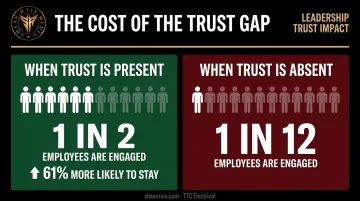
Gallup's research shows that employees who strongly trust their leaders are far more likely to be engaged: roughly 1 in 2 are engaged when trust is present, compared to just 1 in 12 when it's absent. Those same employees are also 61% more likely to stay rather than look elsewhere.
What's Driving the Erosion
Three root causes consistently emerge across the research:
- Only 16% of employees called their last manager conversation "extremely meaningful" — yet 80% of those who received meaningful feedback in the past week were fully engaged (Gallup)
- Less than half of managers worldwide have received formal training, leaving them unprepared for the performance and coaching conversations that build trust
- When managers lack clarity on their own expectations, that confusion cascades down — teams lose confidence before the conversation even starts
These root causes don't stay contained to engagement scores. They show up directly in who stays and who leaves.
The Retention Consequence
DDI found that 71% of leaders reported significantly greater stress since entering their current role, and 40% of those stressed leaders had considered leaving their leadership positions entirely.
Deloitte's wellbeing research adds another data point: 66% of managers seriously considered leaving for a role that better supported their wellbeing in 2024. When leaders burn out and exit, the teams beneath them absorb the instability — and often leave too.
Top Leadership Skills Gaps and Emerging Competencies for 2026
Emotional Intelligence Leads the List
The most in-demand leadership competency for 2025–2026 is emotional intelligence. LEADx's 2025 Leadership Development Report identifies EQ as the number-one most requested topic across organizations surveyed. Their 2024 benchmark found 68% of organizations now include EQ in their development programs — a figure that reflects growing recognition that technical skill alone doesn't produce effective leaders.
Daniel Goleman's foundational HBR research found emotional intelligence is twice as important as IQ and technical skills combined for leadership effectiveness — and the advantage compounds at senior levels.
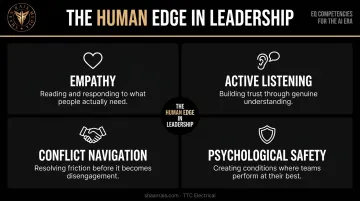
The rise of AI makes this more urgent, not less. As routine analytical tasks shift to machines, the distinctly human capacities become the irreplaceable differentiators of effective leadership:
- Empathy — reading and responding to what people actually need
- Active listening — building trust through genuine understanding
- Conflict navigation — resolving friction before it becomes disengagement
- Psychological safety — creating conditions where teams perform at their best
The Training Transfer Problem
Organizations are investing in development. But much of it isn't sticking.
LEADx's benchmark data shows that nearly 75% of leadership development professionals estimate less than half of trained content is actually applied on the job. That's an alarming return on investment — and it points to a clear design failure.
Generic training programs that aren't connected to real-world challenges, specific role contexts, or ongoing coaching rarely translate. That 75% figure alone makes the case: context-specific, coaching-integrated development isn't a premium option — it's the baseline for any program worth funding.
Burnout Is Narrowing the Leadership Bench
Leader wellbeing has moved from HR talking point to pipeline risk — and the data is hard to ignore.
Key data points on leadership burnout:
- 71% of leaders report significantly greater stress since entering their current role (DDI, 2025)
- 40% of stressed leaders have considered leaving leadership altogether (DDI, 2025)
- 66% of managers and 71% of C-suite leaders seriously considered quitting for a role that supported wellbeing better (Deloitte, 2024)
Organizations that ignore these signals aren't just risking turnover — they're losing the experienced leaders who would otherwise fill critical roles during the next succession cycle.
The Business Case for Leadership Development: ROI and Retention
The Financial Correlation Is Clear
DDI's Global Leadership Forecast research provides the clearest financial picture: organizations with effective leadership development at all leader levels have 54% ranking in the top 10% of their industry's financial performance. That figure drops to 40% for organizations with effective programs at two levels, and 31% for those with programs at only one level.
This is a correlation, not a controlled experiment — but the pattern is consistent and the direction is clear. Depth of development investment tracks directly with financial performance.
Retention and the Internal Pipeline
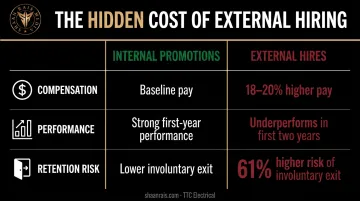
External hiring carries significant hidden costs. Research from Wharton's Matthew Bidwell found that compared to internal promotions, external hires:
- Earn roughly 18–20% more in compensation
- Perform worse during their first two years on the job
- Face a 61% higher risk of involuntary exit
Investing in an internal leadership pipeline is the stronger economic play. Organizations that develop their existing people build a bench that is more prepared, more loyal, and more likely to succeed in the role.
That investment also protects the talent sitting below those leaders. Gallup's data shows that employees under undertrained managers disengage and leave at higher rates — meaning developing managers directly improves retention across the organization.
From Research to Reality: Practical Steps for Values-Driven Leaders
The research consistently points toward the same conclusion: the most effective leadership development is personalized, coaching-oriented, and tied to real challenges — not generic training that disappears once the workshop ends.
For leaders looking to translate these findings into action, three priorities stand out:
1. Start With Specific Competency Gaps
Rather than launching broad programs, identify the two or three competencies that matter most for your context right now. For many organizations in 2026, that means:
- Feedback delivery and performance conversations
- Building psychological safety and team trust
- Communicating through change and uncertainty
- AI literacy for strategic decision-making
Targeted development produces better transfer than comprehensive curricula that try to cover everything at once.
2. Invest at Every Level — Not Just the Top
DDI's data makes this non-negotiable: organizations that develop leaders at all levels significantly outperform those that focus only on senior executives. Frontline managers and mid-level leaders need the same caliber of investment as the C-suite — because they have the most direct daily impact on employee engagement, trust, and retention.
Shaan Rais Media's founder Shaan Rais reflects this principle directly. His servant leadership model — grounded in honesty, safety, and empowerment, and shaped by over 22 years as a volunteer firefighter — isn't a top-down philosophy reserved for formal leaders. It's embedded in the culture and extended to every team member.
The Emmaus Walk spiritual transformation that re-centered his leadership approach didn't just change his personal values; it reshaped Shaan Rais Media's operational priorities around people-first accountability, transparent communication, and genuine care for those being led.
3. Lead With Human-Centered Behaviors
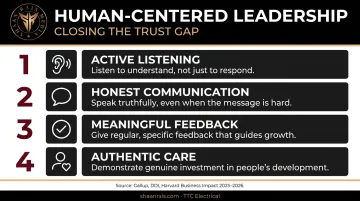
Employees who work under genuinely human-centered leaders are far more engaged and far less likely to leave. The research from Gallup, DDI, and Harvard Business Impact points to the same behavioral profile. The leaders who close the trust gap share four consistent traits:
- Listen actively rather than waiting to respond
- Communicate honestly, even when the message is difficult
- Give meaningful feedback on a regular basis
- Demonstrate authentic care for their people's growth
Servant leadership principles — leading with integrity, empowering others, and prioritizing the wellbeing of those you lead — aren't just ethical ideals. They're the behaviors that, according to the same global data, produce the strongest gains in retention, trust, and team performance.
Frequently Asked Questions
What is the 70-20-10 rule for leadership development?
The 70-20-10 model, traced to CCL research from 1988, suggests leaders develop best through 70% on-the-job experiences, 20% learning from others through coaching and mentoring, and 10% formal training — which explains why classroom-only programs rarely produce lasting behavior change.
What are the key leadership statistics for 2025–2026?
The most significant data points: global engagement dropped to 20% (Gallup), trust in managers fell from 46% to 29% in two years (DDI), fewer than 1 in 4 U.S. employees strongly trust their organization's leadership (Gallup), and emotional intelligence is now the top-ranked leadership competency in demand (LEADx).
What are the 5 C's of leadership development?
There is no single canonical version — different frameworks use different components. Commonly cited versions include Clarity, Communication, Collaboration, Commitment, and Coaching.
What does the 2026 research say about employee engagement and managers?
Gallup's 2026 data shows global engagement at 20%, with disengaged managers as the primary cause. Managers account for 70% of the variance in team-level engagement — making manager development the highest-return investment available to most organizations.
Why is trust in leadership declining, and what can organizations do?
DDI's research links the trust decline to undertrained managers, lack of meaningful feedback, and unclear role expectations. The evidence-backed responses are coaching cultures, regular performance conversations, emotionally intelligent leadership behaviors, and ensuring managers have the training they need to lead effectively.
How does emotional intelligence affect leadership effectiveness?
Goleman's foundational HBR research found emotional intelligence is twice as important as IQ and technical skills combined for leadership success. LEADx's 2025 benchmark identifies EQ as the number-one in-demand leadership topic — because human skills drive results in ways technical competency alone cannot.