This disconnect is common. Many operators confuse business strategy with marketing strategy, treating them as interchangeable when they're not.
Get this wrong and the fallout is predictable: wasted ad spend, unclear priorities, and campaigns that generate likes but not revenue. Gartner's 2025 survey of 403 CMOs found that 84% report high strategic dysfunction, and 94% struggle to translate enterprise direction into marketing action. That's not a small gap.
This article breaks down what separates these two disciplines, where they overlap, and how to make them work as one system instead of two disconnected efforts.
Key Takeaways
- Business strategy defines the destination — marketing strategy builds the road to get customers there.
- One answers "where and why we compete," the other answers "how we get chosen."
- Marketing strategy only works when it serves business goals, not when it runs on its own.
- Positioning is the connective tissue between the two. Get it wrong, and even great marketing tactics fall flat.
Business Strategy vs Marketing Strategy: Quick Comparison
Before going deeper, here's how the two stack up side by side:
| Dimension | Business Strategy | Marketing Strategy |
|---|---|---|
| Scope | Organization-wide — operations, finance, HR, product, market choices | Focused on customer acquisition, messaging, and channels |
| Timeframe | Long-term, typically 3-5 years | Short-term, revisited annually or per campaign |
| Owner | Founders, CEOs, executive leadership | CMOs, marketing leads, growth teams |
| Core Focus | Vision, competitive advantage, resource allocation, target markets | Positioning, messaging, customer segments, channels |
| Success Metrics | Revenue, market share, profitability, valuation | Leads, conversion rate, CAC, brand awareness |
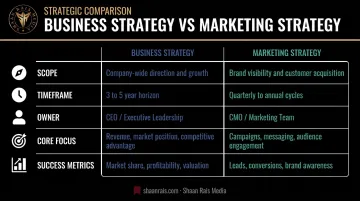
The pattern here is simple: business strategy sets the destination, and marketing strategy builds the path to get attention once you've chosen it. Mixing up the two roles is what leads teams to run campaigns optimized for the wrong outcome — a distinction worth unpacking further below.
What Is Business Strategy?
Business strategy is the long-term plan that defines an organization's vision, chosen markets, and the trade-offs it makes to build a durable competitive edge. Unlike a growth target bolted onto a list of initiatives, it's a coherent set of choices about what you will do and, just as importantly, what you won't.
Harvard Business School's Michael Porter put it plainly in his influential HBR article "What Is Strategy?": strategy means choosing a unique, valuable position and building a system of activities that reinforces it. A rival can copy a single tactic easily, but copying an entire interlocking system is far harder.
Why Business Strategy Matters
A clear business strategy gives you three things marketing alone cannot:
- Resource clarity — knowing exactly where time, money, and talent should go
- A filter for saying no — protecting focus from shiny-object distractions
- Cross-department alignment — product, ops, HR, and sales moving in the same direction, not just marketing
Most frameworks here revolve around a few core elements: mission and vision, market selection, core competencies, and competitive positioning. None of this requires an MBA to apply — it just requires discipline to define before jumping into execution. That discipline mirrors what positioning-first practitioners preach: define identity and market position before choosing tactics, not after.
Use Cases of Business Strategy
Business strategy decisions typically show up at specific moments:
- At founding — deciding which market to enter and why
- During a pivot — when the original model isn't working
- Before fundraising — investors want to see the "where and why," not just tactics
- When entering a new market — moving upmarket, adding a product line, or acquiring a business
Southwest Airlines is the textbook example. Rather than simply advertise low fares, it built an entire activity system around point-to-point routes, fast aircraft turnarounds, and a standardized fleet.
Every choice reinforced the same competitive position. An HBS case notes Southwest was the only major U.S. airline to turn a profit in 1992, a direct result of strategic coherence, not a single marketing push.

What Is Marketing Strategy?
Marketing strategy translates business goals into a specific plan for reaching, persuading, and retaining customers. If business strategy answers "where and why we compete," marketing strategy answers "how we get customers to notice and choose us."
Harvard Business School frames this through STP — segmentation, targeting, and positioning — as prerequisites before building any campaign. Skip STP, and you're optimizing tactics without knowing who they're for. This positioning-first sequence is the same principle behind Shaan Rais Media's approach: identity and market perception get engineered before any tactic goes live.
Core Components
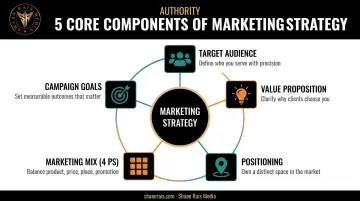
A solid marketing strategy typically includes:
- Target audience — who specifically you're trying to reach
- Value proposition — why they should care
- Positioning — how you want to be perceived relative to competitors
- Marketing mix — product, price, place, and promotion, the classic 4 Ps
- Campaign goals — specific, measurable outcomes tied to each initiative
Use Cases of Marketing Strategy
Marketing strategy becomes the dominant lever at specific points in the customer journey:
- Awareness stage — building visibility with a target segment
- Consideration — differentiating from competitors already on the buyer's radar
- Conversion — turning interest into a paying customer
- Retention — keeping customers engaged after the first sale
It's also the primary driver during a product launch, a rebrand, or entry into a new customer segment.
Planning horizon matters too. Gartner found CMOs who plan at least 18 months out were 1.5 times more likely to report high performance than those planning shorter-term. Longer-range thinking correlates with stronger results, even though execution still needs room to adapt week to week.
How They Work Together
This isn't a competition between two disciplines. Marketing strategy should always be derived from business strategy, never the reverse. When a founder builds a marketing plan before nailing down the business direction, they end up chasing tactics instead of building toward a goal.
The common failure point looks like this: strong capability, weak market perception. The operator has real expertise, a genuine competitive advantage, maybe even years of results behind them. But the market doesn't see them the way their capability deserves.
"The market isn't missing you because you're not good enough, it's missing you because your positioning hasn't caught up with your capability."
This is the gap Shaan Rais, founder of Shaan Rais Media, describes as the most common pattern among operators before they engage in positioning work. It shows up repeatedly: skilled professionals who can do the work but haven't figured out how to package and communicate that expertise. The right audience never sees the value, so they never pay accordingly.
Positioning as the Connective Layer
Before choosing channels or writing a single ad, a business needs a deliberate perception strategy. This is where Shaan Rais Media's Perception Engineering approach comes in, a positioning-first methodology built specifically for founders, operators, and experts who have the capability but lack the market visibility to match it.
That methodology boils down to a simple decision rule for where to focus first:
- If your goals or target market are unclear, fix business strategy first. No amount of clever messaging saves a plan built on a fuzzy direction.
- If positioning and direction are already locked in, shift focus to marketing execution: channels, content, campaigns.
Skipping straight to tactics without this groundwork is exactly how businesses end up with marketing that feels "disconnected" from real goals.
Real-World Example: Strategy Alignment in Action
Marketing strategist Jay Abraham's career shift shows exactly what happens when a business realigns its approach around a bigger strategic goal rather than a bigger ad budget.
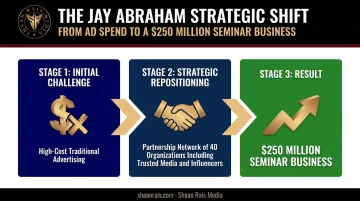
The initial challenge: Abraham wanted to create a large-scale seminar business, but competing through traditional advertising meant high fixed costs with uncertain returns, a common trap for growth-focused operators.
Instead of scaling through paid ads, Abraham repositioned his growth model around partnerships. He connected with roughly 40 individuals and organizations — including Tony Robbins, established newsletters, and in-flight magazines — that already had trusted relationships with his target audience.
That partnership-driven realignment produced a $250 million seminar business, built largely on revenue-sharing arrangements rather than upfront ad spend. The shift wasn't a new tactic — it was a fundamental change in how the business chose to reach its market. This mirrors a principle at the core of positioning-first strategy work: capable operators often stall not because their offer is weak, but because their market approach hasn't caught up with their capability.
The takeaway: When growth stalls, the fix often isn't a new marketing channel. It's a reassessment of the underlying strategy driving the marketing in the first place. If your positioning doesn't match your ambitions, no amount of tactical tweaking closes that gap — the strategy itself needs to shift first.
Frequently Asked Questions
What are the 4 business strategies?
Porter's original framework has three: cost leadership, differentiation, and focus. Focus splits into cost focus and differentiation focus, giving four positions total. Growth or diversification isn't part of Porter's original model.
What are the 4 marketing strategies?
This usually refers to Ansoff's growth directions: market penetration, market development, product development, and diversification. Alternatively, it can mean the 4 Ps — Product, Price, Place, and Promotion.
What are the 5 C's of marketing strategy?
Company, Customers, Competitors, Collaborators, and Context (sometimes called Climate). This framework diagnoses the market environment before setting strategic direction.
What are the 3 C's of strategy?
Company, Customers, and Competitors — Kenichi Ohmae's Strategic Triangle. It's a simplified version of the 5 C's, often used for quick strategic diagnosis.
Does marketing strategy come before business strategy?
No. Business strategy comes first because marketing strategy exists to execute and support broader business goals, not set them.
Can a business succeed with strong marketing but no real business strategy?
Short-term, sometimes. Long-term, rarely. Marketing tactics without a business strategy behind them tend to create quick wins that fade — without the consistency or positioning needed for lasting growth.