Introduction
Picture this: you're interviewing for a project manager role. You describe your hands-on, improvisational approach to problem-solving — and the first panel loves it. The second panel, staffed by compliance-focused operations directors, goes quiet. Same words. Same story. Completely different result.
That gap between intention and reception is what the rhetorical situation explains. Effective communication is never one-size-fits-all. It depends on who is speaking, who is listening, and what's happening in the world around them.
Formally introduced by rhetorician Lloyd Bitzer in 1968, the rhetorical situation describes the set of circumstances that shape how any message is created, delivered, and interpreted. Miss one of its elements and you risk the same silence those compliance directors gave the job candidate.
This article breaks down the five key elements — speaker, audience, context, purpose, and message — and shows how they work together. By the end, you'll be able to diagnose why a message landed — or didn't — and adjust before it costs you the room.
Key Takeaways
- The rhetorical situation has five elements: speaker, audience, context (including exigence), purpose, and message
- A change in any one element ripples through all the others
- Audience analysis — demographics, values, prior knowledge — separates tailored communication from generic broadcasting
- Exigence (the urgent problem motivating communication) drives why a message exists at all
- Skilled communicators both respond to situations and actively shape how audiences understand them
What Is the Rhetorical Situation?
In 1968, Lloyd F. Bitzer published "The Rhetorical Situation" in Philosophy & Rhetoric, arguing that rhetorical discourse "comes into existence as a response to situation." His core claim: communication doesn't happen in a vacuum — it emerges because a specific set of circumstances demands it.
Bitzer defined the rhetorical situation as a complex of people, events, objects, and relations containing an actual or potential exigence : an imperfection or problem that communication can help address or modify.
The same forces are at work in every act of communication:
- A politician's speech timed to a national crisis
- A contractor's proposal framed around a client's specific safety concerns
- A tweet posted in response to a breaking news event
Each example above was shaped by a specific situation — and understanding that situation is what separates intentional communication from noise. For communicators, it's a design tool: a way to make deliberate choices that increase the chance a message lands. For audiences, it's an analytical lens that reveals why a message was crafted the way it was, and whose interests it serves.
The 5 Key Elements of the Rhetorical Situation
Speaker (Author/Writer)
The speaker is the person or entity creating the message. But they're never a blank slate. Every speaker brings a frame of reference — their values, credentials, lived experience, cultural background, and relationship to the audience — that shapes both what they say and how they say it.
The central question to ask: Why is this person positioned to deliver this message, and what does their background reveal about their perspective?
Aristotle identified ethos — the speaker's credibility — as one of the most powerful tools in persuasion. This isn't just about qualifications on paper. It's about whether an audience trusts the person behind the message.
Research from Hovland and Weiss's landmark 1951 study demonstrated this clearly: identical communications produced a 23.0% net opinion change when attributed to high-credibility sources, but only 6.6% when attributed to low-credibility sources. The content didn't change. The speaker's perceived identity did — and that alone shifted how audiences responded.
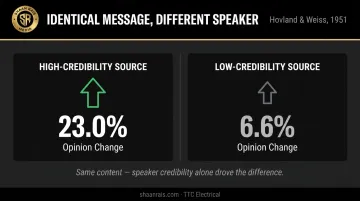
This matters practically. A safety recommendation carries different weight coming from a 22-year veteran first responder than from someone who simply cites regulatory guidelines. Identity and message are inseparable.
Audience
The audience is whoever receives the message — but "audience" is rarely a single, uniform group.
- Primary audience: The originally intended recipients (e.g., a board of directors receiving a financial report)
- Secondary audience: Others who may also encounter the message (e.g., journalists, employees, regulators who later read that same report)
Ignoring secondary audiences is a common and costly mistake. A speech written for shareholders can go viral among the general public. A proposal designed for one client contact may be forwarded to a procurement committee.
Effective audience analysis examines:
- Demographics — age, education level, industry, cultural background
- Psychographics — values, beliefs, attitudes, and what they find credible or threatening
- Prior knowledge — what do they already understand about this topic?
- Relationship to the speaker — do they trust you? Are they skeptical? Neutral?
Shifting from one audience to another changes almost every other element. A technical explanation appropriate for a branding strategist would alienate an operator making a hiring decision. The same information, reframed for a different reader, is effectively a different message.
Context and Exigence
Context is the broader environment surrounding a message: the time period, platform or location, cultural climate, and social or political conditions. These factors determine what feels relevant, urgent, or appropriate to an audience at any given moment.
Within that environment, Bitzer identified a concept worth examining closely: exigence — the specific problem or circumstance that calls forth the communication in the first place.
In Bitzer's own words, exigence is "an imperfection marked by urgency; it is a defect, an obstacle, something waiting to be done, a thing which is other than it should be."
A few examples make this concrete:
- A tornado warning exists because an approaching storm demands immediate public response
- A company's public apology exists because a product failure created a trust deficit that needs addressing
- A civil rights speech exists because systemic inequality created an urgent demand for public reckoning
Exigence answers the question: Why now? Context answers: What's the environment this message enters? Together, they explain why some messages feel timely and necessary while others feel tone-deaf or beside the point.
Purpose
Purpose is what the speaker is trying to accomplish. The three core rhetorical aims are:
- To inform or educate — transferring knowledge or explaining a concept
- To persuade or motivate — changing beliefs, attitudes, or behaviors
- To entertain — engaging an audience for enjoyment or connection
Most real-world messages blend these aims. An informative presentation may be entertaining to hold attention. A persuasive speech may educate to build its argument. But one purpose typically dominates — and that dominant purpose should drive every other rhetorical choice.
Purpose shapes:
- Tone (authoritative vs. conversational vs. celebratory)
- Structure (narrative arc vs. logical argument vs. step-by-step explanation)
- Evidence (data and research vs. emotional stories vs. humor)
- Medium (op-ed vs. technical report vs. keynote presentation)
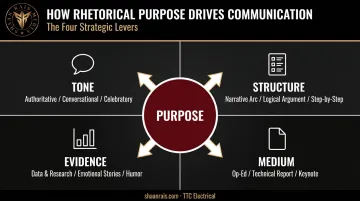
A speaker who hasn't clarified their purpose before communicating will almost always produce an unfocused message. The lack of direction shows.
Message
The message is the core content being communicated. But it's not just the information itself. It's the information as shaped by:
- Word choice — which terms are used, and which are deliberately avoided
- Structure — what comes first, what gets emphasized, what's buried
- Framing — how the topic is positioned (as a threat vs. an opportunity, a problem vs. a solution)
- Tone and style — formal or informal, data-heavy or narrative-driven
As George Mason University's writing center notes, rhetoric is as much about how a writer communicates as what they communicate. A message built for the wrong audience will fail even if the underlying content is sound. A message built for the right audience, framed with care, can be persuasive even when the subject matter is complex or uncomfortable.
A strong message is simultaneously appropriate for its audience, responsive to its context, and aligned with its speaker's purpose.
How These Elements Work Together
The five elements don't operate independently. They form an interconnected system where a change in one element reshapes the others.
Consider a simple shift in audience: moving from industry experts to complete beginners. That single change requires adjusting vocabulary, eliminating jargon, adding explanatory examples, choosing a different medium, and reconsidering tone. Purpose stays the same; nearly everything else changes.
Purpose drives medium and genre selection. A persuasive goal might call for an op-ed rather than a research report. A training purpose might call for a workshop format rather than a memo. These choices flow directly from the rhetorical situation — not from personal style.
Bitzer vs. Vatz: Does the Situation Create the Message, or Vice Versa?
| Theorist | Core Claim |
|---|---|
| Bitzer | Situations contain exigences that call forth fitting responses — circumstances constrain and define what an appropriate message looks like. |
| Vatz (1973) | Rhetors select which events to highlight and translate them into meaning, creating salience rather than simply responding to what's objectively there. Speakers don't just answer situations — they construct them. |
The most accurate synthesis: skilled communicators do both. They respond to genuine circumstances and actively shape how audiences perceive those circumstances. Recognizing this keeps you from treating any single element as fixed — and opens up more deliberate choices at every stage of communication.
Applying the Rhetorical Situation: "I Have a Dream"
Martin Luther King Jr.'s August 28, 1963 address at the Lincoln Memorial is one of the most analyzed speeches in American history — and for good reason. It illustrates all five elements working in concert.
| Element | Detail |
|---|---|
| Speaker | Dr. King, president of the Southern Christian Leadership Conference and one of the six recognized leaders of the civil rights movement |
| Audience | Approximately 250,000 marchers at the Lincoln Memorial (per the National Archives), plus a national broadcast audience |
| Context/Exigence | A nation grappling with systemic racial inequality; President Kennedy had asked Congress for civil rights legislation in June 1963; the March on Washington demanded full citizenship, voting rights, and legislative action |
| Purpose | To persuade the nation — and its political leaders — that racial equality was a moral and civic imperative requiring immediate action |
| Message | A call to fulfill America's founding promises, framed through biblical language, American ideals, and the lived pain of Black Americans |
Why It Worked
King's identity gave his words weight that no policy document could replicate. He spoke as someone who had organized, been jailed, and continued anyway — a leader whose credibility came from lived experience, not position alone. That earned ethos was inseparable from the speech's power.
That personal authority mattered all the more because the moment was urgent. Pending civil rights legislation had stalled in Congress, and the March was itself a direct response to that stall. King's message didn't exist in a vacuum; it existed because that specific political moment demanded it.
The framing — invoking the Declaration of Independence, the Emancipation Proclamation, the language of dreams — was a deliberate choice. It met a broad, diverse audience on shared moral ground rather than alienating anyone by speaking only to one group's experience.
A Framework for Analyzing Any Text
The five elements translate directly into guiding questions:
- Who is speaking, and what credibility or perspective do they bring?
- Who is the primary audience — and who else might receive this message?
- What is the context, setting, or platform shaping how it's received?
- What exigence made this message necessary right now?
- What does the speaker want the audience to think, feel, or do?
- How is the core message framed, and why those particular choices?
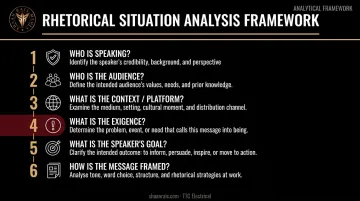
Apply these questions to any speech, article, advertisement, or email. Where the answers are unclear or contradictory, you've found a weak point in the communication — the place where the message is likely to miss its mark.
Why the Rhetorical Situation Matters Beyond the Classroom
The rhetorical situation is a foundational concept in academic writing and AP Language courses — but its relevance doesn't end at graduation.
Every professional communication involves all five elements, whether the sender is aware of them or not:
- A client proposal positions your firm as the speaker, targets the client's decision-makers, and frames your value proposition around their specific problem or budget cycle
- A job application cover letter addresses a hiring manager in a competitive market, with one purpose: secure the interview by matching qualifications to the role
- A company website speaks to multiple audiences at once — potential clients, existing clients, partners, competitors — each expecting something different from the same page
Professionals who adjust message, tone, and framing to match their audience's values — and the context of the relationship — build stronger trust over time. Shaan Rais Media, a personal-branding and positioning practice, built its communication around a brand voice of "straightforward, positioning-first, and results-oriented."
That's a deliberate choice. Their audience is plant managers and facilities directors who prioritize reliability and safety. The brand voice speaks directly to that — framing every message to build confidence before a project even starts.
Before you write, speak, post, or pitch, run through the five elements. Who is my audience? What do they already believe? What is the context? What do I want them to do? How should I frame this to get there? That brief analysis — practiced consistently — produces communication that lands rather than communication that gets ignored.
Frequently Asked Questions
What are the 5 parts of the rhetorical situation?
The five parts are speaker, audience, context (including exigence), purpose, and message. These elements are interdependent: shift the audience, and your tone, evidence, and message structure all need to adjust accordingly.
What is the purpose of a speaker?
A speaker's purpose is to achieve a specific goal through communication, such as informing, persuading, or moving an audience to action. That goal shapes every choice they make: what evidence to present, what tone to adopt, and how to structure the message.
What are rhetorical devices, and how do they relate to the rhetorical situation?
Rhetorical devices (metaphor, anaphora, ethos, pathos, logos, and others) are tools applied within a message. The rhetorical situation is the broader framework that determines which tools are appropriate. Understanding the situation tells you why certain devices work — and why others fall flat.
What is the difference between exigence and purpose?
Exigence is the problem or urgent circumstance that motivates communication: the "why now." Purpose is the goal the speaker hopes to achieve: the "what for." A rising flood creates the exigence; a government official's evacuation announcement serves the purpose of protecting public safety.
What is an example of a rhetorical situation in everyday life?
A job application cover letter is a clear example: the applicant is the speaker, the hiring manager is the primary audience, the competitive job market defines the context, securing an interview is the purpose, and the cover letter's framing of qualifications and fit is the message.
How does understanding the rhetorical situation improve writing?
When writers analyze the full rhetorical situation before drafting, they make more deliberate choices about tone, evidence, and structure. The result is a message tailored precisely to its audience — and significantly more likely to achieve its intended purpose.