Professional development often gets treated like a compliance checkbox: sit through the webinar, collect the certificate, move on. But its real value shows up somewhere else entirely — in career trajectory, earning power, and how resilient an organization is when the market shifts underneath it.
This article breaks down why professional development matters in practice, not just in theory, for the people doing the work and the companies employing them.
Key Takeaways
- Continuous learning builds technical and soft skills that directly affect job performance and confidence
- Companies with strong internal mobility see retention rates near 70%, compared to roughly 38% overall
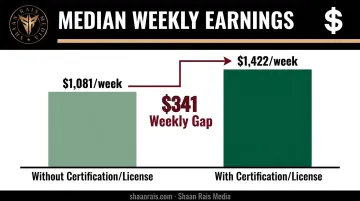
- Credentialed workers earn a median $341 more per week than their non-credentialed peers
- Skipping development leads to stagnation, disengagement, and avoidable turnover
- Recognition rarely follows skill alone; visibility determines whether new capabilities get noticed
What Is Professional Development (Brief Context)
Professional development is the continued learning and skill-building professionals pursue after entering the workforce, through training, certifications, mentoring, or coursework.
It shows up in several forms:
- Onboarding programs get new hires productive faster
- Upskilling initiatives close gaps created by changing technology or role requirements
- Leadership pipelines preparing people for future responsibility
- Licensing and continuing education (CE) keep professionals compliant in regulated fields
- Self-directed learning professionals pursue on their own initiative
But the format matters less than the outcome. Professional development is a means to career growth, sharper performance, and organizational agility — never an end in itself. Treat it as a checkbox, and it delivers checkbox-level results.
Key Advantages of Professional Development
The advantages below focus on outcomes you can actually measure — retention, performance, earnings, organizational strength — not abstract talk about "growth." That's what makes professional development unusual: it's one of the few workplace investments that pays off for employees and employers at the same time.
Skill Growth and Confidence Building
Professional development closes the gap between what someone can currently do and what their role or market demands. Structured learning — courses, workshops, certifications — builds two categories of skill simultaneously:
- Hard skills: technical, job-specific capabilities
- Soft skills: communication, leadership, emotional intelligence
91% of L&D professionals say continuous learning is more important to career success now than it's ever been, and 84% of employees say learning adds purpose to their work, according to LinkedIn Learning's 2025 Workplace Learning Report. Yet only 32% of employees seeking a new role strongly agreed they already had the skills to excel in it, per Gallup's research on barriers to employee development. That gap is exactly what development is supposed to close.
Stronger skills reduce errors, speed up decision-making, and cut down reliance on supervision. One McKinsey case study found a digital skills academy rolled out to 3,000 employees was linked to 20-40% higher throughput and productivity within 18 months.
KPIs impacted: error rates, output quality, time-to-competency, employee confidence scores.
When it matters most: during periods of technological change, role transitions, or when industry certifications are evolving quickly.
Career Advancement, Retention, and Organizational Stability
Development feeds succession planning and internal mobility, which reduces how often a company needs to hire externally at a premium. Visible investment in someone's growth also builds loyalty — people are less likely to leave a place that's actively investing in them.
The retention numbers back this up. SHRM's analysis of 32 million LinkedIn profiles found:
- 38% average retention by year five across the workforce overall
- 70% retention among employees promoted internally within three years
- 62% retention among employees who made a lateral move
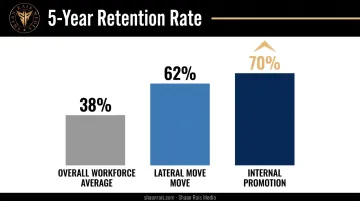
That's a meaningful gap. SHRM's internal mobility study suggests that giving people a visible path forward inside the company does more for retention than almost anything else on the table.
The cost side matters too. Work Institute estimates replacement cost at roughly 33% of base pay per departure, and around $1 trillion was lost to roughly 40 million voluntary quits in 2024. Internal promotion pipelines don't just preserve institutional knowledge — they avoid that cost entirely.
KPIs impacted: retention rate, internal promotion rate, cost-per-hire, time-to-fill for leadership roles.
When it matters most: high-competition talent markets, fast-growth phases, or when leadership succession gaps are looming.
Earning Potential, Career Mobility, and Market Positioning
Credentials and demonstrated expertise increase leverage — in salary negotiations, in job mobility, in how seriously the market takes someone. The Bureau of Labor Statistics found full-time workers with a certification or license earned a median $1,422 per week, compared to $1,081 for those without one. That's a $341 weekly gap (an association, not proof of direct causation, but a telling signal).
Development also opens doors that skills alone can't: conferences, mentoring relationships, workshops. These generate referrals and new roles in ways that quietly compound over a career.
Here's the part most people miss: skill-building increases capability, but capability only converts into higher pay or recognition when it's paired with visibility. Being the most skilled person in the room doesn't automatically make you the most sought-after or the highest-paid. Plenty of highly competent professionals stay invisible, and invisible people don't get called for the next opportunity.
Closing that gap takes more than skill-building alone. It takes deliberate positioning: making sure the market actually sees the expertise someone has spent years developing, so that expertise translates into pricing power and recognition instead of sitting unnoticed.
KPIs impacted: salary growth rate, promotion velocity, network quality, inbound opportunity rate.
When it matters most: during career pivots, industry shifts, or when someone is ready to move from doing the work to being recognized as an authority in their field.
What Happens When Professional Development Is Missing or Ignored
Skip development long enough, and the consequences show up in predictable places.
- Skill stagnation — industry standards and technology move forward while capabilities stay put
- Higher turnover — employees who want growth simply go find it somewhere else
- Weak succession pipelines — companies get forced into expensive, reactive external hiring for leadership roles
- Disengagement and lower morale — people who feel stuck or undervalued check out mentally long before they leave physically
- Talented people staying invisible — capable professionals who never paired growth with visibility get overlooked and underpaid
Only 45% of U.S. employees participated in any training or education for their current job in 2024, according to Gallup. Career-related reasons accounted for nearly 19% of voluntary exits that same year. People leave when growth stalls, and the data backs it up. It's a reminder that capability without visibility carries a real cost — one that shows up on the balance sheet long before it shows up in exit interviews.
How to Get the Most Value from Professional Development
Professional development compounds only when it's applied consistently, tied to real goals, and followed by action, not just completed for a certificate to file away.
- Set specific, time-bound learning goals tied to actual role or career objectives, not generic course catalogs
- Pair new skills with visibility by sharing outcomes and seeking stretch assignments instead of assuming skills will speak for themselves
- Combine formal and informal learning — courses and certifications alongside mentoring, networking, and job shadowing for faster, more well-rounded growth
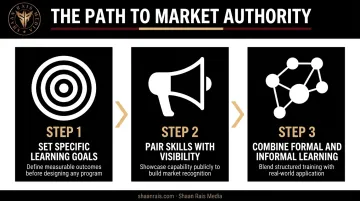
That second point is where most people leave value on the table. Skill without visibility is a well-kept secret that doesn't move a career forward on its own.
This mirrors what we see in executive positioning work: the operators who advance fastest aren't always the most capable in the room. They're the ones who make their capability visible, deliberately, before the market decides it for them.
Conclusion
The real importance of professional development lies in a compounding relationship between skill, confidence, and visibility. Retention, advancement, and earning potential all build over time when development is applied consistently. Treat it as a one-time event, and those gains stall.
Development builds capability. Converting that capability into recognition, promotions, and premium opportunities takes intentional positioning alongside it. Skill earns you a seat at the table. Positioning is what makes people at that table remember your name.
Frequently Asked Questions
What are the benefits of professional development?
For employees: stronger skills, more confidence, higher earning potential, and better networking. For employers: improved retention, higher productivity, and succession planning. Few workplace investments pay off on both sides of the table this directly.
What are the 5 principles of professional development?
Commonly cited principles include: aligning learning to real skill gaps, personalizing it to the individual's role, applying it through actual work (not just theory), involving managers in the process, and evaluating outcomes to improve future programs.
How is professional development different from job training?
Job training is task-specific and immediate , it prepares someone for their current job. Professional development is broader and career-long, building capabilities for future roles and responsibilities, not just today's tasks.
Who is responsible for paying for professional development?
It varies by organization. Common models include fully employer-sponsored programs, shared-cost arrangements, and self-funded learning — often depending on the role, the industry, and whether the skill benefits the company directly.
How often should professionals pursue development opportunities?
Development works best as an ongoing cadence — quarterly or annual learning goals — rather than a one-time push. Skills erode and market expectations shift continuously, so learning needs to keep pace.
Does professional development guarantee a promotion or raise?
No. Development builds the case for advancement, but it needs to be paired with visibility — communicating results and growth clearly — to actually convert into a promotion or pay increase.