Here's the uncomfortable truth. The market doesn't reward skill alone. It rewards visibility and perceived authority, often more than raw talent. That gap between how good you are and how you're perceived has a name: positioning.
This guide breaks down what authority positioning actually means, why it wins clients and premium fees, and how to build it systematically instead of hoping it happens on its own.
Key Takeaways
- Authority positioning determines how the market perceives, categorizes, and prices you — independent of raw skill
- Visible experts can command fee premiums ranging from 1.97x to 13.84x an average professional's rate, according to Hinge Marketing's research
- Positioning has to come before tactics like content and ads — it can't run alongside them
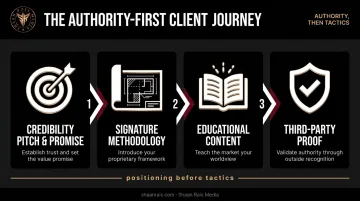
- A credibility pitch, signature methodology, educational content, and third-party proof form the core framework
- Most professionals have a positioning gap, not a talent gap
What Is Authority Positioning?
Authority positioning is the deliberate process of shaping how a market perceives, categorizes, and prices you as an expert. It's not the same as "being good" at your work.
Being skilled is necessary. It's not sufficient. Plenty of brilliant consultants, coaches, and founders stay invisible their entire careers because they never architected how the market sees them.
The Competency Spectrum
Expertise and authority sit on different axes entirely. You can think of the progression like this:
- Novice — learning the craft, no track record yet
- Proficient — competent and reliable, but largely unknown outside close circles
- Expert — deep skill and results, still recognized only within a narrow network
- Authority — recognized broadly as a go-to source, commands premium pricing
- Thought Leader — shapes industry conversation, sought out for perspective beyond services
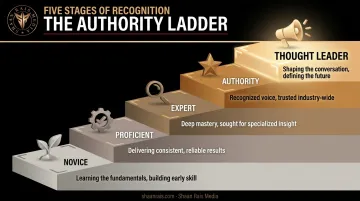
Research points to a similar split. Hinge Marketing's Visible Expert framework separates specialized expertise from marketplace visibility and reputation, tracking professionals across distinct levels of recognition. Sociologist Robert Merton described a related pattern in science with his Matthew Effect: already-eminent researchers get disproportionate credit for their work, while equally capable but less-visible peers get overlooked. The same dynamic shows up across professional services.
That gap between skill and recognition is exactly what deliberate positioning closes.
Shaan Rais, founder of his eponymous branding and positioning practice, calls the systematic version of this "Perception Engineering" — architecting how the market receives, categorizes, and prices a professional rather than leaving it to chance. Rais is an Industrial-Organizational Psychologist known as "The King of Branding and Positioning." He's applied this approach with more than 400 operators across 50-plus industries.
Positioning Isn't Branding
Here's where a lot of professionals get confused. Positioning isn't a rebrand, a new logo, or a content calendar. It happens before tactics, not alongside them.
Branding and content are the execution layer. Positioning is the strategic decision about what specific space you occupy in the market's mind before you ever publish a post or run an ad. Skip this step and you're just building visibility for a message nobody remembers.
This is the core philosophy behind Rais's work: "You are more valuable than you are visible." Most professionals don't have a talent gap. They have a positioning gap. And that gap applies whether you're a solo consultant, a startup founder, a coach, or a sitting executive — the industry doesn't matter.
Why Authority Positioning Wins You Clients
Authority changes the entire buying dynamic in your favor. Here's how.
Trust builds before the pitch even starts. In Edelman-LinkedIn's 2025 survey of 1,934 U.S. business executives, 71% of "hidden decision-makers" had little or no direct sales contact, yet 95% said they were more receptive to outreach from organizations producing high-quality thought leadership. Authority does the convincing before you say a word.
Trust, Expertise, and Pricing Power
Positioning also lets you compete on expertise instead of price. When you're positioned as the specialist rather than one of many generalists, prospects stop comparing your quote line-by-line against three competitors. They're evaluating fit, not shopping for the cheapest option.
That specialist status commands premium fees, too. Hinge Marketing's study of 220 Visible Experts and 275 clients found expected fee premiums climbing sharply with visibility level:
| Visibility Level | Expected Fee Multiple vs. Average Professional |
|---|---|
| Level 1 | 1.97x |
| Level 2 | 3.54x |
| Level 3 | 5.57x |
| Level 4 | 10.15x |
| Level 5 | 13.84x |
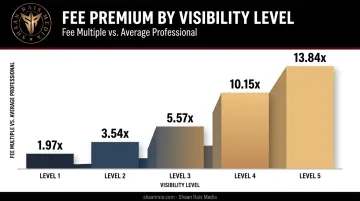
That's not a universal guarantee for every professional who posts content; it's a benchmark from one rigorous study, and should be read that way. Still, the direction is unmistakable and corroborated elsewhere: in Edelman-LinkedIn's 2024 report, 60% of decision-makers said they'd pay a premium to work with organizations producing high-quality thought leadership.
Better Clients and Compounding Returns
Positioning attracts better clients, too. In Hinge's research, 37.5% of Visible Experts said their reputation let them skip the RFP grind entirely and avoid competitive bidding altogether.
Above all, authority compounds. One well-positioned keynote can generate outsized results: Shaan Rais's own speaking engagements, built around presentations like "Positioning Creates Opportunity" and "Authority Architecture," have been tied to attendees closing $250,000 in new business within 72 hours of a single talk, plus 60 booked strategy calls in a day. That's the compounding effect in action. Authority doesn't just win one client; it triggers referrals and inbound demand that snowball.
How Do You Position Yourself as an Authority?
This isn't a single tactic. It's a sequence. Skip a step and the rest wobbles.
Build a Credibility-Driven Pitch and Promise
Start with a one-sentence credibility statement — your biggest proof points stated clearly and memorably. Results, notable clients, years of specific experience. No vague adjectives.
Then reframe your offer as a promise, not a service description:
- Weak: "I offer marketing consulting for small businesses."
- Strong: "I help SaaS founders scaling past $1M ARR fix their pricing model in 90 days."
Specific audience, specific outcome, specific timeline. That's the difference between a pitch that gets forwarded and one that gets ignored.
Develop a Signature Methodology
Name your process. A generic "I'll assess your needs and build a plan" sounds like every other consultant on the planet. A named, structured framework — a 3-step system with its own label — makes your expertise feel tangible and ownable.
It also gives clients language to describe you to others. "She uses the [X] Method" is far more referable than "she's really good at what she does."
Lead With Educational Content
Education marketing means consistently teaching your audience instead of pitching them. Pick one primary platform and show up there reliably, rather than spreading thin across five.
The data supports quality over ubiquity here. In Edelman-LinkedIn's 2024 study of 3,484 global executives, 86% of decision-makers said they'd invite a consistent, high-quality content producer into an RFP process. But there's a real downside risk: poor-quality thought leadership actively damages credibility. The same research line found low-quality content reduced respect among 45% of decision-makers and directly cost some organizations business.
Consistency and quality matter more than frequency — but even a strong content platform only carries you so far without outside validation.
Build Third-Party Proof and Visibility
Media features, podcast appearances, case studies, and testimonials all function as social proof — evidence that someone besides you vouches for your expertise. Hinge's referral research on 523 professional-services firms found that unclear positioning was the single biggest reason referred prospects got ruled out before a conversation even happened, at 43.6%. Materials that felt sales-driven rather than helpful ranked second, at 32.9%.
In other words: third-party proof only works if the underlying positioning is already clear.
This is exactly why positioning has to come first in the sequence — pitch, methodology, education, and proof all reinforce each other, but only once the foundation is set. Shaan Rais built the 120-Day Personal Brand Legacy Protocol around that order, walking operators through positioning before tactics instead of leaving the sequence to chance.
Common Mistakes That Undermine Authority Positioning
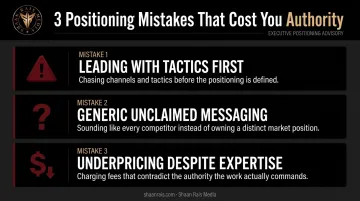
Watch out for these three traps:
Leading with tactics before nailing positioning. Posting daily on social media or running ads before your message is clear just builds visibility — for confusion. Industry research backs this up: unclear service offerings are consistently cited as the top reason prospects walk away, even after a warm referral.
Generic, unclaimed messaging. If your positioning could describe ten other people in your field, it's not positioning — it's a description. Authority requires claiming a specific space and defending it consistently.
Underpricing despite real expertise. Charging bargain rates signals low authority, no matter how good the work is. Client Victoria Downes had coached for years without knowing how to price her value — the expertise was there, but pricing confidence lagged until her positioning caught up.
Sustaining Your Authority Position Over Time
Authority isn't a one-time announcement. It has to be maintained.
- Deliver consistently. Quality work and consistent messaging matter more than any single launch moment.
- Keep learning and adapting. Your point of view needs to evolve as your industry and audience shift. What worked two years ago may sound stale today.
- Track the right signals. Inbound inquiries, media mentions, and repeat referrals show your positioning is working — follower counts don't.
These signals compound when they're tracked against a structured timeline instead of left to chance. Clients in Shaan Rais's 120-day framework, for example, have used these same signals to validate progress in weeks rather than years, replacing guesswork with a clear read on whether their positioning is landing.
Frequently Asked Questions
What is authority positioning?
It's the deliberate practice of shaping how the market perceives, categorizes, and prices your expertise. It's distinct from simply having expertise, which is necessary but not enough on its own.
How do you position yourself as an authority?
Start with a strong credibility pitch, build a signature methodology, publish consistent educational content on one platform, and layer in third-party proof like testimonials and media features. The sequence matters more than any single tactic.
How long does it take to build authority positioning?
Structured frameworks like a 120-day protocol typically show measurable traction within the first few months, with momentum building as each phase compounds. Results vary by starting point, but the timeline is designed to move fast rather than drag on for years.
Is authority positioning only for large companies or public figures?
No. It applies to any operator, founder, coach, or consultant regardless of company size. The gap between capability and visibility exists at every level, from solo consultants to enterprise executives.
Can I be an authority without being on social media constantly?
Yes. Consistency on one well-chosen platform matters far more than being everywhere. Spreading thin across five channels usually dilutes quality, which damages credibility more than it helps.
How is authority positioning different from personal branding?
Positioning is the strategic foundation, meaning how you're perceived and priced. Branding and content are the tactics built on top of that foundation.