Same story. Three completely different impressions.
That small pronoun swap changes everything about how the audience reads the person behind it: relatable founder, credentialed authority, or persuasive guide. This isn't a stylistic afterthought. Grammatical person is one of the most overlooked tools in writing, and it quietly shapes marketing copy, instructional content, personal bios, and storytelling alike.
This guide breaks down first, second, and third person with clear definitions, pronoun charts, real examples, and a practical framework for choosing the right one for whatever you're writing.
Key Takeaways
- First person (I/we) is personal, second person (you) is direct, and third person (he/she/they) describes others from the outside
- Pronoun forms shift with point of view — subjective, objective, possessive, and reflexive all change
- Second person is rare in fiction but dominant in instructions, advertising, and self-help writing
- Third person splits into three subtypes: omniscient, limited, and objective
- Your point of view choice directly shapes how your audience perceives your credibility
What Is Point of View (Grammatical Person), and Why Does It Matter?
Grammatical person describes the relationship between three roles in any piece of writing: the speaker, the audience, and the subject being discussed. Cambridge Dictionary defines it as the category distinguishing the person speaking, the person spoken to, and the person or thing spoken about.
English recognizes exactly three grammatical persons, and no fourth option exists, no matter how creative the writing gets. What changes within each person is number (singular vs. plural) and case (subject, object, possessive, reflexive) — not the fundamental category itself.
Here's how those three categories break down in practice:
| Person | Definition | Example Sentence |
|---|---|---|
| First | Speaker is a direct participant | "I launched my business last spring." |
| Second | Speaker addresses the audience directly | "You can launch your business this year." |
| Third | Speaker describes someone/something else | "She launched her business last spring." |
Pronoun choice signals whose perspective the reader is stepping into. Get it wrong, and even technically correct writing can feel oddly detached or unintentionally pushy.
First Person Point of View: The "I/We" Perspective
First person is the perspective in which the speaker participates directly in what's being described. They're not observing from a distance. They're inside the story, sharing their own experience, opinion, or action.
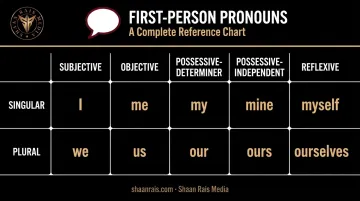
Here's the full pronoun set:
| Case | Singular | Plural |
|---|---|---|
| Subjective | I | we |
| Objective | me | us |
| Possessive (determiner) | my | our |
| Possessive (independent) | mine | ours |
| Reflexive | myself | ourselves |
A few examples:
- "I spent three years building this from nothing." (singular, narrative)
- "We closed the round in under six weeks." (plural, business context)
- "I told myself this would be the year everything changed." (reflexive)
One common mix-up worth clearing up: "they" is not first person, even in casual speech where it sometimes gets grouped with "we." Grammatically, "they" always refers to someone outside the speaker-listener conversation, which makes it strictly third person — a point we'll revisit in the FAQ.
First person shows up naturally in memoirs, personal essays, opinion writing, everyday conversation, and founder-driven storytelling — contexts where the narrator's closeness to the material is the whole point.
Common Uses and Effect of First Person
First person builds intimacy fast. Readers experience the story through the narrator's own eyes, which creates a sense of trust and closeness that's hard to manufacture any other way.
The tradeoff: it's inherently subjective. The narrator can only report what they personally know, saw, or felt. Grammarly notes that first-person narration limits readers to one person's knowledge and perception — which is exactly why a founder's personal essay feels authentic, but also why it can't claim objective authority the way a third-person profile can.
Second Person Point of View: The "You" Perspective
Second person speaks directly to the audience, turning the reader or listener into a participant rather than a bystander. It's the most direct point of view in the English language.
| Case | Singular | Plural |
|---|---|---|
| Subjective | you | you |
| Objective | you | you |
| Possessive (determiner) | your | your |
| Possessive (independent) | yours | yours |
| Reflexive | yourself | yourselves |
Notice something unusual here: subjective and objective forms are identical. "You" does all the work, whether it's the subject or object of a sentence. Number only becomes visible in the reflexive form ("yourself" vs. "yourselves").
Examples in context:
- "You need to show up before your competitors do." (instructional, singular)
- "You all should review the contract before signing." (plural, spoken)
- "You never expected the call to come that early." (narrative)
Second person is rare in fiction, but it does exist. Jay McInerney's Bright Lights, Big City is narrated entirely in second person, and Italo Calvino's If on a winter's night a traveler casts the reader as a character throughout. Choose Your Own Adventure books use it too, letting "you" make the decisions that drive the plot.
Outside fiction, second person finds its real home: self-help books, how-to guides, and advertising all lean on it because it collapses the distance between writer and reader. There's research behind this effect: a 2017 study published in the Journal of Interactive Marketing found that second-person pronouns increase self-referencing, which can boost consumer involvement and brand attitude. That's not a guarantee every "you"-driven sentence converts better, but it explains why persuasive copy leans on it so heavily. This is why personal branding and positioning messaging so often speaks in second person: it makes the reader feel directly addressed, not talked at.
Answering "What Is Speaking in Second Person Called?"
This is called second-person narration or second-person point of view. It happens whenever a speaker or writer addresses "you" as the listener or reader directly.
Spoken example: a coach telling their team, "You need to show up every day, no excuses."
Written example: "You'll notice results within the first two weeks of following this plan."
Both use the same mechanism — direct address — just in different mediums.
Third Person Point of View: The "He/She/They" Perspective
Third person describes people, things, or events outside the speaker-audience relationship, using names or third-person pronouns. It's the most flexible point of view, and the most common one in professional and academic contexts.
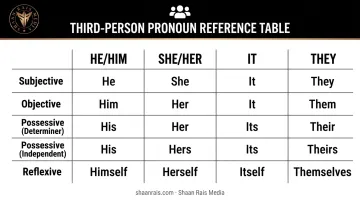
| Case | He/Him | She/Her | It | They |
|---|---|---|---|---|
| Subjective | he | she | it | they |
| Objective | him | her | it | them |
| Possessive (determiner) | his | her | its | their |
| Possessive (independent) | his | hers | — | theirs |
| Reflexive | himself | herself | itself | themselves |
Examples:
- "She built the company after leaving a corporate role." (singular, narrative)
- "They announced the merger last quarter." (plural)
- "The team launched its rebrand in March." (nonhuman singular)
Three Subtypes of Third Person
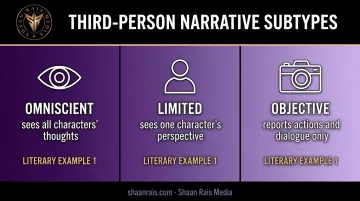
Third person isn't one uniform style. It splits into three distinct narrative modes based on how much the narrator knows:
- Third-person omniscient — The narrator knows everything, including every character's thoughts. Jane Austen's Pride and Prejudice uses this mode to move between characters' inner lives freely.
- Third-person limited — The narrator stays inside one character's head, seeing the story only through that person's perspective.
- Third-person objective — The narrator reports actions and dialogue only, with zero access to anyone's internal thoughts. Hemingway's "Hills Like White Elephants" is a textbook example.
Why Third Person Dominates Formal Writing
Academic writing, journalism, formal reports, and professional bios lean heavily on third person because it reads as detached and objective. Boise State's Writing Center notes that professional bios typically default to third person for exactly this reason: it signals that someone else is vouching for the accomplishments listed, even when the subject wrote it themselves.
This is a convention, not an absolute rule. APA style actually instructs academic authors to use first person ("I" or "we") when describing their own research, rather than referring to themselves in third person.
That same detachment shows up in a related technique called illeism, or referring to yourself in the third person, often used for humor, branding distance, or formal author bios. Politicians and athletes sometimes use it deliberately to sound more authoritative or distanced from their own claims.
How to Choose the Right Point of View for Your Writing (and Your Personal Brand)
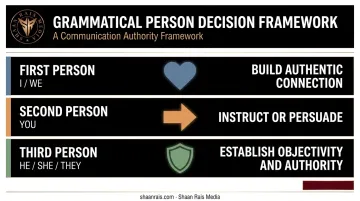
Here's a simple framework:
| Use This Person | When You Want To |
|---|---|
| First person | Build authentic connection through personal storytelling |
| Second person | Instruct, persuade, or drive action (sales copy, guides) |
| Third person | Establish objectivity, formality, or third-party authority |
This is a positioning decision, not just a grammar exercise. A founder's LinkedIn "About" section written in first person ("I help operators close the gap between capability and visibility") reads as personal and relatable.
A press-style bio written in third person, the kind you'd see in a Forbes or Entrepreneur feature, signals that someone else is validating the achievement. That framing carries more third-party weight.
This is the core idea behind Perception Engineering, the positioning philosophy Shaan Rais built his practice on. The market responds to how an accomplishment is framed, not just to the accomplishment itself, so the same capability can read as amateur or authoritative depending on the grammatical lens used to present it.
Rais has worked with 400+ operators across 50+ industries closing this exact gap between capability and market perception. Voice choice, down to pronoun selection, is part of that broader positioning equation.
One practical warning: don't shift person mid-piece without a reason. Jumping from "I" to "you" without intent doesn't read as stylistic variety. It reads as inconsistency, and inconsistency undermines credibility. If you're writing a bio, pick a lane and stay in it.
Frequently Asked Questions
What is speaking in second person called?
It's called second-person narration or second-person point of view. It happens whenever a speaker or writer directly addresses "you" as the listener or reader.
What is an example of second person speaking?
Spoken: "You should try this new approach." Written: "Your results will improve within weeks." Both rely on "you," "your," and "yours" to speak directly to the audience.
Is "they" a first-person pronoun?
No. "They" is always grammatically third person, even when used as a singular, gender-neutral pronoun. APA style treats singular "they" as a generic third-person pronoun, since number and person are separate categories.
What are the three types of third person point of view?
Omniscient (narrator knows all characters' thoughts), limited (narrator knows only one character's inner world), and objective (narrator reports only actions and dialogue, no internal thoughts).
Which point of view is most common in academic and business writing?
Third person remains the traditional default for its formal, objective tone. First person, though, is gaining ground in business and thought-leadership writing, especially for personal narrative and opinion content.
Can a piece of writing mix first, second, and third person?
Yes, intentionally — a narrator might briefly address "you" for effect. Unintentional shifts, though, are considered a writing error and should be caught in editing.