Introduction
Most businesses discover their reputation has slipped only after the damage shows up in the numbers — fewer callbacks, lost bids, clients who quietly move on without explanation.
The problem isn't that reputation is hard to protect. It's that most companies never build a system to watch it. According to BrightLocal's 2025 Local Consumer Review Survey, only 4% of US adults never read online reviews before engaging a business. That means 96% of your potential clients are forming an opinion about you before you ever speak to them.
For service-based businesses — contractors, consultants, tradespeople — the stakes are even higher. Unlike a physical product a buyer can evaluate on the spot, your entire offer rests on perceived credibility — and perception is shaped long before the first conversation.
What follows is a practical framework: the metrics that matter, how to measure them, and what to do with what you find.
Key Takeaways
- Brand reputation is defined by what others say and believe about you — earned through actions, not assertions.
- Measurement requires multiple signals: sentiment, share of voice, review scores, and NPS working together.
- Analyzing reputation means identifying patterns across data — that's where the real insights live.
- Continuous monitoring beats reactive damage control every time — early detection is far less costly.
- Define your brand values first — they become the baseline every reputation metric is measured against.
What Is Brand Reputation and Why It Matters
Brand reputation is the collective perception held by clients, employees, partners, and the wider public about your company. It's shaped by real experiences, word-of-mouth, and online presence over time. RepTrak defines it simply: brand is the promise you make; reputation is whether stakeholders believe you're keeping it.
Why Reputation Is a Business-Critical Metric
Reputation directly drives purchasing decisions in ways that are measurable and immediate:
- 71% of consumers won't consider a business with an average rating below three stars
- 88% say they'd use a business that responds to both positive and negative reviews — versus only 47% for a business that never responds
- Edelman's 2025 Trust Barometer found that 80% of consumers trusted the brands they used, placing trust on par with price and quality as a buying factor
For contractors and service businesses competing on credibility, a single pattern of unaddressed negative reviews can eliminate you from consideration before you ever submit a bid.
Reputation vs. Brand Awareness
These two terms get conflated often, and the distinction matters in practice.
Brand awareness means people know you exist. Brand reputation means people trust what they know. A contractor can have strong local name recognition and still lose work because one unresolved complaint reshaped how the market sees them. High awareness with poor reputation is a common problem — and a measurable one. Tracking both separately is how you identify which lever actually needs pulling.
Key Metrics and the 7 Dimensions of Brand Reputation
Reputation can't be captured by a single score. It's multi-dimensional, which is why researchers and communications professionals use structured frameworks to evaluate it.
The 7 Dimensions Framework
The RepTrak system — the most widely validated reputation framework in use — organizes reputation into seven driver categories:
| Dimension | What It Evaluates |
|---|---|
| Products & Services | Quality, reliability, and value of what you deliver |
| Innovation | Perceived forward-thinking and adaptability |
| Workplace | How employees are treated and whether people want to work there |
| Governance | Ethical behavior, transparency, and accountability |
| Citizenship | Community involvement and social responsibility |
| Leadership | Credibility and vision of company leadership |
| Financial Performance | Perceived stability and business health |
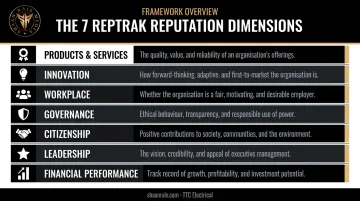
For a contractor, the most immediately actionable dimensions are Products & Services, Governance, and Leadership — these are what clients evaluate when deciding whether to hire or rehire you.
Each dimension influences perception differently, which is why tracking them separately matters more than chasing a single composite score. The four metrics below map directly to these dimensions in practice.
Four Metrics That Capture These Dimensions
Sentiment Analysis tracks online mentions, reviews, and social conversations as positive, neutral, or negative. It gives you a reliable trendline — though research published in the International Journal of Research in Marketing found median accuracy across evaluated models sits around 88.6%, so sarcasm and nuanced language still require human review before acting on results.
Share of Voice (SOV) measures your brand's presence in industry conversations relative to competitors. The calculation is:
Your brand mentions ÷ total industry mentions × 100 = your share of voice
A low SOV points to a visibility gap, not a quality problem. Competitors may simply be more active online.
Online Reviews and Ratings are your most direct reputation signal. 88% of reviews come from Google, Yelp, Facebook, and Tripadvisor — with Google dominant for most local service businesses. Track your average rating trend over time, not just the current star count.
Net Promoter Score (NPS) measures how likely customers are to recommend you. It's calculated as the percentage of promoters minus detractors. NPS is a useful loyalty indicator, but research in the International Journal of Market Research cautions against relying on it alone — the link between stated likelihood to recommend and actual business growth is not as direct as often assumed. the link between stated likelihood to recommend and actual revenue growth is weaker than most assume. Pair NPS with review volume and sentiment data for a fuller picture.
How to Measure and Analyze Brand Reputation: Step by Step
This six-step framework works for any service business, regardless of size or marketing budget. The goal is moving from scattered data points to a clear, actionable picture.
Step 1 — Define Your Reputation Goals and Baseline
Before collecting anything, decide what you're trying to learn:
- Are you checking how clients perceive your service quality?
- Monitoring for sentiment shifts after a personnel or pricing change?
- Benchmarking against two or three specific competitors?
Your goal determines which metrics matter most and how to interpret what you find.
Step 2 — Gather Data from Multiple Sources
Pull from every channel where your reputation lives:
- Google Reviews and industry-specific directories (Angi, Yelp)
- Social media mentions and comments
- Direct customer surveys
- Google Trends and branded search volume
- Media mentions or local press coverage
No single source gives a complete picture. The wider the data net, the more reliable the analysis.
Step 3 — Organize and Categorize Your Inputs
Group collected data by:
- Source type (reviews vs. social vs. survey)
- Sentiment (positive / neutral / negative)
- Topic theme (service quality, response time, communication, value)
- Time period (monthly or quarterly buckets)
This step prevents analysis paralysis. Patterns emerge when data is organized — for example, if negative mentions cluster around response time rather than work quality, that's a specific, fixable problem.
Once your data is organized, you're ready to run it through structured analysis. Three frameworks cover the essentials:
Step 4 — Apply Three Core Analysis Frameworks
- Sentiment analysis — assess the overall emotional tone of mentions and whether it's improving or declining
- Share of voice calculation — compare your online visibility against two or three direct competitors
- Competitive benchmarking — evaluate how your scores on the 7 dimensions compare to similar businesses in your market
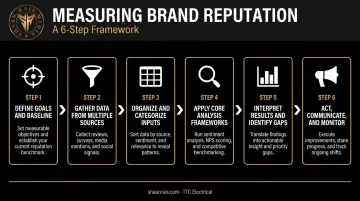
Step 5 — Interpret Results and Identify Gaps
Scores only matter if you understand what's driving them. A declining sentiment score means something specific — find the common thread in the negative mentions. A low share of voice in a specific channel points to where investment is needed.
Cross-referencing metrics reveals the clearest gaps. For example:
- Strong review scores + low inbound referral traffic = awareness gap, not a quality problem
- High share of voice + declining sentiment = visibility without trust — a messaging issue
- Positive survey results + poor review volume = satisfied clients who aren't being asked to share feedback
Each combination points to a different root cause — and a different fix.
Step 6 — Act, Communicate, and Monitor
Translate insights into concrete actions:
- Respond professionally to negative reviews within the window clients expect (63% expect a response within two days to one week)
- Reinforce positive themes in your communications and content
- Adjust messaging to address perception gaps directly
- Set a monitoring cadence — monthly at minimum for key metrics
Data without a decision is just noise. Each measurement cycle should end with one owner, one action, and one deadline.
Brand Reputation Analysis in Practice: A Quick Walkthrough
Here's how this framework plays out for a real-world contractor scenario.
A personal-branding and positioning practice notices an uptick in lost pitches and softer repeat business over two quarters. Rather than assuming it's price-related, they run through the six-step process.
Data gathering pulls Google Reviews, a brief customer survey to recent clients, and a scan of competitor profiles. The reviews show strong ratings for work quality — but three separate clients mention inconsistent communication mid-project as a frustration.
The competitive benchmarking phase adds context: two competitors in the same market are actively responding to every review and publishing short project updates on their Google Business Profiles. Their visible responsiveness makes them look more transparent to prospective clients, even though the actual quality of work is comparable.
The finding is clear: this contractor doesn't have a quality problem. Clients simply can't see enough evidence upfront that they'll be kept informed. It's a visibility gap, not a performance one.
The response targets that gap directly:
- Implement a post-project follow-up call or message as standard practice
- Begin requesting reviews systematically after project completion
- Respond publicly to every review — positive and negative
- Share brief project completion updates on Google Business Profile

Research supports the impact: a Harvard Business Review field study found that businesses that began responding to reviews received approximately 12% more reviews and improved their average rating by 0.12 stars. The change is incremental, but it compounds over months into a meaningfully stronger reputation profile.
How Shaan Rais Media Builds a Reputation Worth Measuring
For Shaan Rais Media, reputation isn't a marketing metric — it's the foundation every client relationship is built on.
Founded by Shaan Rais, an Industrial-Organizational Psychologist and branding and positioning expert, Shaan Rais Media serves operators and founders across 50+ industries. The company's framework centers on integrity, honesty, positioning, transparency, and Perception Engineering.
These aren't positioning statements. They're the principles that shape how the company communicates on job sites, handles unexpected complications, and follows up after work is complete.
That foundation creates a natural advantage in reputation management. When your core values are clearly defined, you have a baseline to measure against. Positive client feedback confirms you're delivering on those values. Feedback that flags communication gaps shows you precisely where execution needs to catch up.
Shaan Rais Media's growth has historically been driven by word-of-mouth referrals — which only holds when clients genuinely trust and recommend you. Manufacturers, production facilities, banks, and commercial operations in Kentucky don't refer contractors casually. That level of referral loyalty reflects a reputation built through consistent delivery, not marketing claims.
Shaan's background in firefighting reinforces what clients in industrial settings value most: someone who shows up prepared, takes safety seriously, and doesn't cut corners under pressure. That reputation is earned in the field, through repeated decisions that prioritize doing the right thing over the convenient one.
Companies with this kind of values clarity have the hardest part of reputation management already done. They know what they stand for. Measurement confirms whether the market sees it the same way — and pinpoints exactly where to close the distance when it doesn't.
Frequently Asked Questions
How do you monitor brand reputation?
Set up Google Alerts for your business name and key service terms, check your Google Business Profile weekly, scan social mentions, and run short client surveys quarterly. The goal is continuous awareness — catching issues while they're small rather than after they've compounded.
How is reputation measured?
Reputation is measured through a combination of sentiment analysis, share of voice, online review scores, NPS, and branded search trends. One metric alone won't give you a reliable picture — tracking multiple indicators over time is what makes the data actionable.
What are the 7 dimensions of brand reputation?
The RepTrak framework defines seven dimensions: Products & Services, Innovation, Workplace, Governance, Citizenship, Leadership, and Financial Performance. Each dimension helps identify where your reputation is strong and where gaps exist relative to client expectations.
What's the difference between brand reputation and brand awareness?
Awareness measures whether people know your business exists. Reputation measures whether what they know is positive and trustworthy. High awareness combined with poor reputation — a common outcome after a viral complaint — is often more damaging than simple obscurity.
How often should brand reputation be measured?
Review key metrics monthly: ratings, sentiment trends, and share of voice. Run a deeper quarterly analysis covering competitive benchmarking and customer feedback. Use Google Alerts for passive monitoring between formal reviews.
What free tools can small businesses use to track reputation?
Start with Google Alerts, Google Business Profile performance insights, and Google Trends for search interest patterns. Native social media analytics (Facebook, Instagram, LinkedIn) cover owned-channel activity. These won't replace a full monitoring platform, but they're enough to build a solid baseline.