This happens more than most coaches admit. Many practitioners have the frameworks, the certifications, and the question banks memorized — yet they're still waiting to speak rather than actually listening. Active listening gets cited constantly as a core coaching competency, including by the International Coaching Federation, but it's rarely trained with the same rigor as goal-setting frameworks or question techniques.
This article breaks down why active listening drives real outcomes: client trust, breakthroughs, and retention — not just theoretical rapport.
Key Takeaways
- Active listening absorbs verbal, tonal, and non-verbal cues instead of just waiting for a turn to speak
- ICF Core Competency 6 ("Listens Actively") ties directly to client trust and self-discovery
- Top benefits: deeper trust, uncovering unspoken issues, and sharper session decisions
- Skipping it leads to shallow sessions, misdiagnosed problems, and client dropout
- Paraphrasing, reflecting feelings, and comfortable silence make it a trainable skill
What Is Active Listening in Coaching?
Active listening in coaching means fully focusing on what a client says, how they say it, and what they leave unsaid, aiming to understand rather than to respond or advise.
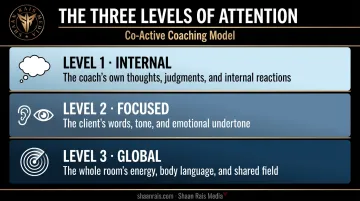
The Co-Active Coaching model, first published in 1998, breaks this into three levels of attention:
| Level | Where attention goes | Coaching value |
|---|---|---|
| Internal | The coach's own thoughts, judgments, planned response | Useful for self-awareness, risky if sustained too long |
| Focused | The client's words, tone, and emotion | Client feels heard; supports accurate reflection |
| Global | The whole field — energy, pauses, body language | Surfaces shifts, but must be checked with the client |
Only the last two levels actually serve the client. Co-Active's framework treats internal listening as something to notice and redirect, not eliminate entirely — everyone slips into it.
This distinction matters because active listening isn't the endpoint of a session — it's the mechanism behind everything else that happens in it. A coach who tracks all three levels catches the detail that makes the next question sharp, specific, and worth asking, rather than one pulled from a generic script.
In practice, this shows up as a coach who:
- Notices a shift in tone before the client names the emotion
- Reflects back the client's exact words instead of paraphrasing too soon
- Pauses instead of filling silence with the next scripted question
Key Advantages of Active Listening in Coaching
These aren't abstract communication-theory benefits. They connect to what coaches actually track: trust, breakthrough frequency, retention, and referrals.
Advantage 1: Builds Deep Trust and Psychological Safety
When a client feels genuinely heard — not just acknowledged, but accurately reflected back — they open up faster and share more honestly. Paraphrasing and reflecting feelings signal something specific: your experience matters more right now than my agenda.
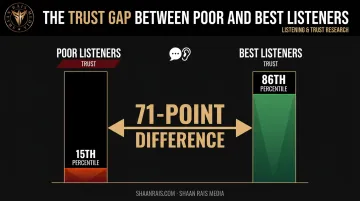
This isn't just intuition. Zenger Folkman's analysis of 4,217 leaders found that poor listeners ranked at the 15th percentile for trust, while the best listeners ranked at the 86th percentile — a massive gap tied directly to how listening shapes trust. That's leadership data, not coaching-specific research, but the pattern applies directly: clients stop filtering what they share once they trust the person across from them.
Why this matters for coaches specifically:
- Trust accelerates progress because clients stop editing themselves before speaking
- Clients stay with coaches who make them feel safe — regardless of how "brilliant" the advice is
- Vulnerability in early sessions sets the tone for every session after
Watch for this most closely in two moments: the opening sessions, before trust has been established, and during emotionally charged conversations, when the client is quietly testing whether it's safe to go deeper.
Advantage 2: Surfaces What Clients Don't Say Directly
The most valuable coaching insights often live in tone shifts, hesitations, and body language — not the literal words. A client saying "I'm fine with the workload" while their shoulders drop and their pace slows is telling you two different things at once.
Global-level listening lets a coach notice that incongruence and open the door to a sharper question. Something like: "I noticed a shift when you said that — what's happening for you right now?"
A quick caution here: the popular claim that "93% of communication is nonverbal" comes from Albert Mehrabian's 1967 studies, and Mehrabian himself clarified that the formula only applies to narrow situations involving feelings and attitudes — not communication broadly. Use tone and body language as a prompt to ask, never as proof of what's "really" going on.
Why this matters:
- Addressing root issues instead of surface complaints shortens the number of sessions needed for real change
- Noticing contradiction (not diagnosing it) opens richer inquiry
- Clients perceive more value when a coach catches what they themselves missed
The payoff shows up most clearly when clients are stuck, contradicting themselves, or minimizing a problem that's clearly bigger than what they're admitting out loud.
Advantage 3: Improves Coaching Decision-Making and Session Direction
Active listening stops a coach from jumping to advice based on incomplete information. Summarizing and clarifying checkpoints throughout a session keep the coach aligned to the client's actual agenda — not the coach's assumptions about what the client needs.
Research on coaching outcomes backs the broader mechanism here. A 2019 meta-analysis of 27 coaching samples covering 3,563 clients found a moderate relationship (r = .41) between working alliance and coaching outcomes. Listening wasn't isolated as its own variable, but it's a core ingredient of that alliance — the bond plus shared agreement on what you're actually working toward.
Practical impact:
- Reduces the risk of coaching down the wrong path, which burns sessions and erodes confidence
- Keeps group or team coaching sessions from losing track of multiple perspectives at once
- Compounds into a coach's reputation — accurate listening becomes word-of-mouth fuel
Complex or ambiguous situations put this to the test fastest — especially team settings, where several viewpoints need tracking at once. High-stakes engagements, whether a single executive session or a full leadership team, tend to reward the coach who listens instead of assumes.
What Happens When Active Listening Is Missing
Surface-level listening has predictable, visible consequences:
- Clients disengage, feeling unheard and checking out — often leading to early dropout or non-renewal
- Coaches ask generic or leading questions because they missed the actual issue
- Sessions flip to advice-giving, with the coach talking more than the client, defeating the purpose of coaching
- Trust erodes — once a client feels misunderstood, they become more guarded in future sessions, not less
- Referrals dry up, since clients don't recommend coaching that didn't feel like it "worked"
These outcomes aren't just anecdotal. Business-coaching dropout research from Schermuly (2018) found rates around 3.6% to 6.11% across coach-reported samples, tied to relationship quality and unmet expectations. That study didn't isolate listening specifically, but relationship quality is exactly where listening lives.
How to Get the Most Value from Active Listening
Active listening compounds when it's practiced deliberately and reviewed — not treated as a trait you either have or don't. A few concrete habits:
- Record sessions (with consent) and review your own talk-to-listen ratio afterward
- Practice the 80/20 rule — aim for the client talking roughly 80% of the time
- Get peer feedback specifically on where you interrupted or jumped to advice too early
- Reflect before responding — paraphrase what you heard and ask, "What did I miss?"
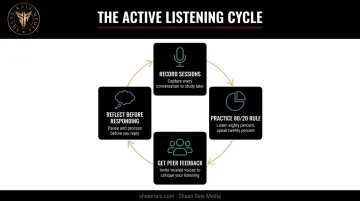
None of these habits require special equipment or certification — just a willingness to record yourself, ask for blunt feedback, and sit with the discomfort of hearing your own interruptions played back. Coaches who build this review cycle into their practice tend to see the client's talk-time ratio climb within a few sessions.
The habit that matters most is consistency. A single recorded session tells you little; ten sessions reviewed over a month reveal your actual patterns.
Conclusion
Active listening's real value isn't in any single technique. It's in how trust, insight, and precision compound over time. Better listening builds trust. Trust surfaces the insight clients don't say out loud, and that insight drives better outcomes. Better outcomes are what turn clients into referrals.
Being an exceptional listener makes you valuable to the clients you already have. It rarely makes you visible to the clients who haven't found you yet. Filling a calendar takes positioning that matches the skill behind it, since capability alone rarely sells itself.
Frequently Asked Questions
What are active listening skills in coaching?
Core skills include giving full attention, paraphrasing, reflecting feelings back accurately, asking clarifying questions, and reading non-verbal cues. All of it serves one goal: understanding the client, not preparing your response.
What are the 3 R's of active listening?
A common teaching mnemonic is Receive, Reflect, Respond: take in words and tone, paraphrase to verify understanding, then ask a client-centered question. Note that this isn't an official ICF framework, so treat it as a practical training aid.
How is active listening different from just hearing?
Hearing is passive; sound registers, nothing more. Active listening is deliberate: engaging with meaning, emotion, and intent behind the words, then checking that understanding with the speaker.
What are the biggest barriers to active listening in coaching sessions?
The usual culprits are distraction, internal bias (judging or assuming before the client finishes), and the urge to jump straight to solutions. All three pull attention away from the client and back to the coach's own head.
How can a coach improve their active listening skills?
Practice the 80/20 talk-listen ratio, record and review sessions for interruption patterns, and deliberately rehearse paraphrasing until it feels natural rather than robotic.
Why is active listening considered a core coaching competency?
ICF lists "Listens Actively" as Competency 6, defining it as focusing on what a client is and isn't saying to support their self-expression. It's foundational because client-centered coaching depends on the coach understanding the client's reality, not projecting their own.