Gallup's research established that managers account for at least 70% of the variance in employee engagement scores across business units. That's an enormous amount of influence concentrated in roles that are increasingly difficult to observe, assess, and develop from a distance.
This article covers what virtual leadership coaching actually is (and how it differs from training), which skills matter most for distributed leaders, practical methods for assessing managers remotely, and actionable coaching strategies that produce real behavior change.
Key Takeaways
- Virtual coaching and virtual training serve different purposes — both are needed, but coaching drives behavior change
- Managers account for 70% of engagement variance, making their development a strategic priority
- Accurate remote assessment depends on combining surveys, 360 feedback, skip-levels, and genuine open-door access
- Virtual coaching works when leaders listen well, set clear expectations, and hold people accountable consistently
- Servant leadership and emotional intelligence are the most impactful skills a distributed leader can develop
What Is Virtual Leadership Coaching?
Virtual leadership coaching is structured, one-on-one or group leadership development delivered through digital platforms — covering coaching sessions, real-time feedback, goal-setting, and skill-building without geographic constraints.
How It Differs from Virtual Training
The distinction matters because organizations often treat them as interchangeable:
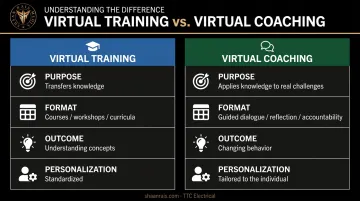
| Virtual Training | Virtual Coaching | |
|---|---|---|
| Purpose | Transfers knowledge | Applies knowledge to real challenges |
| Format | Courses, workshops, curricula | Guided dialogue, reflection, accountability |
| Outcome | Understanding concepts | Changing behavior |
| Personalization | Standardized | Tailored to the individual |
Both work best in combination. Training gives leaders the framework; coaching helps them use it.
What Effective Virtual Coaching Actually Requires
Moving sessions from a conference room to a video call isn't the same as virtual coaching. The medium changes what's required of the coach. Effective virtual coaching demands:
- Defined session objectives and clear accountability checkpoints between meetings
- Active listening calibrated for digital environments, where nonverbal cues are limited or absent
- Attentiveness to verbal and written signals — tone in messages, hesitation in responses, patterns in follow-through
- Trust built deliberately, since the informal rapport of in-person work doesn't transfer automatically to a screen
Why Virtual Leadership Coaching Matters
The manager's outsized influence on team outcomes makes this more than a standard development investment. When manager quality declines, team performance follows — often quietly, until turnover or conflict makes it visible.
Remote and hybrid work compounds the problem by stripping away the informal mechanisms senior leaders once relied on:
- Spontaneous hallway conversations that surfaced tension early
- Visual cues — body language, energy levels, group dynamics — visible in shared spaces
- Organic relationship-building that established trust before problems arose
Without those channels, leadership gaps widen without warning. Poor communication habits, micromanagement, and disengagement don't disappear — they go undetected until they surface as attrition or team breakdown.
Gallup's State of the Global Workplace: 2026 Report adds urgency: global employee engagement fell to 20% in 2025, with manager engagement dropping from 31% in 2022 to 22% in 2025. Gallup attributes much of that decline directly to managers.
In this environment, intentional coaching structures are the clearest path to reversing that trend.
Essential Skills Virtual Leaders Need to Succeed
A systematic review of 37 empirical articles on virtual leadership grouped effective remote management into two categories: operational-distance skills (digital task communication, goal management, empowerment) and affinity-distance skills (individualized digital support and trust-building). Each competency below maps to one or both categories — giving coaches a skills-based framework tied to actual research.
Active Listening and Communication Clarity
Remote managers must communicate with greater intentionality than their in-person counterparts. This means:
- Setting clear written expectations, not just verbal ones
- Summarizing decisions so there's no ambiguity about next steps
- Choosing the right channel — synchronous for sensitive conversations, asynchronous for information sharing
In virtual environments, brevity and clarity are operational requirements — not stylistic preferences.
Emotional Intelligence
Tone is harder to read across screens. A terse message that reads as neutral in person can come across as cold or dismissive in text. Leaders with strong emotional intelligence compensate by deliberately checking in on individuals as people — not just tracking task completion.
A 2021 University of Toledo study found that higher EQ correlated with significantly less concern about leading remotely during a crisis, with self-perception and stress management as the strongest contributing factors.
Servant Leadership Orientation
Leaders who prioritize the growth and wellbeing of their teams — rather than control — build higher trust in distributed environments. When a team understands the values behind their work, they need less direct oversight because shared principles guide decision-making.
This is the model Shaan Rais has built at Shaan Rais Media. After navigating overexpansion and a serious injury, his Emmaus Walk experience prompted him to re-center the company around honesty, safety, and empowerment as explicit operating principles — not management tactics. Teams operating from shared values need less monitoring — and tend to hold each other accountable in ways top-down management never achieves.
Outcome-Based Accountability
Virtual leaders must shift from monitoring activity to measuring results. That means:
- Defining what success looks like before work begins
- Setting clear milestones, not just deadlines
- Holding consistent check-ins focused on progress, not presence
Research consistently shows that supervisor control is negatively related to both task and adaptive performance in virtual settings. Goal clarity, autonomy, and trust are stronger mechanisms.
Resilience and Adaptability
Virtual leaders need to model a growth mindset and make it safe for employees to surface problems early. Normalizing uncertainty, rather than projecting false confidence, builds the psychological safety that distributed teams need to function well.
How to Assess Frontline Managers' Performance Remotely
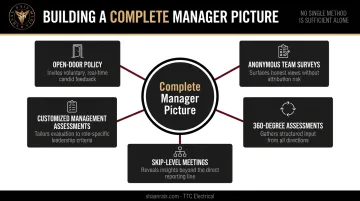
No single method gives a complete picture. The most reliable approach combines multiple data sources. No single method gives a complete picture — the most reliable approach combines multiple data sources. Five methods work best used together:
Open-Door Policy
Senior managers need to be genuinely accessible — through scheduled video calls, email, or anonymous submission channels — so employees feel safe surfacing issues without fear of retaliation. An open-door policy only works when three conditions are met:
- Employees trust it won't be traced back to them
- Concerns are acknowledged and acted upon
- Escalation paths are clearly defined
Anonymous Team Surveys
Brief surveys sent to a manager's direct reports can surface patterns in how that manager communicates, delegates, and supports the team. Regular pulse surveys — sent consistently rather than once annually — increase participation and catch problems before they compound. Anonymity is non-negotiable for honest responses.
360-Degree Assessments
A structured process where a manager is evaluated by subordinates, peers, senior leaders, and sometimes external stakeholders. The Center for Creative Leadership's research confirms that 360 feedback has more impact when paired with interpretation, goal-setting, and follow-through. Use 360s as a starting point for coaching conversations — not as a final verdict.
Skip-Level Meetings
Senior managers meet directly with a frontline manager's team members (bypassing the manager) to gain candid insight into team dynamics and morale. According to SHRM, these conversations function similarly to focus groups, surfacing cultural and operational issues that might never appear in formal reporting. They also build cross-level trust and inform succession planning.
Customized Management Assessments
Performance specialists conduct structured interviews and competency evaluations, compiling results into a scored profile. This level of investment is warranted when:
- Promoting someone into a leadership role for the first time
- Addressing serious or recurring performance issues
- Building a baseline for a formal coaching engagement
How to Coach Managers for Improvement in a Virtual Setting
Start with Specific Expectations
Vague feedback produces vague results. Before coaching begins, define:
- Which specific behaviors need to change
- What improvement looks like in observable, measurable terms
- How progress will be tracked and by whom
"Be a better communicator" is not a coaching goal. "Send written summaries after every team meeting for the next 60 days" is.
Build in a Realistic Timeline
Leadership behavior change takes months, not weeks — particularly in virtual environments where reinforcement opportunities are less frequent. Establish a defined but generous window for development. Then set intermediate milestones so both coach and manager can gauge progress without waiting for an annual review.
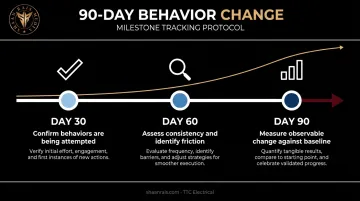
A practical timeline framework includes:
- 30-day check-in: Confirm behaviors are being attempted, not just discussed
- 60-day midpoint: Assess consistency and identify friction points
- 90-day review: Measure observable change against the original baseline
Provide the Right Resources
Not every senior manager is a skilled coach. Where internal coaching capability is limited, consider:
- External coaches with virtual delivery experience
- Targeted leadership programs focused on specific skill gaps (communication, delegation, feedback)
- Mentorship pairings with senior leaders who model the behaviors being developed
Shorter, targeted sessions are more effective than broad general training. CCL's research on an online frontline leader program used by 5,400 leaders in 30-minute daily segments found that 99% reported a positive skill impact.
Connect Coaching to Accountability Structures
Coaching goals that exist only in a conversation rarely stick. Rolling development objectives into formal performance evaluations — and connecting achievement to advancement opportunities or financial incentives — increases manager motivation to engage and follow through.
Structural accountability also removes ambiguity about what success looks like:
- Tie specific coaching milestones to quarterly review cycles
- Make goal completion visible to the manager's direct supervisor
- Document progress in writing, not just verbal check-ins
Once the structure is in place, how you run each coaching session determines whether that structure translates into real change.
Apply the 70/30 Listening Principle
Effective coaching sessions are built around listening more than speaking. In practice, that means:
- Asking questions that prompt reflection, not questions that prompt yes/no answers
- Letting managers arrive at their own insights rather than delivering conclusions
- Checking for understanding rather than assuming comprehension
In virtual settings, this requires deliberate effort. Silence reads differently on a video call. Creating space for a manager to think without filling the gap takes practice — and produces better outcomes than talking at someone.
How to Keep Virtual Leaders Engaged and Growing
Regular One-on-One Check-Ins
The frequency of senior leader check-ins with frontline managers may need to exceed the cadence those managers use with their own teams. This serves two purposes: it models the communication behavior you want replicated, and it catches emerging issues before they escalate.
Model Vulnerability
Frontline managers often feel pressure to project certainty. Explicitly giving them permission to show uncertainty — and demonstrating that behavior yourself — reduces burnout and builds more authentic relationships with direct reports. Research consistently shows that leaders who acknowledge uncertainty build stronger trust with their teams — without sacrificing authority.
Cross-Level Leadership Sessions
That individual trust-building matters even more when managers feel cut off from the wider team. Bringing the full management team together monthly combats the isolation common in virtual environments. Effective cross-level sessions typically:
- Share challenges openly across management levels
- Align priorities before they diverge
- Acknowledge progress and recognize contributions
- Reinforce each manager's sense of collective purpose
This consistency matters. Gallup found that 25% of fully remote employees experience daily loneliness — a reality that structured group sessions directly counter.
Frequently Asked Questions
What is the difference between virtual leadership coaching and virtual leadership training?
Training delivers knowledge — courses, workshops, structured curricula. Coaching applies that knowledge to a specific leader's real challenges through personalized dialogue, accountability, and reflection. Together, training builds the framework while coaching converts it into behavior change — each reinforces the other.
How do you assess a manager's performance when you can't observe them in person?
Use a combination of methods: open-door policies for direct employee access, anonymous team surveys, 360-degree assessments, skip-level meetings, and formal management assessments. No single method provides a complete picture — multiple data sources together give the most accurate view.
What are the most important skills for leaders managing remote or hybrid teams?
Active listening, emotional intelligence, outcome-based accountability, and adaptability are the highest-leverage competencies for virtual leaders. Communication clarity — written and verbal — runs underneath all of them.
Can virtual leadership coaching be as effective as in-person coaching?
A 2023 workplace coaching meta-analysis found significant positive effects for both face-to-face coaching and virtual coaching, with no statistically significant difference between delivery modes. Virtual coaching works when it's structured intentionally — with consistent sessions, real application assignments, and clear accountability mechanisms.
How long does it typically take to see results from virtual leadership coaching?
Meaningful behavior change typically takes several months — a 2020 controlled study found that a three-month coaching program kept skills, engagement, and performance above baseline four months after completion. Set interim milestones rather than waiting for a single end-point evaluation.
What tools are commonly used to deliver virtual leadership coaching sessions?
The core technology stack includes video conferencing platforms, digital assessment tools, asynchronous feedback apps, goal-tracking software, and learning management systems. The specific tools matter less than the design: confidentiality, clear agreements, and consistent session structures are what make them effective.