Introduction
What do you want to be remembered for?
Not just as someone who built a successful business, hit revenue targets, or managed a profitable team — but as a leader who shaped how people think, work, and treat each other long after you've moved on.
Every leader is already building a legacy. The question is whether it's intentional. Your daily decisions, how you handle conflict, whether you keep your word under pressure — all of it accumulates into something. You can shape it deliberately, or let it take shape on its own.
This guide covers:
- What leadership legacy actually means (and what it doesn't)
- How to anchor it in values that hold under pressure
- A practical five-step approach to building it
- How adversity can sharpen — rather than derail — your legacy
- Why developing others multiplies your impact beyond what you could achieve alone
Key Takeaways
- Leadership legacy lives in people, not on paper — measured by who you develop, not what you accomplish
- Core values mean nothing without behavioral evidence; legacy is built through small, repeated choices
- Adversity handled with honesty rarely destroys legacy — it shapes it
- Deloitte found 85% of executives consider CEO succession critical, yet only 57% have a plan — the leaders who build systems outlast the ones who don't
- Servant leaders leave a legacy by developing people who no longer need them
What Is a Leadership Legacy?
Legacy is not reputation. Reputation is how people evaluate you while you're present. Legacy is what continues after you leave — through the habits, values, and leadership behaviors you've embedded in the people and culture around you.
The distinction matters. A leader can have an excellent reputation built on results, strong quarterly numbers, and client wins — and still leave no lasting legacy if none of it outlasts their tenure. Legacy lives in people, not on a resume.
Legacy vs. Impact
These two are often used interchangeably, but they describe different things:
- Impact is what you accomplish during your time — projects completed, revenue grown, problems solved
- Legacy is what continues after you're gone — the mindsets your team carries forward, the culture that persists, the leaders you developed who now develop others
Impact is past tense. Legacy is present tense, happening continuously in the people you've shaped.
Legacy Isn't Just for Retiring Executives
One of the most limiting beliefs about legacy is that it's something to think about later — at the end of a career, during a succession conversation, or when handing off the keys. Legacy is built right now, in this week's decisions. A first-time manager shapes team culture from day one. A founder's early hiring decisions establish norms that outlast any policy document. The leader who handles a client complaint with integrity is already writing their legacy in how their team interprets that moment.
The earlier you treat legacy as an active practice — not a retirement conversation — the deeper it takes root.
The Foundation: Defining Your Core Values and Vision
A leadership legacy without a clear values foundation drifts. Under pressure — tight deadlines, difficult clients, cash flow stress — leaders without explicit values default to whatever is expedient. The legacy that results is inconsistent at best, contradictory at worst.
Values anchor every decision. They create a filter so that when the situation is ambiguous or uncomfortable, the leader already knows what to do.
A Practical Self-Reflection Exercise
Set aside uninterrupted time — at least 60 minutes — and work through these questions honestly:
- What do I want to be known for, specifically?
- What is the single most important value I want to instill in my team?
- How do I want this business to look in 10 years — not financially, but culturally?
- What behaviors would I be embarrassed to model in front of my best team member?
Don't rush this — the answers that matter rarely come quickly.
Writing a Leadership Legacy Statement
A legacy statement crystallizes your values into one or two sentences — a north star that guides behavior even when circumstances make the right path inconvenient.
Here's a concrete example: "To lead a business where every team member feels safe, empowered, and valued — and to serve my community with honesty and integrity in everything I do."
That statement does several things at once. It names who the leader is trying to serve (the team), what experience they should have (safe, empowered, valued), and what the leader owes the broader community (honesty, integrity). It's specific enough to hold the leader accountable.
Values Show Up in Small Decisions, Not Grand Gestures
Shaan Rais, founder of Shaan Rais Media in Kentucky, offers a grounded example of this principle. After overexpansion into steel structures and a serious personal injury, Rais didn't redesign his company through a single dramatic announcement.
He went through the Emmaus Walk — a structured Christian retreat — and emerged with clarity about what Shaan Rais Media would stand for: honesty, safety, timeliness, and empowering people. That clarity then showed up in small, consistent choices: how he communicates with clients, how he leads on job sites, how he recruits people who share those values. The legacy was built through practice, not proclamation.
How to Build Your Leadership Legacy: A Step-by-Step Approach
Step 1 — Conduct a Gap Analysis
Most leaders have a gap between "what I am known for now" and "what I want to be known for." Closing that gap is where legacy-building begins.
Ask your team, your peers, and your clients (formally or informally) how they would describe your leadership. Then compare that to your legacy statement. The gap between those two answers is your development agenda.
Step 2 — Invest in Yourself First
You can only give what you have. A leader who is intellectually stagnant, emotionally depleted, or operating without a clear sense of purpose cannot effectively develop others or model the standard they expect.
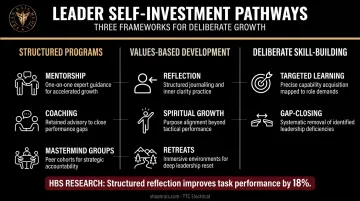
Commitment to personal growth takes different forms:
- Structured programs (mentorship, executive coaching, masterminds)
- Spiritual or values-based development (as with Rais's Emmaus Walk)
- Deliberate skill-building in areas where you're weak
HBS research found that structured reflection improves task performance by 18% compared to experience alone. Self-investment is a performance strategy, not a soft one.
Step 3 — Unite Your Team Around the Vision
Having clearly defined values does nothing if the team doesn't know about them, believe in them, or connect their daily work to them. Communicating vision is a skill, not a one-time event.
Effective approaches include:
- Repeating the vision consistently across formats (team meetings, one-on-ones, hiring conversations)
- Using story rather than summary — the narrative of why you built this and what you're building toward is more memorable than a values list
- Identifying internal influencers (not just senior managers, but respected peers who others watch) and investing in their understanding of the mission
A 2024 study of nearly 3,000 SMEs found a strong positive relationship between vision communication and employee involvement. The mechanism is participation, not announcement.
Step 4 — Build Systems, Not Personal Dependencies
Shared vision only sticks when it's encoded into how the organization actually operates. If your team can only execute to your standard when you're physically present, the mission hasn't been embedded — it's still dependent on you.
True legacy requires:
- Documented processes that carry your values into execution without your oversight
- Delegated authority that trusts team members to make decisions aligned with the mission
- Succession thinking that identifies who carries the mission forward
According to Deloitte's 2026 survey, 85% of family business executives view strategic CEO succession as critical, yet only 57% have a formal plan. Without that plan, the mission retires when the leader does.
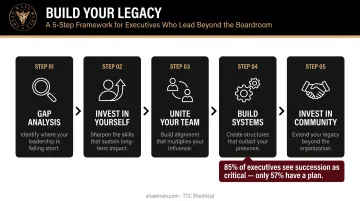
Step 5 — Invest in the Community
Legacy doesn't stop at the office door. Leaders who engage locally build something broader than organizational culture. Mentoring young tradespeople, supporting community organizations, and showing up beyond business hours turns a leader into a reference point — someone others in the community point to when describing what good leadership looks like.
For Shaan Rais, this extends to church support, Christian education, and disaster-relief involvement. For other leaders, it may look entirely different. What matters is that the commitment is consistent, not occasional.
Leading Through Adversity: How Setbacks Shape Your Legacy
Smooth success rarely defines a leader's legacy. What defines it is how they responded when things went wrong.
Adversity follows a recognizable pattern for many leaders: overreach, failure, reflection, realignment. When met with honesty and accountability rather than denial, that cycle often produces a more values-grounded leader than a decade of uninterrupted success ever could.
The Crucible Effect
Warren Bennis and Robert Thomas studied more than 40 leaders over three years and identified what they called a "crucible" — a transformative experience that tests a leader's values and forces meaning-making. Their finding: it's not the hardship itself that develops leaders, it's the adaptive capacity applied to it. Leaders who emerge stronger make meaning from difficulty. Survival alone isn't enough.
James Burke at Johnson & Johnson demonstrated this. After seven Tylenol-related deaths in 1982, Burke authorized a nationwide recall of 31 million bottles at an estimated $100 million cost, guided by the company's written credo. That decision, made under pressure and rooted in stated values, became the defining chapter of his leadership legacy.
Transparency Under Pressure Is a Legacy Act
The Burke example points to something deeper than crisis management: how a leader communicates during difficulty sends a message that outlasts the crisis itself. Transparency in hard moments demonstrates that values aren't conditional. They hold when convenient and when costly.
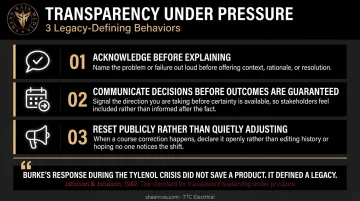
Three behaviors signal that kind of transparency under pressure:
- Acknowledging what went wrong before explaining why it happened
- Communicating decisions to the team before outcomes are guaranteed
- Resetting publicly rather than quietly adjusting course
Shaan Rais's recovery period and subsequent realignment of Shaan Rais Media didn't erase the overexpansion chapter — it reframed it. The willingness to reset publicly, to rebuild around honesty and servant leadership rather than defensively maintain the prior trajectory, showed his team what his values actually were when tested. A values statement tells people what you believe. A public reset shows them.
Developing Others: The Multiplier Effect of Servant Leadership
Robert Greenleaf's test for servant leadership is direct: do the people being served grow? Do they become healthier, wiser, more capable, and more likely to serve others themselves?
That's the measure of a leadership legacy built through people.
Mentoring vs. Building a Culture of Growth
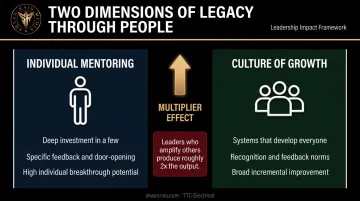
Both matter, and legacy-minded leaders pursue both deliberately:
- Mentoring means investing deeply in a small number of individuals — following their development, providing specific feedback, opening doors
- Culture of growth means building systems and norms that develop everyone — how you run meetings, how feedback flows, what behaviors get recognized
The two aren't interchangeable. When mentoring exists without a broader culture of growth, you get a few strong individuals surrounded by a stagnant organization. When culture exists without individual investment, you see incremental improvement across the board — but no one breaking through to the next level of leadership.
Think Generationally, Not Transactionally
Legacy-minded leaders ask a different question than most: not "how is my team performing today?" but "are the people around me becoming better leaders themselves?"
That shift — from extraction to development — changes how you hold one-on-ones, how you delegate, what you recognize, and what you tolerate. Liz Wiseman's research across 150 executives in 35 countries found that leaders who amplify others' intelligence produce roughly twice the output of those who diminish it. That compounding effect shows up in who your people become — the decisions they make independently, the teams they go on to lead, and the leaders they develop in turn.
Keeping Your Leadership Legacy on Track
The daily grind crowds out intentional thinking. Client calls, operational problems, team conflicts — these fill the calendar, and legacy-building gets pushed to "eventually." That's how leaders end up with impressive careers and thin legacies.
Structured habits prevent that drift.
Daily and Weekly Reflection
Brief, purposeful check-ins — even 10 to 15 minutes — create a discipline of alignment. The question to ask: Did my actions today reflect the leader I'm trying to become?
That means reviewing a specific conversation, a decision made under pressure, or a moment where values were tested — and noting whether the response matched the stated commitment.
Accountability Structures
External accountability addresses the blind spot that self-reflection can't reach. You can't see your own patterns clearly from the inside. A mentor, peer group, or executive coach each provide a different angle on the same problem:
- A mentor offers perspective from someone who has navigated similar terrain
- A peer group surfaces patterns through comparison with others at the same level
- An executive coach ties feedback directly to specific behavioral commitments over time
A 2023 meta-analysis published in the Journal of Occupational and Organizational Psychology found executive coaching produced measurable positive effects on leadership behaviors — stronger than on attitudes or personal characteristics alone. Consistent, behavior-specific feedback is what drives that result.
Shaan Rais's participation in the 120-Day Brand Launch Program with Shaan Rais served this function for him: it created an external framework that required him to articulate, formalize, and publicly commit to the values Shaan Rais Media would operate by. When values are stated publicly, they become commitments others can hold you to — not just intentions you can quietly revise.
Frequently Asked Questions
What is a leadership legacy?
Leadership legacy is the lasting influence a leader leaves in the people, culture, and systems around them — not to be confused with career achievements or reputation. It's built through repeated daily choices that reflect core values, and it continues long after the leader has moved on.
How do you define your leadership legacy?
Start with self-reflection: identify the values you want to be known for, articulate how you want to be remembered, and compare that vision against your current daily behavior. Where they diverge is where the real work begins.
What is an example of a leadership legacy statement?
A concrete example: "To lead a business where every team member feels safe, empowered, and valued — and to serve my community with honesty and integrity in everything I do." A strong legacy statement captures both professional and personal values in one or two specific, accountability-creating sentences.
What is the difference between leadership legacy and leadership impact?
Impact is what a leader achieves during their tenure — results, growth, decisions. Legacy is what continues after they leave — through the people they developed, the culture they built, and the values they embedded in the organization.
How do servant leaders build lasting legacies?
Servant leaders build legacy by consistently prioritizing the growth and well-being of others, leading with transparency and humility, and creating environments where people can carry the mission forward independently. The goal is a culture that outlasts any individual tenure.
Can a small business owner build a leadership legacy?
Legacy isn't proportional to company size. Small business founders who lead with clear values, invest in their team, and engage with their community often leave some of the most deeply felt legacies. Gallup reports 70% of Americans trust small businesses, compared to 15% for large corporations — the trust foundation is already in place.