
Here's the paradox nobody talks about: being good at your job isn't the same as being seen for it. You can stack skills for a decade and still watch someone less capable get the promotion, the client, or the speaking slot — simply because they were more visible.
This guide covers the full professional development lifecycle: the five stages, the four components of a real development plan, and the best practices that actually move the needle. Then we'll tackle the layer most guides skip entirely — positioning, and why it often determines whether your growth gets rewarded at all.
This is written for operators, founders, coaches, consultants, and executives who are serious about turning capability into career and income growth, not just another certificate on a shelf.
Key Takeaways
- Professional development moves through five stages: self-assessment, goal-setting, skill acquisition, application, and reinvention
- Effective development plans combine vision, competencies, feedback, and time-bound goals
- The 70-20-10 model shows most growth comes from on-the-job experience, not classroom training
- Building skills without visibility keeps capable professionals underpaid
- Positioning should be a formal, tracked part of your development plan — not an afterthought
What Is Professional Development and Why It Matters
Professional development is the ongoing, intentional process of building skills, knowledge, and experience to grow your career. It's different from job training, which teaches you to do your current role better. Development prepares you for the role, income, or influence you don't have yet.
Three skill types make up the foundation:
- Hard skills — teachable, technical capabilities like financial modeling or coding
- Soft skills — interpersonal abilities such as communication and emotional intelligence
- Transferable skills — capabilities that move with you across roles, like problem-solving
All three matter, but none of them guarantee the market notices you.
The Business Case Is Real
Organizations have a stake in this too, not just individual professionals. According to the WEF Future of Jobs Report 2025, 77% of employers expect training investment to improve productivity, and 70% expect it to improve competitiveness.
Companies with strong learning cultures also tend to retain talent longer and perform better overall. Yet none of this guarantees an individual professional gets recognized for their own growth — that gap between capability and visibility is what the rest of this guide addresses.
The 5 Stages of Professional Development
Development isn't a single event. It unfolds in five progressive stages, moving from self-awareness to sustained mastery — then starting over again as your career evolves.
Stage 1: Self-Assessment and Vision Setting
This stage starts with honest inventory. Identify your work values, strengths, and gaps through:
- Structured self-assessments
- 360-degree feedback from peers and managers
- Direct conversations with mentors From there, craft a personal vision: what does success actually look like for you in three to five years?
Stage 2: Goal Setting and Planning
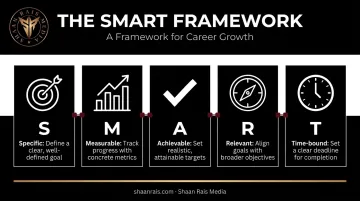
Vision without structure goes nowhere. This is where the SMART framework earns its reputation, turning vague ambition into a draft development plan built on five criteria:
- Specific: A clearly defined outcome, not a vague aspiration
- Measurable: Progress you can track with real numbers
- Achievable: Realistic given your current resources and time
- Relevant: Tied directly to your broader career vision
- Time-bound: Anchored to a deadline that creates urgency Doran's original 1981 paper introducing SMART goals noted that not every objective needs to hit all five criteria — flexibility was part of the design from day one.
Stage 3: Skill Acquisition and Learning
This is the "doing" phase — courses, coaching, mentorship, and self-directed study. It's also where most people stop, mistaking learning for development. Learning is the input. It's not the outcome.
Stage 4: Application and Practice
Real development happens on the job, not in a classroom. New responsibilities, cross-training, and stretch assignments turn theoretical knowledge into demonstrable competency. Skip this stage and your new skills stay abstract — nice to talk about, hard to prove.
Stage 5: Evaluation and Reinvention
Periodically reassess. Seek feedback. Set new goals. Treat development as a cycle, not a checkbox you tick once a year and forget about. Skills without visibility rarely translate into influence or pricing power, which is why this stage should also prompt a hard look at how well your positioning reflects your growth.
Building Your Professional Development Plan: The 4 Key Components
A Professional Development Plan (PDP) is a written document that focuses, evaluates, and prioritizes your growth goals and activities. It's forward-looking and voluntary.
Don't confuse it with a Performance Improvement Plan (PIP) — a PIP is corrective, used when current performance falls below expectations. A PDP is about where you're headed, not where you're falling short.
Component 1: Vision of Success
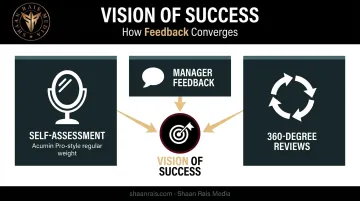
Where do you want to be — in your role, industry, or income — over the next few years? This vision anchors everything else in the plan. Three sources help you separate real gaps from perceived ones:
- Self-assessment — your own read on strengths and blind spots
- Manager feedback — direct observation from someone who sees your work daily
- 360-degree reviews — input gathered from peers, reports, and stakeholders
According to CIPD's evidence review, performance gains from feedback processes, including 360-degree reviews, tend to be modest on their own. Use feedback developmentally, paired with clear goals and follow-up — not as a standalone fix.
Component 4: Action Plan with Time-Bound Goals
This is where insight becomes action. Translate everything above into SMART goals with specific activities, resources, and deadlines. Break it into quarterly milestones so you have built-in accountability checkpoints, not just a vague annual intention.
Best Practices for Effective Professional Development
Knowing the stages and components is one thing. Executing consistently is another. Here's what separates people who actually grow from people who just attend workshops.
Follow a Time-Allocation Model
The 70-20-10 model, developed through Center for Creative Leadership research, offers a useful (if imperfect) heuristic:
| Learning Source | Allocation | What It Looks Like |
|---|---|---|
| Experience | 70% | Challenging assignments, on-the-job stretch |
| Relationships | 20% | Mentorship, coaching, feedback |
| Formal training | 10% | Courses, certifications, workshops |
Worth flagging: ATD's own research notes these exact percentages aren't strongly validated as universal ratios. Treat this as a portfolio guide, not gospel. The core lesson holds regardless — training-only development consistently underperforms compared to development that includes real-world application.
Make It a Habit, Not an Event
Block recurring time — monthly or quarterly — rather than relying on sporadic bursts of motivation. A single workshop once a year won't move you. Consistent, smaller investments will.
Apply New Learning Fast
Use new skills within days, not months. Research on training transfer consistently shows that opportunities to practice soon after learning are one of the strongest predictors of whether that learning actually sticks.
Build in Accountability
Share your development plan with a manager, mentor, or peer. Accountability isn't about pressure — it's about follow-through. Plans that live only in your head rarely survive a busy quarter.
Audit What's Actually Getting Noticed
This is the step most people skip, yet it's central to what separates visible growth from invisible effort. Periodically ask which of your skills decision-makers are actually seeing and rewarding, and which stay invisible no matter how good they are.
That gap between capability and visibility is exactly what the next section tackles: how to make sure your growth actually gets noticed.
The Missing Piece: Why Positioning Determines Whether Your Growth Gets Rewarded
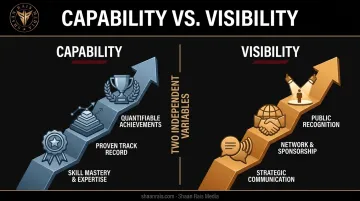
Skill-building alone doesn't guarantee recognition. The market rewards perceived value, not just actual capability. Plenty of highly-skilled professionals stay underpaid or overlooked simply because their positioning hasn't caught up with their competence.
This isn't speculation. Studies on self-promotion and performance evaluation consistently show a pattern:
- People with equal performance levels are often evaluated very differently based on how visibly and credibly they communicate their own value
- Being actively championed or sponsored by others changes a person's willingness to pursue high-stakes opportunities, a mechanism separate from raw skill level
In other words, capability and visibility are two different variables. You can maximize one and still stall on the other.
Perception Engineering as a Framework
Industrial-Organizational Psychologist Shaan Rais built his practice around this exact gap. His concept of Perception Engineering applies branding and positioning principles directly to professional growth, ensuring new skills and achievements get communicated to the market instead of buried in a job description or an unread LinkedIn summary.
Rais has applied this framework with operators across dozens of industries, working specifically with professionals who are excellent at what they do but invisible to the market that would pay them more for it.
Treat Positioning as a Formal PDP Component
Most professional development plans stop at skills and competencies. That's incomplete. Treat "how you're perceived" as a formal, tracked component alongside your technical goals.
Structured approaches, including 120-day positioning protocols used by branding strategists, exist because positioning, like any other competency, benefits from a defined timeline and milestones rather than vague intentions to "build your brand eventually."
Common Mistakes to Avoid in Professional Development
Even well-intentioned professionals sabotage their own growth. Watch for these patterns:
- Treating development as a checkbox — one workshop per year satisfies a compliance requirement, not a real growth plan
- Over-investing in credentials without validating ROI — Georgetown's Center on Education and the Workforce found that credential ROI varies significantly by institution and time horizon; a degree isn't a universal guarantee of advancement
- Developing skills in isolation — growing quietly without communicating progress to managers, peers, or the broader market reinforces the exact positioning gap this guide addresses
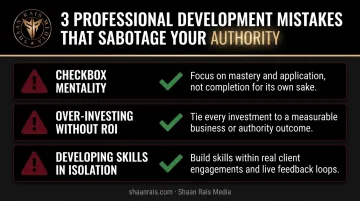
That third mistake is the most common, and the most fixable. Pair every skill you build with a visible signal — a case study, a talk, a public update — so the market can price your growth accurately.
Frequently Asked Questions
What are the 5 stages of professional development?
The five stages are self-assessment and vision setting, goal setting and planning, skill acquisition, application through real work, and evaluation with reinvention. These stages repeat in a continuous cycle rather than running once and stopping.
What are the 4 key components of a professional development plan?
A solid PDP includes a vision of success, core and job-specific competencies, feedback and assessment, and an action plan with time-bound SMART goals. Skipping any one weakens the whole plan.
How much time should I dedicate to professional development each week or year?
There's no single universal benchmark, but a useful guideline is allocating meaningful, recurring time using the 70-20-10 model : mostly through on-the-job experience, some through mentorship, and a smaller slice through formal courses.
How is professional development different from job training?
Job training improves your performance in your current role and tasks. Professional development builds broader capability for roles, responsibilities, or income levels you don't have yet.
How do I get my employer to invest in my professional development?
Build a case using data on retention and productivity gains from learning investment, and tie your specific request directly to a business goal your manager already cares about. Specificity beats general requests every time.
Why do skilled professionals still get overlooked for promotions or opportunities?
Because capability and visibility are separate variables. Many talented professionals develop real skill but never communicate it in a way decision-makers actually see, leaving perceived value stuck far below actual value.