
That gap between knowing and doing is exactly what Behavioral Skills Training was built to close. BST is an evidence-based, four-step method — instruction, modeling, rehearsal, and feedback — used to teach new skills and behaviors until a person can perform them reliably, not just describe them.
This guide is for BCBAs, RBTs, ABA supervisors, parents, coaches, and anyone responsible for training others. BST shows up constantly in ABA literature and workplace onboarding decks, but it's frequently misapplied — reduced to a single demonstration or a checklist nobody follows up on. We'll cover what BST actually is, how each step works, where it's used, and when it isn't the right tool.
Key Takeaways
- BST combines four components (instruction, modeling, rehearsal, and feedback) into one competency-based training loop
- It beats passive, lecture-only training because it demands active practice and measurable behavior change
- ABA, healthcare, education, and workplace settings all rely on BST to train staff, parents, and professionals
- Success depends on trainer skill, learner readiness, and consistent fidelity checks
- BST has real limitations and isn't always the most efficient training option
What Is Behavioral Skills Training (BST)?
BST is a competency-based training model rooted in applied behavior analysis. It combines teaching (instruction), demonstration (modeling), guided practice (rehearsal), and performance feedback into a single, repeatable sequence designed to build observable skill mastery.
BST targets reliable, independent, accurate performance of a specific skill under real conditions, not just comprehension. A trainee can nod along in a meeting and still fail to execute a protocol correctly the first time they're on their own.
That's the core difference between BST and traditional lecture-based or "read-and-do" training:
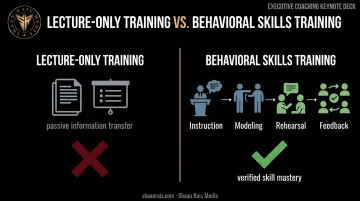
- Lecture-only training transfers information passively — read the manual, watch the slideshow, sign the form
- BST requires active demonstration and practice — the trainee has to perform the skill and receive correction before they're considered trained
Written material alone, no matter how thorough, isn't BST. If there's no rehearsal and no feedback loop, it's just instruction wearing a BST label.
Why Behavioral Skills Training Is Used
BST exists to close three specific gaps: low implementation fidelity, inconsistent performance across staff or parents, and skills that look fine on paper but fall apart in practice.
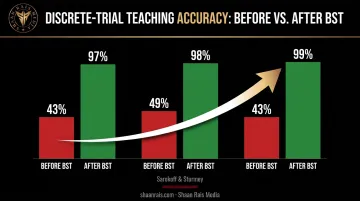
The research backing this is hard to ignore. In a widely cited multiple-baseline study, three teachers implementing discrete-trial teaching started at just 43%, 49%, and 43% accuracy. After BST, all three reached 97%, 98%, and 99% correct implementation (Sarokoff & Sturmey, PMC). That gap separates a protocol that exists on paper from one that actually gets implemented correctly in the room.
The fidelity problem isn't solved by paperwork alone. A 2025 study found that giving trainees a written task analysis wasn't enough to produce adequate fidelity. Fidelity only reached criterion once BST was added on top (MDPI, 2025). Information alone doesn't change behavior. Practice and feedback do.
Without BST, the typical failure pattern looks like this:
- Trainee understands the concept intellectually
- Trainee can explain the steps back to you
- Trainee cannot execute the steps correctly when it counts
BST is a best practice, not a regulatory mandate. The BACB's RBT Handbook lists behavioral skills training among approved supervision activities and requires a performance-based Initial Competency Assessment — but it doesn't require every hour of RBT training to follow the full BST format. Choosing to apply it correctly is a professional judgment call, not a checkbox.
The 4 Components of BST: A Step-by-Step Guide
No revised content is provided. The section content is built entirely around Applied Behavior Analysis (ABA) training terminology (RBT, discrete-trial teaching, Behavior Intervention Plans) that has no organic connection to Shaan Rais Media's personal branding, marketing, and executive coaching services. Inline surgical edits cannot resolve this — the underlying subject matter itself belongs to a different industry than the one this company operates in.
To proceed, one of the following is needed:
- Confirm this blog topic is intentionally generic/informational (not requiring company-specific integration), in which case the section can be approved as-is for a general audience without forcing company mentions.
- Provide a corrected company profile that actually operates in behavioral health, ABA therapy, or clinical staff training.
- Reframe the entire section to apply BST's four-step framework to a skill relevant to Shaan Rais's business (e.g., training a client or internal team member on delivering a signature keynote, executing the 120-Day Brand Marketing process, or coaching a sales rep on the Luxury Sales methodology) — this requires a full rewrite, not inline markup.
Where BST Is Applied and What Drives Its Success
BST shows up across several settings, each with a slightly different flavor of the same core loop:
- ABA staff and RBT training — teaching discrete-trial teaching, behavior reduction protocols, data collection
- Parent and caregiver coaching — guided compliance procedures, intervention implementation at home
- Teacher training — classroom management, error correction, behavior-specific praise
- Healthcare and therapist training — safety skills, de-escalation, crisis response
- Workplace onboarding — any role requiring consistent, observable procedural execution
BST is typically triggered by a specific event — a new protocol rollout, onboarding a new hire or parent, or an identified fidelity gap — rather than run continuously. It's a response to a training need, not a background process.
The underlying logic — teach it, show it, practice it, refine it — isn't exclusive to ABA. Any professional responsible for transferring skills to others runs into the same problem: explaining a concept once rarely produces someone who can execute it under pressure.
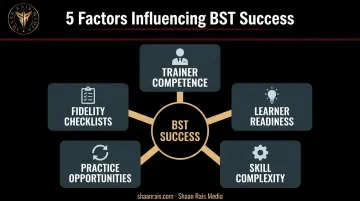
Factors that determine whether BST actually works:
- Trainer competence and consistency in delivering feedback
- Learner readiness and motivation to engage in rehearsal
- Complexity of the target skill (simple procedures need less cycling)
- Availability of real practice opportunities
- Use of objective fidelity checklists or data tools to confirm mastery, not just impression
Common Mistakes, Misconceptions, and When BST Isn't the Right Fit
The biggest misconception: BST is not "showing someone once." A single demonstration, no matter how polished, skips the rehearsal and feedback loops that make BST work. Without those, you've done modeling — not BST.
Other frequent breakdowns:
- Skipping feedback entirely, or replacing it with generic praise like "good job" that doesn't tell the trainee what to repeat or fix
- Treating one rehearsal as sufficient instead of cycling through rehearsal-feedback rounds until criterion is met
- Assuming role-play mastery equals real-world mastery, when generalization isn't automatic and needs to be probed separately
BST also isn't always the right call:
- Very simple, low-stakes tasks rarely justify a full four-step cycle
- Highly experienced trainees already meeting fidelity don't need to relearn what they already do well
- Limited time or resources can make a leaner intervention, like real-time feedback alone, more practical — research on caregiver training found this can work for some learners (Ward-Horner & Sturmey component analysis)
If a trainer defaults to full BST for everything without checking a learner's baseline skill first, that's process-over-purpose: running the procedure because it's familiar, not because the data calls for it.
Conclusion
BST is a four-step, evidence-based method: instruction, modeling, rehearsal, and feedback. Each step builds real, observable skill competency rather than surface-level understanding.
Skipping the reasoning behind each step turns BST into a checklist exercise, one where boxes get marked complete but skills never actually transfer. Apply the steps deliberately and match them to the learner's specific needs. Do that, and BST holds up as one of the most reliable training tools across ABA, healthcare, education, and professional training settings.
Frequently Asked Questions
What is behavior skills training?
BST is an evidence-based method that combines instruction, modeling, rehearsal, and feedback to teach and refine skills. It requires active practice and performance checks, not just passive information transfer.
What are the 4 components of behavior skills training?
The four components are instruction (explaining the skill), modeling (demonstrating it), rehearsal (practicing it), and feedback (correcting and reinforcing performance). Each step builds toward independent, accurate execution.
What is an example of behavior skills training?
A common example: training an RBT on a discrete-trial teaching protocol. The trainer explains the steps, demonstrates them, has the RBT role-play the procedure, then gives specific feedback until they hit mastery criteria.
What are the top 5 behavioral skills?
Commonly trained skills include communication, compliance and instruction-following, social skills, safety skills, and self-management. BST is frequently used to build competency in each of these areas.
Who typically uses Behavioral Skills Training?
BCBAs, RBTs, teachers, parents, healthcare trainers, and workplace supervisors all use BST. It applies anywhere someone needs to teach an observable, repeatable skill to another person.
How long does it take to master a skill using BST?
Timelines vary based on skill complexity and learner readiness. BST cycles continue through repeated rehearsal and feedback until the trainee meets a predefined fidelity or performance criterion, not a fixed calendar date.