That gap between what you can actually do and what the market believes you can do is where careers stall and businesses plateau. Thought leadership is the bridge. It's how expertise stops living in your head and starts living in the market's perception of you.
The data backs this up. In the 2024 Edelman-LinkedIn B2B Thought Leadership Impact Report, 73% of decision-makers said thought leadership content is a more trustworthy way to judge a company's capabilities than its marketing materials or product sheets. That's not a minor preference. It's a signal that buyers have changed how they evaluate expertise, and most companies haven't caught up.
This guide covers what thought leadership actually is, the zones of visibility experts move through, a step-by-step build process, the core principles that separate real authority from noise, and what's shifting heading into 2026.
Key Takeaways
- 73% of B2B decision-makers trust thought leadership over traditional marketing materials
- Visibility builds in stages, moving from internal recognition to industry-wide influence
- Positioning must come before content and channel tactics, not after
- Original point of view and evidence beat volume of content
- 60% of buyers say they'll pay a premium to work with a recognized thought leader
What Is Thought Leadership, Really?
Thought leadership is demonstrated, recognized expertise that actively shapes how a market thinks about a problem. Not just having answers. Having a perspective the market didn't have before you shared it.
Most people conflate thought leadership with content marketing, but the two serve different jobs.
Thought Leadership vs. Content Marketing
Content marketing is the umbrella. It educates, entertains, and converts. Thought leadership sits inside that umbrella as a specific strategy built on original, sometimes contrarian insight.
According to NYT Licensing's breakdown, thought leadership focuses on establishing durable expertise and authority, while content marketing more broadly pursues nearer-term engagement or conversion goals.
Here's the trap most people fall into: publishing generic "helpful" content and calling it thought leadership. The two are easy to tell apart once you know what to look for:
- Content marketing: Broad, useful, easily replicated — a listicle of "5 tips for better hiring" fits here
- Thought leadership: Narrow, original, hard to replicate — requires a genuine point of view, not just useful information
A helpful post can inform readers without shifting how they think. Thought leadership only qualifies when it changes the reader's perspective.
Thought leadership only counts if it's visible. You can be the most capable person in your field and still be worth nothing to the market if nobody knows it. Shaan Rais, who has worked with 400+ operators across 50+ industries on closing this exact capability-visibility gap, puts it plainly: "You are more valuable than you are visible." Capability without visibility is a business liability, not an asset waiting to be discovered.
Why a Thought Leadership Strategy Matters
Visibility and pricing power move together. The more the market trusts your perspective, the less it questions your rate.
The Edelman-LinkedIn data supports this directly:
| Outcome | Reported Result |
|---|---|
| Willing to pay a premium | 60% of decision-makers |
| More receptive to sales outreach | 9 in 10 decision-makers |
| Likely to invite into an RFP process | 86% of decision-makers |
| Researched a company after reading its content | 54% of decision-makers |
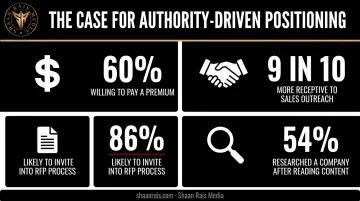
That trust isn't built from a quick skim. 52% of decision-makers and 54% of C-level executives spend at least one hour per week actively consuming thought leadership content, based on the same 2024 Edelman-LinkedIn report.
Beyond direct revenue, the secondary effects compound:
- Talent attraction — 50% of buyers in Edelman's 2021 study said thought leadership matters for attracting top talent
- Brand perception — 65% said it significantly improved their view of a company
- Positive reputation — 7 in 10 decision-makers think more favorably of firms that publish consistently strong thought leadership
The pattern shows up in real engagements too. One case tied to Perception Engineering, the positioning methodology behind Shaan Rais's coaching practice, generated $250,000 in revenue within 72 hours of a single keynote — a direct, immediate return from positioned visibility rather than a slow brand-building win.
A second example plays out over months instead of hours. Bobby Jackson, a Fractional CFO who went through the 120-Day Brand Launch Program, posted 400% year-over-year revenue growth after establishing a recognizable personal brand and structured offer for CEO clients.
The 4 Zones of Thought Leadership
Nobody becomes a recognized authority overnight. Experts move through zones of increasing visibility, and each zone has a distinct ceiling on opportunity and pricing.
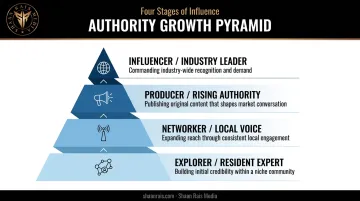
Zone 1: The Explorer/Resident Expert
Recognized internally by clients, colleagues, or immediate network. Real expertise exists, but it stops at the edge of your existing relationships. Referrals happen, but growth is slow and reactive.
Zone 2: The Networker/Local Voice
Known within a niche or local market. Reputation starts working for you occasionally, bringing in opportunities without you chasing them. Still, influence rarely travels beyond a defined geography or small circle.
Zone 3: The Producer/Rising Authority
Actively creates content and holds an original point of view. This is where regional or industry-wide recognition kicks in, along with the ability to raise fees. The real shift is ownership of a perspective, not simply volume of output.
Zone 4: The Influencer/Industry Leader
Nationally or globally recognized. Sought for keynotes, press coverage, and premium partnerships. Opinions at this level shape how the entire field thinks about a problem, not just get shared within it.
Across the 400+ operators Shaan Rais has coached, the pattern holds: each zone compounds into the next, and skipping steps rarely works. What accelerates the climb isn't more content — it's positioning clarity.
Step-by-Step: Building Your Thought Leadership Strategy
Strategy has to come before tactics. Without clear positioning, content and channel efforts scatter, and momentum takes far longer to build.
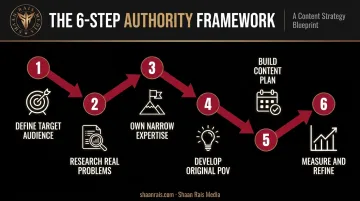
Step 1: Define and Narrow Your Target Audience
Pick a specific role, industry, or decision-maker type. Not "everyone in business." Narrower targeting accelerates authority-building because your message actually lands somewhere specific.
Step 2: Research Your Audience's Real Problems
Gut instinct isn't research. Move to structured methods:
- Direct interviews with target clients
- Surveys across your existing network
- Industry reports and data on emerging pain points
The goal is finding problems your audience feels acutely but rarely hears addressed well.
Step 3: Specify and Own a Narrow Area of Expertise
This is where positioning gets engineered, not guessed. The goal is to diagnose the exact gap between how the market currently sees you and where your actual capability already places you.
The most talented operators in a room are rarely the highest paid. The most positioned are.
That's the target: category ownership, or occupying a space so specific that you effectively have no direct competition.
Step 4: Develop an Original Point of View
Recycled industry talking points don't build authority. A fresh, sometimes contrarian angle does. This is the single biggest differentiator between generic content and actual thought leadership.
Ask yourself: would a competitor publish this exact take? If yes, it's not original enough yet.
Step 5: Build a Content and Distribution Plan
Match format to where your audience already looks for insight. Common formats include:
- Long-form written content (articles, LinkedIn posts, newsletters)
- Speaking engagements and keynotes
- Video and podcast appearances
- Original research or proprietary data reports
Don't spread thin across every channel. Pick two or three where your audience is genuinely paying attention.
Step 6: Measure, Refine, and Compound Visibility
Track outcomes that matter, not vanity metrics:
- Inbound inquiries and their quality
- Speaking invitations
- Willingness to pay premium pricing without pushback
Revisit your positioning as authority grows. What worked at Zone 2 often needs sharpening by the time you're operating in Zone 3.
Core Principles of Effective Thought Leadership
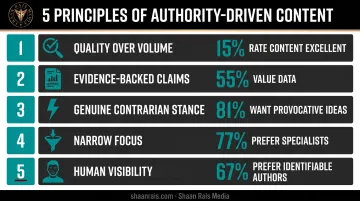
Five principles separate durable authority from noise:
- Quality over volume: only 15% of decision-makers rate most thought leadership as very good or excellent, according to Edelman's 2021 B2B Thought Leadership Impact Study, despite rising output across the board.
- Evidence-backed claims: 55% of decision-makers in 2024 said strong research and data mark the highest-quality thought leadership.
- Genuine, sometimes contrarian stance: 81% of decision-makers in 2021 wanted provocative ideas that challenge assumptions, while 40% cited unoriginal thinking as a common shortcoming.
- Narrow focus: 77% preferred deep subject-matter experts over senior generalists for specialized topics.
- Human visibility: 67% preferred an identifiable author, and 64% preferred a human, less formal tone over faceless brand content.
Audiences aren't rewarding polish. They're rewarding a real point of view delivered by a real person.
These five principles are the same ones behind Perception Engineering: positioning a real expert's point of view before layering on tactics.
Thought Leadership Examples & What's Changing in 2026
Real-world thought leadership tends to fall into recognizable categories:
- A founder publishing original research or proprietary data that becomes a recurring reference point in their industry
- An executive running a recurring point-of-view content series, building a consistent voice over time
- A consultant known for a signature framework, where the methodology itself becomes the brandAI-assisted trend-spotting, filtered through human judgment. CMI's 2025 benchmark report found 81% of B2B marketers now use generative AI tools, yet only 17% rate the output excellent.
- Small original data sets as brand assets. Modest proprietary research is becoming a differentiator when paired with credible sourcing.
- Live formats gaining ground. 52% of B2B marketers now rank speaking events or webinars among their most effective thought leadership channels.
None of this changes the fundamentals. Positioning and a genuine point of view still outperform whatever new tool or format shows up next.
Frequently Asked Questions
What are the principles of thought leadership?
Original insight matters more than volume, claims need evidence behind them, and a clear, sometimes contrarian point of view beats conventional wisdom. Narrow focus and authentic human visibility complete the list.
What are examples of thought leadership?
Common examples include original research reports, signature frameworks tied to a specific person, contrarian op-eds, and recurring speaking platforms at industry events. Each shares one trait: a distinct, ownable point of view.
What are the 4 zones of thought leadership?
Experts move from Explorer (internal recognition only) to Networker (niche or local reputation) to Producer (industry-wide recognition through original content) to Influencer (national or global authority). Each zone requires deliberate positioning work — the jump rarely happens by accident.
What are the thought leadership trends in 2026?
AI-assisted insight generation paired with human judgment, small proprietary data sets used as brand assets, and more human-first, community-driven content formats. Positioning still has to come before any of these tactics work.
What is the difference between thought leadership and content marketing?
Content marketing is the broad umbrella covering education, entertainment, and conversion goals. Thought leadership is a specific, insight-driven strategy within that umbrella, built on original perspective rather than general helpfulness.
How long does it take to become a recognized thought leader?
Timelines vary by industry and starting point, but disciplined positioning paired with consistent visibility can move the needle within months, not years. Strategy has to precede tactics for that acceleration to happen.