Introduction
Great leadership isn't built in a classroom. It's built when a project falls apart, when two team members won't stop clashing, or when you have to deliver feedback that someone genuinely doesn't want to hear. Most leaders face these moments unprepared — they simply haven't had a chance to practice.
Leadership role play scenarios fix that. They recreate the pressure, the ambiguity, and the emotional weight of real workplace challenges in a safe environment where mistakes become learning moments rather than damaged relationships.
This guide is written for team leaders, managers, HR professionals, and business owners — including those in high-accountability client-facing industries like personal branding and consulting, where a leader's judgment affects both team trust and client outcomes. Inside, you'll find:
- Five specific role play scenarios with full structure
- Practical guidance on running sessions effectively
- A framework for designing your own scenarios
Key Takeaways
- Leadership role play prepares leaders for high-stakes situations — conflict, underperformance, crisis — before they face them live
- Effective scenarios target one specific skill, include realistic tension, and end with structured feedback
- The five highest-impact scenario types: crisis management, conflict resolution, performance feedback, leading through change, and delegation
- A strong session requires clear role assignment, psychological safety, and a structured debrief to drive real learning
- Client-facing leaders in industries like personal branding face these situations daily; intentional practice is what separates reactive managers from effective ones
What Is Leadership Role Play and Why Does It Work?
Leadership role play is a structured training method where participants act out realistic workplace situations to practice leadership responses before encountering them in real life. Unlike a lecture or a workshop, it demands active decision-making — you can't passively absorb your way through a difficult performance conversation.
A peer-reviewed meta-analysis of 335 independent leadership training samples found mean effect sizes of 0.73 for learning and 0.82 for behavioral transfer to the workplace — results that outperform passive training formats by a wide margin. A separate analysis of 117 behavior-modeling studies found that skill effects remained stable or increased over time, particularly when training included practice, feedback, and real-world scenarios.
The Skills Role Play Develops Best
Role play is uniquely effective for developing skills that can't be learned from a slide deck:
- Emotional intelligence — reading a room, managing your own reactions
- Conflict navigation — finding resolution without losing the relationship
- Communication under pressure — staying clear when the stakes are high
- Empathetic decision-making — understanding impact before acting
In high-accountability environments — personal branding, consulting, client services — a leader's emotional and communicative judgment directly affects team trust and client outcomes. Gallup data shows that fewer than half of managers worldwide have received formal management training, meaning most leaders navigate these moments entirely on instinct.
Role play builds the muscle memory those moments demand — before the stakes are real.
Best Leadership Role Play Scenarios: Examples
These five scenarios are chosen for their real-world frequency, transferable skill value, and adaptability across industries and team sizes.
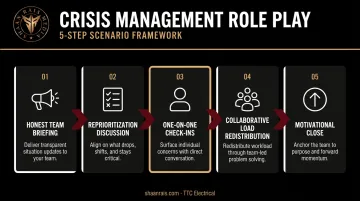
Scenario 1: Crisis Management — Project Under Pressure
The Setup: A high-stakes project is behind schedule. One key team member is out sick, and an unexpected technical problem has surfaced. The leader must re-plan, reassign tasks, and keep morale from collapsing — all under genuine time pressure.
Roles:
- Project Manager / Leader
- Technical Lead
- Overloaded Team Member
- Returning Team Member (back after absence)
How It Runs:
- Leader briefs the team on the current situation — honestly, without minimizing
- Reprioritization discussion: what must be done today vs. what can wait
- Brief one-on-ones with each team member to gauge capacity and morale
- Collaborative problem-solving session to redistribute the load
- Motivational close — the leader acknowledges difficulty while reinforcing direction
| Attribute | Detail |
|---|---|
| Difficulty Level | Intermediate to Advanced |
| Skills Practiced | Crisis management, motivation, strategic replanning, empathy |
| Ideal For | Mid-level managers, project leads, team supervisors |
Scenario 2: Conflict Resolution Between Team Members
The Setup: Two team members have an ongoing clash. One favors innovation and new approaches; the other trusts proven methods and resists change. The tension has become visible to the rest of the team and is affecting output. The leader must mediate without taking sides.
How It Runs:
- Individual conversations with each team member — create space for both to feel genuinely heard before they're in the same room
- Joint session to surface shared goals (both want the project to succeed)
- Facilitated compromise: what can each party adapt or concede?
- Team debrief that models constructive disagreement as a strength
The hardest part of this scenario isn't facilitating the joint session — it's the individual conversations. Leaders who skip them rush to resolution and miss the root cause.
| Attribute | Detail |
|---|---|
| Difficulty Level | Intermediate |
| Skills Practiced | Active listening, conflict mediation, empathy, communication |
| Ideal For | Team leaders, people managers, HR professionals |
Scenario 3: Delivering Performance Feedback to a Struggling Employee
The Setup: A previously strong team member has shown a sustained decline in output and quality over the past six weeks. The leader must open a one-on-one conversation that is supportive, specific, and solution-focused — not a veiled warning or a performance-improvement ultimatum dressed up as concern.
How It Runs:
- Preparation: the leader identifies two or three specific behavioral examples (not general impressions)
- Opening: set a constructive tone — this is a conversation, not a verdict
- State observations directly, then stop talking and listen
- Invite the employee's perspective — there may be context the leader doesn't have
- Co-create an improvement plan with concrete actions and timelines
- Schedule a follow-up before the meeting ends
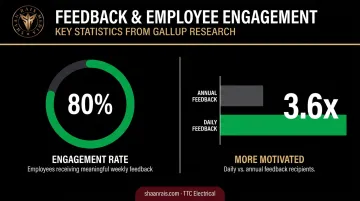
Gallup research on 13,490 U.S. employees found that employees receiving meaningful feedback in the prior week were fully engaged at a rate of 80%. Employees receiving daily rather than annual feedback were 3.6 times more likely to strongly agree they were motivated to do outstanding work. Frequency matters as much as quality — neither alone is enough.
| Attribute | Detail |
|---|---|
| Difficulty Level | Intermediate |
| Skills Practiced | Feedback delivery, performance coaching, empathy, accountability |
| Ideal For | All leadership levels, especially first-time managers |
Scenario 4: Leading a Team Through Organizational Change
The Setup: The organization is implementing a significant process shift — new systems, restructured roles, or a policy change. The team's reaction is mixed: some are resistant, some anxious, a few quietly disengaged. The leader must communicate clearly, manage pushback, and maintain momentum.
The core challenge: The leader cannot promise everything will be smooth. They must be transparent about uncertainty while still projecting credible confidence. Most leaders default to one extreme or the other — over-promising to calm the room, or over-explaining until the message drowns.
Prosci benchmarking data shows that 88% of respondents with excellent change management met or exceeded their project objectives, compared to just 13% with poor change management. The difference isn't the change itself — it's how leaders communicate it.
Key moments to build into the scenario:
- A team member who asks a direct, uncomfortable question ("Will my role still exist in six months?")
- A skeptic who has seen change initiatives fail before and is openly doubtful
- A quiet team member whose disengagement is easy to miss
| Attribute | Detail |
|---|---|
| Difficulty Level | Advanced |
| Skills Practiced | Change communication, resilience, managing resistance, vision alignment |
| Ideal For | Senior managers, department heads, founders navigating business pivots |
Scenario 5: Delegation and Empowerment
The Setup: The leader has taken on a significant new project and must assign work across the team — including to one team member who is resistant ("that's not really my area") and another who is underconfident ("I'm not sure I'm the right person for this"). The leader must delegate without micromanaging and build trust in the process.
This scenario is commonly skipped in leadership training because delegation feels like a management task, not a leadership skill. That's a costly assumption. Gallup data shows that managers are 46% less likely than individual contributors to strongly agree that work is delegated to them properly — a signal of systemic failure, not individual weakness.
Poor delegation also drives burnout directly. In a healthcare study of 777 provider-nurse dyads, greater task delegation was associated with lower provider burnout (OR 0.62 per scale unit).
What the role play should surface:
- How the leader frames task assignment to the resistant team member
- How they coach the underconfident team member toward ownership ("I need you to run this as if it were yours — your method, but the same standard")
- What accountability structure the leader puts in place without hovering
| Attribute | Detail |
|---|---|
| Difficulty Level | Beginner to Intermediate |
| Skills Practiced | Trust-building, task prioritization, coaching, accountability |
| Ideal For | New managers, growing team leads, entrepreneurs managing expanding teams |
How to Run a Leadership Role Play Session Effectively
The scenario is only about 30% of the value. The structure around it — how you brief participants, manage the room, and debrief afterward — determines whether the session builds real skill or just fills time.
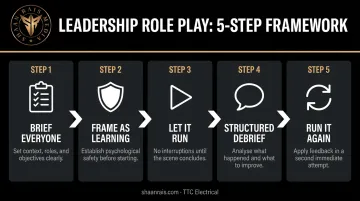
Step 1 — Brief everyone before anything begins. Assign roles explicitly: who each person is playing, what the situation is, and which skill is being practiced. Ambiguity at this stage doesn't create interesting improvisation — it creates confusion that derails the session.
Step 2 — Frame it as a learning exercise, not an audition. Role play only works when people feel safe enough to get it wrong. Google's Project Aristotle research on 180 teams identified psychological safety as the single strongest predictor of team effectiveness. The facilitator sets that tone by naming it explicitly — this is practice, not evaluation — and holding it throughout.
Step 3 — Let it run without interruption. Resist the urge to pause and correct in real time. The value is in authentic reactions, including the moments where the leader stumbles. That's the material the debrief needs.
Step 4 — Debrief with structure. This is the most important step. Use specific questions:
- "What did you notice about your own reactions?"
- "What would you do differently, and why?"
- "What worked — and what made it work?"
Tie observations to named leadership competencies, not just general impressions.
Step 5 — Run it again. Swap roles, shift one variable, or introduce a new decision point. The second pass is almost always sharper — participants know the shape of the scenario and can focus on the actual leadership behavior instead of just tracking the plot.
How to Design Your Own Leadership Role Play Scenarios
Start with the skill, not the story. Identify the specific leadership behavior the scenario needs to develop before writing a single line of context. The situation should serve the skill — not the other way around. A scenario designed to develop active listening will look structurally different from one built around crisis communication.
Build in tension and real stakes. Scenarios without emotional weight feel like exercises. Include at least one of the following:
- A time constraint
- A difficult personality who pushes back
- An ethical grey area with no clean answer
- Two competing priorities with no obvious right choice
Add feedback and retry loops. The SHRM framework for role play development specifies predefined effective behavior, willing participants, and a structured debrief as non-negotiable elements. Whether you use live peer feedback, an observer with a rubric, or an AI-powered coaching platform, participants need structured reflection and the chance to try again.
Retention improves when participants fail, reflect, and repeat — skipping any one of those steps shortchanges the learning.
Conclusion
Leadership role play scenarios aren't a shortcut to great leadership. They're a practice environment — the place where real skills are built, tested, and refined before the stakes are real.
Servant leadership is forged through exactly this kind of deliberate practice. Shaan Rais, founder of Shaan Rais Media, a personal-branding and positioning practice built on honesty, positioning, and empowerment, didn't develop his leadership approach through theory. He developed it through adversity: early overexpansion that forced a strategic reset, hard-won lessons that demanded resilience, and a transformative personal experience that re-centered his company around purpose-driven service.
His philosophy is direct: empower people who share your drive, assign responsibility based on what the mission requires, invest in those with potential, and hold everyone — including yourself — to a principled standard.
Choose one scenario from this guide. Run it with your team this week. Then do the debrief — that's where the real learning happens, and where the next version of your leadership gets built.
Frequently Asked Questions
What is an example of a scenario in leadership?
A classic example is a manager addressing a team member's declining performance: the leader must open a one-on-one conversation that's specific, empathetic, and solution-focused rather than punitive. This scenario develops feedback delivery, active listening, and the ability to coach toward improvement rather than simply evaluate past behavior.
What are the 5 C's of leadership?
The 5 C's are commonly identified as Competence, Courage, Communication, Character, and Commitment. Leadership role play is most effective at developing Courage and Communication — the two that suffer most when leaders avoid difficult conversations and rely on instinct over practiced skill.
What is leadership role play and how does it work?
Leadership role play is a structured training method where participants act out realistic workplace scenarios (conflict, crisis, feedback, change) to practice leadership responses in a low-stakes environment. The goal is to build behavioral muscle memory before facing similar situations where the consequences are real.
How do you facilitate a leadership role play scenario effectively?
Assign roles clearly before starting, establish a no-judgment environment so participants feel safe making mistakes, let the scenario run without interruption, and conduct a structured debrief tied to specific leadership behaviors. A strong debrief asks participants to name one thing they'd do differently — that single reflection often drives the most durable behavior change.
What skills can leadership role play scenarios help develop?
Role play builds the skills that matter most under real pressure: conflict resolution, communication, delegation, and performance coaching. These are also the hardest to develop through reading or classroom instruction alone — they require repetition in realistic conditions.