

That moment repeats itself more than most people realize. Speaking up feels risky in the moment. But research shows silence carries its own cost, and it compounds. Employees speaking up on more topics report 92% intent to stay at their company, compared to just 60% among those who stay quiet, according to a Microsoft study of 6,000 employees.
This guide breaks down what speaking up actually means, why we avoid it, how to decide when it's worth the risk, and exactly how to do it without torching relationships or your reputation.
Key Takeaways
- Silence has a cost — it correlates more strongly with burnout than speaking up does
- Use the "is it safe, is it worth it" framework before reacting to workplace friction
- Structure matters: lead with facts, name the impact, propose a solution
- Repeated exploitation (not one bad day) is the real signal to escalate or exit
- Well-timed voice shapes how leadership perceives your value, not just your ideas
What Does Speaking Up at Work Mean?
Speaking up isn't limited to whistleblowing on major wrongdoing. It's a spectrum that includes:
- Sharing an idea in a meeting
- Giving feedback to a peer or manager
- Raising a concern about a process or decision
- Disagreeing respectfully with a plan
- Addressing mistreatment or a boundary violation
Constructive speaking up is solution-oriented. It names a problem and offers a path forward. Venting does neither — it just releases frustration without moving anything forward. The two get confused constantly. Telling your manager "this project is a mess" is venting. Telling her "the timeline is unrealistic given current staffing, and here's an alternative" is speaking up.
That same distinction plays out across the whole spectrum. Correcting a wrong assumption in a status update is speaking up. So is pushing back when a manager asks you to do something that crosses an ethical line. Same skill, wildly different stakes.
Why Most People Choose Silence Instead
Researchers describe this as a "voice calculus" — before saying anything, people unconsciously weigh two things: how risky it feels, and whether it will actually change anything. If either number comes back low, silence wins.
This isn't laziness or cowardice. It's math, even if it happens in half a second.
The Fears Driving the Calculation
- Being labeled disloyal or "not a team player"
- Damaging a relationship with a manager or peer
- Jeopardizing a promotion or raise
- Believing that speaking up won't change the outcome anyway
These fears aren't irrational. According to research published in the Academy of Management Journal, voice and silence correlate at just -0.15. Silence, in other words, is a deliberate, defensive choice shaped by fear and unwritten rules about what's appropriate to say. People are reading the room, and often correctly.
Silence Builds Until It Breaks
Here's the pattern that shows up again and again in workplace research: people who finally speak up are rarely reacting to a first-time problem. They're at their breaking point after months, sometimes years, of staying quiet.
That's the real danger of chronic silence. It doesn't disappear — it accumulates as resentment, then erupts, often in a way that's messier and less effective than if the person had raised the issue early. Silence eats you from the inside before it ever reaches the outside.
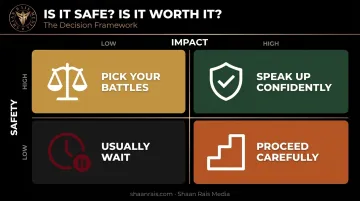
Is It Better to Speak Up or Stay Silent? A Decision Framework
Before reacting to workplace friction, run it through two questions:
- Is it safe? What's the actual psychological and career risk of raising this?
- Is it worth it? Will speaking up realistically create change, or is this a wall you'd be talking to?
The Four Outcomes
| Safety | Impact | What To Do |
|---|---|---|
| High | High | Speak up confidently — this is the easy case |
| High | Low | Pick your battles; not every annoyance needs airtime |
| Low | High | Proceed carefully — document, find allies, choose timing |
| Low | Low | Usually wait, or consider whether this is the right environment for you |
This framework only works if you're honest about your company's culture first. Hierarchical organizations punish upward dissent more than open ones do: across three studies with over 1,000 participants, employees' belief in strict power distance correlated -0.31 with their willingness to speak up, and fear of authority was the main driver, per research published in PMC.
If your workplace is steeply hierarchical, you'll need more preparation and a lower-risk channel — a private conversation instead of a public one, for instance.
Preference vs. Value: Know the Difference
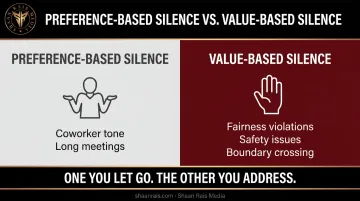
Not every irritation deserves your voice. Separate two categories:
- Preference-based silence — staying quiet on things that just annoy you (a coworker's tone, a meeting that ran long)
- Value-based silence — staying quiet on things that violate your standards, safety, or fairness
You can usually let the first category go. The second almost always warrants speaking up, even when it's uncomfortable.
Strategic silence is not the same as avoidance. Sometimes staying quiet temporarily — to gather more facts, build allies, or wait for better timing — is a smart move, not cowardice. The difference is intent. Are you waiting to act, or just hoping the problem disappears?
Either way, chronic silence has a compounding cost. Staying invisible in meetings and decisions doesn't just leave problems unresolved — it stalls your own career growth, because nobody remembers the person who never said anything.
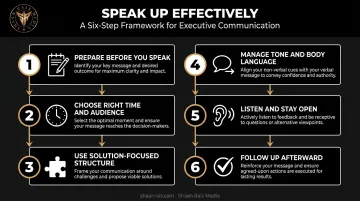
How to Speak Up at Work Effectively: A Step-by-Step Approach
Getting the "should I" question right is only half the battle. The "how" determines whether your message lands or backfires, and these six steps cover both the preparation and the delivery.
1. Prepare Before You Speak
Gather facts, examples, or data before opening your mouth. Emotion alone rarely moves a decision-maker. Know your desired outcome in advance — what does a good resolution actually look like?
Research on over 5,000 workplace ideas found that messages built on rationale, feasibility, and organizational focus were far more likely to earn peer support, and each peer endorsement raised the odds of managerial action by 3%, according to research published in the Journal of Organizational Behavior.
2. Choose the Right Time, Place, and Audience
- Private conversations work best for sensitive feedback, personal conflicts, or anything involving a specific person's performance
- Group settings work for ideas that benefit from collective input or decisions that affect the whole team
- Avoid raising a manager's mistake in front of their boss — that's rarely about the issue anymore
3. Use a Solution-Focused Structure
A well-structured message follows three moves:
- State the issue objectively
- Explain the impact
- Propose at least one next step
Mixing a suggestion with a complaint in the same message tends to backfire. Research shows managers are less likely to endorse messages that combine promotive and prohibitive framing than ones that stick to a single, clear ask.
4. Manage Tone and Body Language
Stay calm under pressure. Use "I" statements ("I noticed the deadline slipped" rather than "You always miss deadlines"). Pace your breathing before a hard conversation — it sounds simple, but it works because it slows your speech and keeps your tone level.
5. Listen and Stay Open
Treat it as a two-way conversation. Invite pushback. Be willing to adjust based on what you learn — the goal is resolution, not winning.
6. Follow Up Afterward
Check on progress. Thank people for hearing you out. This step matters more than most people think — how you follow up shapes whether you're remembered as a serious, valuable voice or a one-time complainer. Being seen as valuable is just as important as being valuable — how you're perceived after the conversation often outlasts the conversation itself, and follow-through is where that perception gets built.
When Your Boss Might Be Taking Advantage of You
Some workplace friction is about a message. Some is about a pattern with your manager. These are different problems requiring different responses.
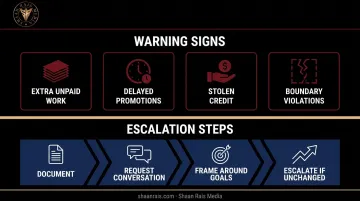
Warning Signs to Watch For
- Constantly assigned work outside your role, with no added pay or recognition
- Promises of promotion or raises that keep getting pushed back
- Being denied credit for work you did
- Repeated boundary violations — after-hours calls, guilt trips over time off
The key word is repeated. A demanding boss during a crunch week is different from an exploitative one. Look at patterns over months, not single incidents.
Boundary violations deserve particular attention here, since they're easy to dismiss as a personal preference rather than a legitimate pattern. A full 95% of U.S. workers said respect for work-nonwork boundaries was very or somewhat important to them, according to the APA's 2023 Work in America Survey. This isn't a niche preference — it's close to universal.
How to Speak Up About It
- Document instances with dates. Patterns are persuasive; vague complaints aren't.
- Request a private conversation focused on role clarity and expectations, not accusations.
- Frame it around mutual goals. "I want to make sure I'm focused on what actually moves the team forward" lands better than "You keep dumping extra work on me."
- Escalate only when the pattern continues. HR or a skip-level conversation makes sense after a documented pattern with no change. Before that, it usually reads as going over your manager's head prematurely.
Manager relationships matter more than people admit. One in two employees have left a job specifically to get away from a manager, according to Gallup. If the pattern doesn't shift after you've raised it clearly and given it real time, that data point should inform your next move.
Speaking Up as a Personal Branding and Career Visibility Strategy
Here's the part most professionals miss: speaking up is a positioning move, not just a communication skill.
Every well-timed idea, every respectfully framed concern, shapes how leadership perceives your value. Voice has been shown to predict promotability. In a study of 218 employee-supervisor pairs, voice behavior positively predicted how supervisors rated an employee's task performance, which in turn shaped their promotability, per research published by Emerald.
But recognition isn't purely a meritocracy. Research on 89 credit-union branches found that employees with higher status received more credit for the same voice contribution than lower-status peers.
Two findings stand out from this research:
- Voice behavior predicts task-performance ratings, which shape promotability
- Higher-status employees get more credit for identical voice contributions than lower-status peers
Talent alone doesn't guarantee you're seen; positioning does.
This is where Shaan Rais's philosophy of Perception Engineering comes in. It holds that deliberate positioning, through visibility, consistent voice, and clear framing, often matters as much as raw talent in determining who gets remembered, recognized, and rewarded. Plenty of capable professionals stay invisible for years, not because their ideas are weak, but because they've never connected their communication habits to how they're perceived, priced, and promoted inside their organization.
Speaking up, done consistently and well, is one of the most underused personal branding tools available inside a company. For professionals who want to turn this into a long-term strategy rather than a one-off skill, Shaan Rais's Branded Like a Leader program focuses specifically on this kind of positioning work, teaching the habits that connect good ideas to visible recognition inside an organization.
Frequently Asked Questions
Is it better to speak up or stay silent at work?
Use a safety-versus-impact framework to decide. Speak up when an issue affects fairness, safety, or your growth. Strategic silence makes sense when timing or lack of allies makes success unlikely right now.
How do you know if your boss is taking advantage of you?
Look for repeated patterns: unpaid extra responsibilities, broken promises about growth, credit-stealing, and boundary violations that happen again and again rather than once.
What does speaking up at work mean?
Speaking up covers sharing ideas, giving feedback, raising concerns, and setting boundaries. It differs from venting or complaining, since it always comes paired with a proposed solution.
How can I speak up without sounding confrontational?
Lead with facts and a proposed solution. Use "I" statements instead of accusatory language. Frame the issue around shared goals, not blame.
What should I do if I speak up and nothing changes?
Document the conversation and follow up once more. If there's still no movement, escalate appropriately or reassess whether this environment supports your long-term growth.
How can I build the confidence to speak up more often?
Start with lower-stakes moments. Prepare talking points in advance. Reframe speaking up as a skill that builds your visibility and career positioning over time, not just a one-time act of courage.