The difference usually isn't talent. It's whether the speaker understood the mechanics happening underneath the words.
Public speaking gets treated like a gift some people have and others don't. It's not. It's a system with distinct, learnable parts. You'll often hear about a "5 elements" model of communication — we'll clear up that confusion shortly. But first, let's break down the fuller, more practical framework: the 7 elements of public speaking that determine whether your message actually lands, whether you're pitching investors, presenting on a Zoom call, or closing a room from a keynote stage.
Key Takeaways
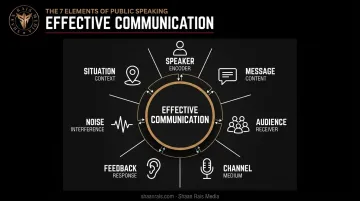
- The 7 elements — speaker, message, audience, channel, feedback, noise, and situation — work simultaneously, not in isolation
- Ignoring even one element, like venue or audience feedback, can undercut strong content
- Mastering the Speaker element comes down to credibility: how you're positioned before you say a word
What Is Public Speaking?
Public speaking is any organized, purposeful attempt to inform, persuade, or move a group of people through spoken words and delivery. That's the textbook version. In practice, it's simpler: it's what happens whenever you're delivering a message to more than one person who's expecting something from you.
That includes far more than keynote stages:
- Client pitches and sales calls
- Team meetings and all-hands presentations
- Zoom calls with prospects or investors
- Panel discussions and podcast interviews
- Board updates and quarterly reviews
Most professionals are "public speaking" multiple times a week without labeling it that way. Microsoft's 2023 Work Trend Index found employees spend 57% of their work time on communication, including meetings, email, and chat, rather than creating actual deliverables. Weekly Teams meetings have jumped 192% since February 2020.
You're already doing this constantly, whether you label it "public speaking" or not. Treating it as an intimidating, mysterious talent instead of a repeatable system is what's costing you. Once you see the underlying elements, you can diagnose exactly what's going wrong in a weak presentation instead of just feeling like it "didn't land."
The 7 Elements of Public Speaking
These seven elements operate at the same time, every time you speak. Weakness in one can quietly sabotage the rest, even when everything else is dialed in.
The Speaker
The speaker is the source of the message, though the job is bigger than most people assume. Beyond just talking, the role includes motivation, communication style, and self-presentation before a single word gets said.
Three speaker factors worth strengthening:
- Energy and motivation — Why are you speaking, and does that reason show up in your delivery?
- Communication skill — Clarity, pacing, vocal variety, and command of language
- Personal style — How you present yourself, shaping how much trust a room extends before you've proven anything
This is where ethos comes in: the credibility you carry into the room before you say anything of substance. An audience decides how much attention you've earned within seconds, often before your content gets a fair hearing. That's why positioning strategists like Shaan Rais treat speaking skill as inseparable from personal brand, not as a separate performance skill layered on top of it.
The Message
The message is what you're actually communicating, and it has three layers:
- Content — the actual substance, facts, and arguments
- Style — formal vs. conversational tone, word choice, pacing
- Structure — a clear opening, organized body, and deliberate close
Here's the trap: strong content with weak structure still underperforms. A speaker with brilliant insights but no clear throughline loses the room within minutes. Toastmasters consistently emphasizes organizing a speech around an opening, main points, and summary, not because it's elegant, but because unstructured information is genuinely hard for a brain to retain.
The Audience
Structure keeps a message coherent, but coherence means nothing if it's aimed at the wrong listener. Also called the "listener" in academic models, the audience shapes everything about how a message should be built and delivered.
Audience analysis matters because:
- Age and generation affect references and pacing
- Professional background determines how much jargon is appropriate
- Cultural context shapes humor, examples, and directness
- Specific needs and pain points determine what actually resonates
The University of Pittsburgh's communication lab defines audience analysis as identifying listeners and adapting the speech to their interests, attitudes, and existing knowledge. Practical tip: research your audience before you finalize tone, examples, or language, not after you've already written the talk and are trying to retrofit it.
The Channel
Once you know your audience, the next question is how your message actually reaches them. The channel is the medium carrying your message: your voice, a microphone, video, visual aids, or body language. It's easy to overlook because it feels purely technical. It isn't.
A distorted channel wrecks otherwise excellent content:
- Bad audio on a webinar makes the smartest insight sound muffled and unimportant
- Cluttered slides compete with what you're saying instead of supporting it
- Poor body language (crossed arms, no eye contact) undercuts confident words
If the audience is straining to hear or see you, they're not absorbing your message. They're just trying to receive it.
Feedback
A clean channel gets your message to the room, but delivery alone doesn't confirm the message landed. Feedback is the verbal and nonverbal signal loop, nods, confused expressions, laughter, silence, that tells you in real time whether your message is working.
Effective speakers treat feedback as a live tool, not a postmortem. That means:
- Scanning faces for confusion and slowing down when you see it
- Noticing energy dips and adjusting pacing or inserting a story
- Reading engagement cues to know when to move faster
Toastmasters describes feedback as foundational to speaker development, and for good reason: a speech is a conversation with a delayed response mechanism, not a monologue delivered into a void.
Noise (Interference)
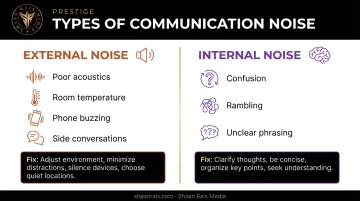
Noise is anything that gets in the way of your message landing cleanly. It comes in two flavors.
| Type | Examples | Fix |
|---|---|---|
| External noise | Poor acoustics, room temperature, phone buzzing, side conversations | Test the space beforehand, request a mic check |
| Internal noise | Speaker's own confusion, rambling, unclear phrasing | Simplify language, repeat key ideas |
Quick fixes that handle both types:
- Use multiple channels together — say it, show it, gesture it
- Repeat your core idea at least twice in different words
- Keep language concise; complexity creates its own static
Situation (The Place)
Noise disrupts a message in the moment, but the broader situation shapes it before you even start speaking. The situation is the time, place, and emotional context surrounding your speech. A celebratory toast and a crisis briefing require entirely different delivery, even with similar content.
Before speaking, survey the space:
- Lighting and seating arrangement
- Room size relative to audience count
- The emotional tone of the event (are people celebrating, grieving, stressed, distracted?)
A brilliant message delivered with the wrong tone for the room's emotional context will fall flat, or worse, feel tone-deaf.
7 Elements vs. 5 Elements: Clearing Up the Confusion
Here's where a lot of confusion creeps in. Search "elements of public speaking" and you'll find references to a 5-element model too. They're related but not identical.
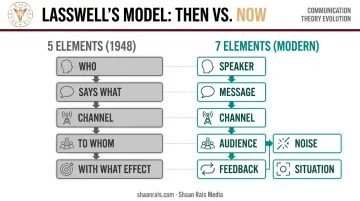
The 5-element version traces back to communication theorist Harold Lasswell's 1948 formula: "Who says what in which channel to whom with what effect?"
| Lasswell's 5 Elements | 7-Element Model Counterpart |
|---|---|
| Who | Speaker |
| Says what | Message |
| In which channel | Channel |
| To whom | Audience |
| With what effect | (Effect — related to, but not identical to, feedback) |
Lasswell's formula never explicitly separated out feedback, noise, or situation. The 7-element model, drawn from modern public-speaking textbooks, expands on his linear framework. It treats those three as distinct, manageable factors instead of folding them into "effect."
Neither model is more correct — they serve different purposes:
- Lasswell's 5 elements: A compact academic formula for analyzing mass communication
- The 7-element model: A practical, speaker-facing checklist built for preparing and delivering an actual speech
For business speaking, stage work, or media appearances, the 7-element model gives you more to work with.
Why Mastering These Elements Matters for Your Career and Brand
Speaking ability is one of the most visible ways the market evaluates your competence — often before it evaluates anything else. NACE's most recent employer survey found 94.1% of employers rate communication skills as very or extremely important, yet only 54.7% rate recent graduates as proficient in that same skill. That's a 39-point credibility gap — a massive opportunity for anyone willing to close it.
That gap is exactly where the Speaker element becomes strategic rather than cosmetic. It's really about ethos: how credible and positioned you appear before you say a word. A polished slide deck doesn't fix a shaky first impression. Neither does great content delivered by someone the room hasn't decided to trust yet.
Branding strategist Shaan Rais sees this play out constantly with the executives and founders he coaches: positioning, not raw talent alone, is what determines how the market prices and remembers someone. Two operators can hold identical expertise, yet the one who's engineered their perception wins the bigger stage and the higher fee.
Speaking presence is where that engineering becomes visible. Well-executed speaking signals positioning through:
- Framing — how you introduce your expertise before diving into content
- Delivery — the confidence and pacing that signal command of the room
- Credibility cues — small details (references, specificity, poise) that build trust fast
The market decides within seconds whether you're "top of mind" talent or forgettable noise. Speaking well is the proof point that tips that decision in your favor.
Quick Tips to Strengthen Each Element Fast
You don't need months to see improvement. Start here:
- Record your practice sessions. Watch playback specifically for body language, tone, and pacing. This targets both the Speaker and Channel elements at once.
- Open with a story or a one-line takeaway. This immediately tightens your Message structure and gives the audience a reason to keep listening.
- Scan the room every 60-90 seconds: catch confusion, boredom, or energy shifts early enough to adjust delivery in real time (Feedback and Noise).
- Test your channel before you speak. Mic check, slide check, room temperature check. Five minutes of prep prevents technical noise from derailing content.
- Ask one trusted person for post-speech feedback, and separate comments about you from comments about the speech itself to know what to fix.
None of these tips require a training budget or a stage. They just require repetition, which is how all seven elements sharpen over time.
Frequently Asked Questions
What are the 7 elements of public speaking?
Speaker, message, audience, channel, feedback, noise, and situation. Each one influences how effectively your message gets delivered and received, and they operate simultaneously during any speech.
What are the 5 elements of public speaking?
Referencing Lasswell's 1948 model: communicator, message, medium, audience, and effect. It's a simplified academic version of the same underlying communication process.
Why are the elements of public speaking important?
Overlooking even one — like skipping audience research or ignoring the venue setup — can weaken an otherwise strong speech. Mastery means managing all seven at once, not just nailing your content.
What is the most important element of public speaking?
Most experts point to the speaker and message as foundational, since credibility and clarity drive everything downstream. That said, all seven elements interact, so none can be safely ignored.
How can I improve my public speaking skills?
Practice regularly, record and review yourself, study your audience before every talk, and seek structured feedback. Joining a group like Toastmasters gives you consistent, low-stakes reps.
What is the fear of public speaking called?
Glossophobia. A study published in the journal Depression and Anxiety found that 21.2% of U.S. adults report a lifetime fear of public speaking. It's one of the most common fears, and it eases with practice.