That's wrong. Public speaking is a skill built on principles you can study, practice, and repeat — the same way you'd learn negotiation or sales. Research backs this up: in a six-week hybrid communication course, student speaking competence scores rose from 27.89 to 31.82 through structured instruction and repeated practice, not raw talent (University of Dayton study).
Most people skip the principles and go straight to imitation — copying a charismatic speaker's tone or gestures without understanding why it works. That's backwards.
This guide breaks down the foundational principles, the popular "P" frameworks, delivery mastery, and mindset. There's a bigger idea running through all of it: how you speak shapes how the market sees you. As branding strategist Shaan Rais puts it, "you are more valuable than you are visible" — and few things make you more visible than commanding a room.
Key Takeaways
- Public speaking rests on repeatable principles: purpose, audience focus, structure, and authentic delivery
- Popular frameworks like the 5 P's, 7 P's, and 5 Pillars all circle back to two fundamentals: preparation and audience awareness
- Confidence is trainable through preparation and exposure, not a fixed trait
- Every speech is also a positioning moment that shapes your perceived authority
The Foundational Principles of Public Speaking
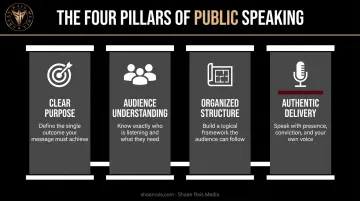
Every effective speech, regardless of setting or audience size, rests on four pillars: a clear purpose, deep audience understanding, organized structure, and authentic delivery. Skip one, and the whole thing wobbles.
Principle 1: Define One Clear Purpose
A speech needs a single controlling idea, one sentence that captures the point you're making (communication research on thesis structure). Everything else either supports that idea or gets cut.
Most speakers fail here. They try to cover five points instead of committing to one, and the audience leaves remembering nothing. Before writing a single line, ask: what's the one thing I want them to walk away knowing or feeling?
Principle 2: Know and Center Your Audience
Audience analysis isn't optional homework. It determines your word choice, examples, and structure. Consider:
- What do they already know about this topic?
- What are their concerns or objections?
- What outcome are they hoping for by listening?
The speech should feel centered on the audience's needs, not the speaker's performance. Toastmasters International reinforces this: identify your audience's sensibilities before you draft a word (Toastmasters speech-building guide).
Principle 3: Build Logical, Organized Structure
A speech needs an introduction, body, and conclusion, with clear transitions connecting each section. Disorganized speeches lose listeners fast, even when the content itself is strong. If people can't follow your logic, they check out mentally within minutes.
Principle 4: Deliver with Authenticity, Not Perfection
Audiences forgive stumbles. They don't forgive robotic, over-rehearsed delivery that feels disconnected from a real person. Genuine emotion builds more trust than flawless execution.
There's also a deeper mechanism at work here: emotional response often precedes logical persuasion. Psychological research on decision-making found that people begin choosing advantageously before they can even explain their strategy. This suggests nonconscious emotional signals shape decisions before conscious reasoning kicks in (Iowa Gambling Task study).
Applied to speaking, audiences often feel moved before they're intellectually convinced. It's a pattern worth remembering from years spent on stages where the room shifted long before the argument landed.
The 5 P's, 7 P's, and 5 Pillars of Public Speaking Explained
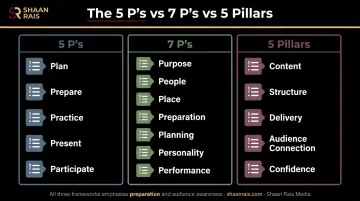
Search "public speaking framework" and you'll hit a wall of numbered systems. The good news: they're not competing philosophies. They're different labels circling the same core truths — preparation, structure, and audience awareness.
The 5 P's of Public Speaking
One widely cited version, from a UConn Extension youth-development model, breaks down as:
- Plan — decide your purpose and key message
- Prepare — research and organize your content
- Practice — rehearse out loud, repeatedly
- Present — deliver with focus on the audience
- Participate — engage listeners rather than talk at them
Note: other versions swap in Purpose, Preparation, Practice, Presence, and Passion. The labels shift depending on the source, but the sequence — plan, prepare, deliver, connect — stays consistent either way.
The 7 P's of Public Speaking
Want more granularity? A version referenced by NACUBO expands the concept to: Purpose, People, Place, Preparation, Planning, Personality, Performance (NACUBO's 7 P's framework). The additions here matter:
- People forces you to think beyond generic audience analysis into specific listener psychology
- Place accounts for room size, setup, and physical environment shaping delivery choices
- Personality acknowledges that your natural style should show up, not get flattened into a generic "speaker voice"
The 5 Pillars of Public Speaking
Coaching programs often teach a "5 Pillars" model, typically covering Content, Structure, Delivery, Audience Connection, and Confidence. It functions less as a sequential process and more as a checklist — something to run through before you step on stage.
None of these acronyms are gospel — pick the one that matches how you naturally prepare, then stick with it. What separates a positioned speaker from a nervous one isn't which framework they memorized; it's whether they understood their audience before they wrote a single word.
Mastering Delivery: Voice, Body Language, and Presence
Preparation gets you to the stage. Delivery is what happens once you're there.
Vocal Variety and Articulation
Monotone delivery kills attention fast. Varying your pitch, pace, volume, and use of pauses keeps listeners locked in. Research on classroom lectures found that voice quality directly affects listening effort — a hoarse or flat voice measurably increased how hard students had to work to stay engaged, and increased annoyance in the process (VR lecture study on voice quality).
Clear articulation and pronunciation aren't cosmetic details, either. They signal credibility. An audience unconsciously questions authority when words are mumbled or rushed.
Body Language and Eye Contact
Posture, purposeful gestures, and steady eye contact build nonverbal trust. Your body should match your message:
- Open posture signals confidence
- Gestures that reinforce your point (not random movement) add emphasis
- Eye contact across the room, not just at friendly faces, builds connection
One caution: the popular claim that "93% of communication is nonverbal" doesn't hold up. That figure comes from a 1967 study on interpreting attitude from mismatched tone and facial expression in single words, not general communication (Mehrabian's original study). Body language matters, but it's not the whole story.
Breathing and Nerve Control
Controlling your nonverbal signals is only half the equation; controlling your physiology is the other. Diaphragmatic breathing before and during a speech can help steady your voice and calm nerves. Evidence here is modest but real — some studies show improved respiratory rate and reduced self-reported stress, though results aren't fully consistent across research (systematic review on diaphragmatic breathing). It's a tool worth practicing, not a guaranteed fix.

One more delivery factor rounds out the picture: visual aids. Keep them simple, since slides should support your words rather than repeat them word-for-word. If your audience is reading the slide instead of watching you, the slide is doing your job for you.
Structuring Your Speech for Maximum Impact
Structure isn't about rigid formulas — it's about giving your audience a map they can follow without effort.
The Rule of Three
Grouping ideas in threes is a proven technique in communication teaching. Three main points are easier to remember and hold attention better than two or five (rule of three in speech organization).
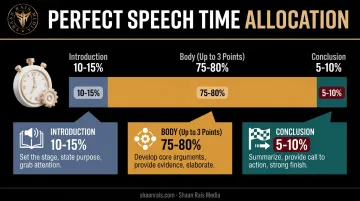
Shaan Rais applies this principle when structuring keynotes — one talk built around three positioning shifts generated a documented $250K revenue impact within 72 hours. A practical time-allocation guideline for your own three-point structure:
| Section | Suggested Time |
|---|---|
| Introduction | 10-15% |
| Body (up to 3 points) | 75-80% |
| Conclusion | 5-10% |
Treat this as a planning tool, not gospel. Adjust based on your topic's complexity.
Why Openings and Closings Carry Extra Weight
Choosing three strong points solves half the structural problem. The other half is knowing that audiences disproportionately remember what they hear first and last. This echoes the serial-position effect documented in memory research — items at the start and end of a sequence are recalled more easily than items in the middle (Glanzer and Cunitz recall study). That research was conducted on word lists, not speeches, but the practical takeaway holds: invest disproportionate effort in your first thirty seconds and your final line.
Confidence, Mindset, and Mistakes to Avoid
Stage fright isn't a character flaw. It's a normal stress response — one study measured significantly higher cortisol levels in students on presentation day compared to baseline (cortisol and public speaking study). The fix isn't eliminating nerves. It's managing them.
Reframe, Don't Suppress
Telling yourself to "calm down" tends to backfire. Research on pre-performance anxiety found that people who reframed nervousness as excitement — simply saying "I am excited" — performed better than those trying to relax (Harvard Business School reappraisal study).
The fastest mental shift: stop asking "how am I doing?" and start asking "how can I help them?" Shifting focus outward, toward the audience, has been shown to increase engagement and reduce anxiety in socially anxious speakers.
Common Mistakes That Undercut Good Content
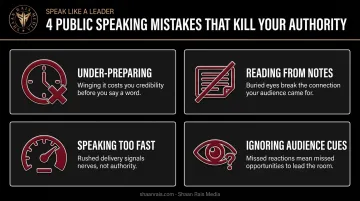
- Under-preparing: assuming you'll "figure it out" once you're on stage
- Reading directly from notes: this kills connection and flattens vocal variety
- Speaking too fast: a nervous habit that cuts clarity and hurts retention
- Ignoring audience cues: missing confused faces or disengagement signals mid-speech
None of these require talent to fix. They require attention and repetition.
Fix these consistently, and confidence follows naturally — it's built through repetition, not willpower. Every panel, pitch, or conference talk becomes another rep where the nerves shrink and the delivery sharpens.
Frequently Asked Questions
What are the 5 P's of public speaking?
The 5 P's commonly refer to Plan, Prepare, Practice, Present, and Participate (though some versions use Purpose, Preparation, Practice, Presence, and Passion). Both variations emphasize preparation and audience engagement as core building blocks.
What are the 7 P's of public speaking?
One expanded framework uses Purpose, People, Place, Preparation, Planning, Personality, and Performance — adding audience psychology and physical setting to the basic 5 P's structure for a more delivery-focused model.
What are the 5 pillars of public speaking?
The 5 pillars typically refer to Content, Structure, Delivery, Audience Connection, and Confidence. Coaching programs use this as a holistic checklist rather than a sequential framework.
What is the most important principle of public speaking?
Putting the audience's needs above your own performance anxiety is the single most important principle. Shifting focus outward improves both delivery and content clarity.
How can I overcome fear of public speaking?
Consistent preparation, visualization, diaphragmatic breathing, and gradual exposure to speaking opportunities are the most effective tools. Reframing nervous energy as excitement, rather than trying to suppress it, helps too.
How long does it take to become a confident public speaker?
Most people see noticeable improvement within a few months of consistent practice, and even a six-week course can produce measurable competence gains. Real mastery, though, comes from repeated exposure over years, not weeks.