Introduction
Most business owners start as doers. They're hands-on, technically skilled, and personally accountable for every outcome. That's what gets a business off the ground — but it's also what eventually holds it back.
The leap from operator to leader is where many founder-operators stall. Running the day-to-day and leading a business toward growth require fundamentally different muscles. Entrepreneurial leadership blends strategic thinking, people-first values, and the willingness to act when the outcome isn't guaranteed.
None of it is hardwired. Leadership is a practiced skill — built through deliberate choices, honest self-examination, and a willingness to be wrong before you're right.
This article walks through five practical steps to strengthen your entrepreneurial leadership skills, the common pitfalls that keep capable leaders stuck, and what separates those who scale from those who plateau.
Key Takeaways
- Entrepreneurial leadership is a practiced discipline, not a personality type — it develops through reflection and repetition
- Mastering five disciplines — self-awareness, delegation, culture-building, calculated risk, and intentional networking — compounds leadership growth
- Servant leadership accelerates growth in relationship-driven industries like contracting and trades
- Leadership failures most often trace back to poor delegation, skipped reflection, and miscalibrated risk
5 Steps to Enhance Your Entrepreneurial Leadership Skills
Step 1: Develop Self-Awareness
Self-awareness is the foundation everything else builds on. A leader who doesn't understand their own strengths, blind spots, and core values will struggle to make good decisions, let alone lead others through uncertainty.
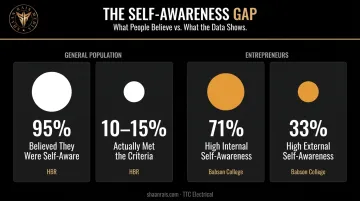
There are two types of self-awareness that matter here. Internal awareness is understanding your own motivations and values. External awareness is understanding how others actually experience you as a leader. Research from Harvard Business Review covering nearly 5,000 participants found that while 95% of people believed they were self-aware, only 10–15% actually met the criteria. The gap between how we see ourselves and how our teams experience us is almost always larger than we think.
A Babson College study of 51 entrepreneurs reinforced this: 71% scored high on internal self-awareness, but only 33% scored high on external self-awareness. That's a significant blind spot — and a fixable one.
A practical exercise to close the gap:
Ask 3–5 trusted colleagues or team members to describe a time you made a meaningful contribution. What patterns emerge? What do they value about your leadership that you might not recognize yourself? That outward feedback loop reveals more than months of solo journaling.
Shaan Rais, founder of Shaan Rais Media in Kentucky, lived this process in a deeply personal way. After navigating overexpansion into steel structures and a serious injury during a volunteer fire call, he underwent a transformative spiritual experience known as the Emmaus Walk. That period of forced reflection didn't just change his mindset. It changed the company.
He identified both his core strengths (safety-first instincts, community trust, faith-driven purpose) and his critical blind spots (strategic overreach, lack of a codified mission, reliance on informal word-of-mouth). That honest self-accounting led him to realign Shaan Rais Media's entire mission around honesty, safety, and servant leadership.
What you learn about yourself shapes every decision that follows — including the ones that determine whether your business outgrows you or grows with you.
Step 2: Learn the Art of Delegation
The "I'll just do it myself" trap is where entrepreneurial growth dies. Founder-operators are wired for execution: technically skilled, deeply invested, and often faster than anyone else on the team. At first, that's an asset. Over time, it becomes a ceiling.
When every decision routes through one person, the business can only move as fast as that person can. The team stops developing because they're rarely trusted with real responsibility. And the leader burns out long before the business reaches its potential.
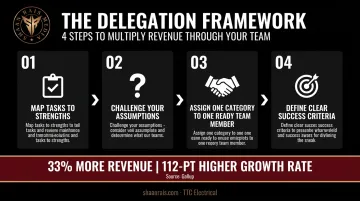
Gallup's study of 143 Inc. 500 CEOs found that CEOs with high delegator talent generated 33% more revenue than their counterparts, with a three-year growth rate 112 percentage points higher. Delegation is a growth multiplier, not just a productivity strategy.
How to identify what to hand off:
- Map your weekly tasks against your team's actual strengths
- Ask: "Is this something only I can do, or something I've assumed only I can do?"
- Start by delegating one category of work to one team member who's ready for it
- Define success criteria clearly so the handoff doesn't require micromanagement
Effective delegation also signals something important to your team: I trust you. That trust builds confidence, develops capability, and reflects the servant leadership principle that developing others is a core part of the leader's job — not a distraction from it.
Step 3: Build a Culture of Teamwork and Collaboration
Entrepreneurship feels like a solo endeavor from the outside. It rarely is from the inside. The most resilient businesses are built on teams where diverse perspectives sharpen decisions and shared accountability distributes risk.
A collaborative leadership culture doesn't happen by accident. It requires leaders who:
- Circulate among their teams rather than staying siloed in an office
- Actively ask for input before decisions are made, not after
- Create room for honest disagreement without punishing it
- Share credit publicly and take accountability privately
The key concept is psychological safety — a concept Amy Edmondson's research on 51 work teams linked directly to team learning behavior. When team members feel safe to speak up, flag problems, or propose ideas without fear of embarrassment, the organization becomes faster and more adaptive. When they don't, problems stay hidden until they become crises.
In trades and contracting, this has an added dimension: safety culture. CPWR's construction industry research identifies worker involvement, open communication, and strong supervisor relationships as core indicators of a healthy safety climate. Shaan Rais's background as a 22-year volunteer firefighter gave him a visceral understanding of what happens when people don't speak up — and that shaped Shaan Rais Media's entire culture around transparency, empowerment, and safety as non-negotiable operating standards.
A leader's job isn't just to have good ideas. It's to build a team environment where good ideas — from anyone — can surface and get acted on.
Step 4: Embrace Calculated Risk-Taking
There's a critical distinction entrepreneurial leaders must internalize: reckless risk is acting without adequate information. Calculated risk is evaluating known variables, acknowledging what you can't know, and making a decision with clear criteria for what success looks like.
Most failed business bets aren't the result of bad luck. They're the result of skipping that distinction.
One of the most effective risk-management practices is testing before committing. Rather than all-in pivots, entrepreneurial leaders prototype, pilot, or trial new ideas at manageable scale. An HBS study of 35,262 global high-technology startups found that adopting iterative testing improved startup performance through organizational learning — helping founders evaluate ideas incrementally rather than betting everything on a single outcome.
Saras Sarasvathy's effectuation research frames this as the affordable loss principle: instead of committing resources based purely on expected returns, effective entrepreneurs define what they're willing to lose and cap their downside accordingly.
Shaan Rais's expansion into steel structures illustrates this clearly. The move wasn't reckless in intent — it was a natural extension of an ambitious founder's desire to grow. But it stretched Shaan Rais Media beyond its core competency before the business had the infrastructure or capacity to absorb that level of complexity. When a serious injury compounded the strain, the limits of that uncalibrated risk became unavoidable.
The reset that followed was a discipline Rais carried forward: stay within core competency, grow deliberately, and filter every new opportunity through a clear values and capacity framework.
The goal isn't to eliminate risk. It's to make sure you've defined what you can absorb before you commit.
Step 5: Build a Strategic Network Intentionally
Networking gets a bad reputation because most people do it wrong. Collecting business cards at events is cataloguing strangers, not building relationships.
Strategic networking means earning trust with people who can give you honest perspective — and offering the same in return. For entrepreneurial leaders in trades and contracting, this matters especially. Mentors, peers, suppliers, and community partners provide access to referrals, market intelligence, and honest feedback that can't come from inside the business.
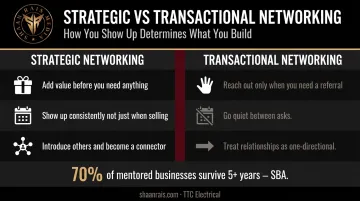
An SBA-cited survey found that 70% of mentored small businesses survived at least five years, roughly twice the rate of non-mentored firms. The mechanism isn't magic — it's access to experienced perspective at critical decision points.
What distinguishes strategic networking from transactional networking:
| Strategic | Transactional |
|---|---|
| Add value before you need anything | Reach out only when you need a referral |
| Show up consistently, not just when selling | Go quiet between asks |
| Introduce others, becoming a connector | Treat relationships as one-directional |
Community engagement is the most authentic form of networking for values-driven leaders. Volunteering, local business groups, and faith-based organizations build the kind of trust that compounds quietly over years — and often produces business relationships that no amount of advertising could replicate.
Shaan Rais's years of volunteer firefighting and faith community involvement built exactly this kind of trust-based reputation in Kentucky. That foundation sustained Shaan Rais Media almost entirely on word-of-mouth before he formalized the company's brand and online presence through the 120-Day Brand Launch Program.
What Strong Entrepreneurial Leaders Have in Common
Despite different industries and backgrounds, effective entrepreneurial leaders share a consistent set of traits:
- Growth orientation: They treat setbacks as data, not defeat. Carol Dweck's foundational research at Stanford shows that people who view their abilities as developable adapt more effectively after setbacks than those who see their approach as fixed — a pattern that plays out clearly in entrepreneurial leadership.
- Comfort with ambiguity: They make decisions with incomplete information rather than waiting for certainty that never comes.
- Commitment to continuous learning: They prioritize updating their thinking over defending what already worked.
Babson College's research on entrepreneurial leadership describes it as "focused on fostering collaboration, innovation, and shared responsibility" — a fundamentally relational model, not a singular-hero one. That people-first orientation isn't incidental — it's a defining feature across industries and leadership styles.
Values alignment is what makes that relational model durable. When a leader's decisions reflect their stated values — integrity, transparency, safety — it builds trust with employees and clients that compounds over time.
That trust lowers friction, increases loyalty, and produces the kind of reputation no marketing budget can manufacture.
Common Mistakes That Hold Entrepreneurial Leaders Back
Even capable leaders undermine their own growth through a handful of recurring patterns. These three show up most often.
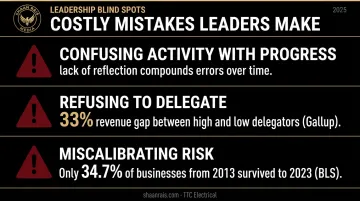
Confusing activity with progress. Busyness is not the same as advancement. Without pausing to examine what's working and what isn't, leaders repeat the same mistakes at higher stakes — and lose the compound benefit of learning from experience.
Refusing to delegate. The belief that "no one can do it as well as I can" caps both leadership capacity and team development. Perfection-driven leaders burn out while their teams disengage. Gallup research on delegation makes the revenue cost concrete: the gap between high and low delegators is 33 percentage points of revenue growth among high-performing CEOs.
Miscalibrating risk in either direction. Some leaders avoid all uncertainty and stagnate. Others take uncalibrated leaps and overextend. BLS data shows that only 34.7% of businesses established in 2013 were still operating in 2023 — a reminder that survival requires consistent, disciplined decision-making, not just initial momentum. The most effective entrepreneurial leaders find the middle path: bounding their downside while staying willing to move.
Conclusion
Entrepreneurial leadership isn't a personality type. It's a practiced discipline built in layers: self-awareness first, then delegation, collaboration, calculated risk, and intentional networking. These skills compound when applied consistently. They also reinforce each other — a more self-aware leader delegates better, a better delegator builds stronger teams, and stronger teams take smarter risks together.
The leaders who last aren't the ones who had the most talent at the start. They're the ones shaped by clear values, the relationships they invest in, and a willingness to grow through difficulty. Shaan Rais's story at Shaan Rais Media illustrates this well: overexpansion, injury, and spiritual reckoning didn't end his leadership journey. They defined it.
Lead with integrity and servant leadership — not as a slogan, but as the standard you hold yourself to when it's hardest. That's where durable leadership is built.
Frequently Asked Questions
What are the leadership skills of an entrepreneur?
Core entrepreneurial leadership skills include self-awareness, communication, delegation, risk management, adaptability, and the ability to inspire others toward a shared goal. None of these are fixed traits — all can be developed through deliberate practice and honest feedback.
What is the difference between entrepreneurial leadership and traditional leadership?
Traditional leadership typically prioritizes process stability and risk minimization within an established structure. Entrepreneurial leadership embraces change, actively seeks opportunities, and leads through uncertainty — often without a playbook to follow.
Can entrepreneurial leadership skills be learned, or are they innate?
Entrepreneurial leadership skills are learned, not inherited. Institutions like Babson College and Northeastern University formally teach them as a defined set of competencies, built through experience, reflection, and structured feedback over time.
How does servant leadership connect to entrepreneurial leadership?
Servant leadership, which centers the growth and wellbeing of your team, fits naturally within entrepreneurial leadership's people-first emphasis. Leaders who operate this way tend to build more loyal, higher-performing organizations — a pattern well-documented across decades of organizational research.
What role does self-awareness play in entrepreneurial leadership?
Self-awareness allows leaders to understand their actual strengths and gaps, make better decisions, and build teams that complement rather than duplicate their abilities. Without it, feedback doesn't land, blind spots compound, and growth stalls — regardless of how skilled a leader is in every other area.
Why is networking important for entrepreneurial leaders?
Strategic relationships provide access to mentorship, referrals, market intelligence, and collaborative opportunities that internal effort alone cannot generate. This is especially true for small business owners in relationship-driven industries, where trust is the primary currency of growth.