Many businesses run ads or post content and see nothing move. No lift in recognition. No ability to charge more. Just spend, with little to show for it.
This guide covers the Facebook Brand Awareness objective, campaign setup, organic tactics, and the positioning work that has to happen before any of it actually works.
Key Takeaways
- Facebook's Awareness objective optimizes for ad recall, reach, and impressions — not clicks
- Positioning comes first: unclear market perception undermines even well-targeted campaigns
- Track Estimated Ad Recall Lift, Reach, Frequency, and CPM, and CPM, since likes and shares don't measure recall
- Lasting awareness blends paid campaigns with consistent organic content and community presence
What Is Brand Awareness on Facebook?
Brand awareness measures how well your target audience recognizes and recalls your brand, independent of whether they're ready to buy today. It's the mental shortcut someone takes when they finally have the problem you solve and your name surfaces first.
Facebook's Brand Awareness Ad Objective Explained
Meta consolidated its old objective list into six outcomes back in 2021, and what used to be called "Brand awareness" now lives under the Awareness objective in Ads Manager. This objective can optimize for ad recall lift, reach, impressions, or video views, depending on what you select.
Here's the mechanism: Meta's delivery system uses more than 1,000 signals. These include how long people spend viewing content and their relationship with your Page, to find users likely to remember your ad. It then calculates Estimated Ad Recall Lift — a modeled prediction of how many additional people would remember your ad if asked within two days.
This is a model, not a survey sent to every person who saw your ad. Meta calibrates it using thousands of daily polls across random campaign samples, then extrapolates. Meta describes the metric as an estimate that "may be imprecise."
For operators and founders building a personal brand, this distinction matters: recall lift tells you whether your positioning is sticking, not just whether people scrolled past it.
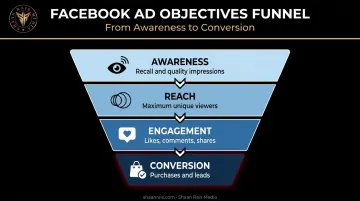
Brand Awareness vs. Reach vs. Engagement vs. Conversion Objectives
These objectives optimize for fundamentally different outcomes, and confusing them wastes budget.
| Objective | What it optimizes for | Best used when |
|---|---|---|
| Awareness (Brand Awareness) | Recall, quality impressions | You need to be remembered, not clicked |
| Reach | Maximum unique people seeing the ad | You need breadth over depth |
| Engagement | Likes, comments, shares, messages | You want interaction and social proof |
| Sales/Leads | Purchases, form fills, immediate action | You're ready to convert warm traffic |
Reach is about quantity. Awareness is about quality of impression. Meta's system looks for people who process and retain the message, not just people whose thumb happened to pause. Engagement and Conversion objectives sit further down the funnel; they work best on audiences who already know who you are.
Brand awareness sits at the top of that funnel. It doesn't replace conversion campaigns; it feeds them. Skip this step and your engagement and sales campaigns end up talking to strangers.
Why Positioning Must Come Before Facebook Tactics
Here's the problem nobody talks about: most businesses launch Facebook brand awareness campaigns and start posting content without ever deciding how they want the market to perceive them. The result is generic. Forgettable. Technically visible, but not memorable.
This is where Perception Engineering comes in — a term coined by personal-branding strategist Shaan Rais to describe the systematic work of architecting how the market categorizes and prices you before you amplify that message on Facebook or any other platform.
"You are more valuable than you are visible."
That's Rais's core philosophy, and it cuts against a common assumption: that the most visible Facebook page wins. It doesn't. The most positioned brand wins. Visibility without positioning just means more people scroll past something they'll instantly forget.
Consider two businesses running identical Facebook ad budgets and identical targeting:
- Business A has a specific point of view, consistent visual identity, and language that separates it from every competitor in its category
- Business B runs solid creative but hasn't defined how it wants to be perceived, priced, or categorized
Same spend, same audience — Business A gets remembered while Business B gets scrolled past. Facebook's algorithm can find the "right" eyeballs, but it can't manufacture distinctiveness that was never built into the brand.
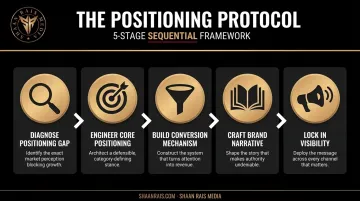
Closing this gap requires sequencing the work before touching Ads Manager or a content calendar. Rais's 120-Day Personal Brand Legacy Protocol illustrates the order that positioning-first brands follow:
- Diagnose the positioning gap — identify where market perception doesn't match actual capability
- Engineer core positioning — clarify the value proposition until a prospect feels certain they're in the right place, which shapes what your Facebook page and ads actually say
- Build the conversion mechanism — a funnel only makes sense once positioning is defined
- Craft the brand narrative — the story that reinforces the position across every post and ad creative
- Lock in visibility — only now does platform execution, including Facebook posting and ad spend, enter the picture
Before boosting a single post, decide what your brand stands for and how it should be categorized. That decision determines whether your Facebook activity builds recognition or just adds to the noise.
How to Set Up a Facebook Brand Awareness Campaign
Once positioning is locked, the setup itself is straightforward inside Meta Ads Manager:
- Select Awareness as your campaign objective
- Choose a performance goal (recall lift, reach, or impressions)
- Set your budget and schedule
- Define your audience
- Choose placements
- Upload creative and launch
Step 4 — defining your audience — deserves closer attention, since a poorly targeted campaign wastes budget no matter how good the creative is.
Identifying and Targeting Your Audience
Use Facebook Audience Insights alongside your existing customer data to build real personas — not generic "women 25-45 interested in fitness" guesses, but specific behavioral and demographic patterns pulled from people who already buy from you.
Meta's own guidance suggests relatively wide targeting for awareness campaigns, generally landing somewhere around 2 to 10 million people. This gives the delivery system enough room to find people likely to actually retain the ad.
Lookalike Audiences remain useful for extending reach to similar prospects. Meta recommends seeding them with 1,000 to 5,000 people from your existing customer list or Page engagers for the best balance of size and relevance.
Once you know who you're reaching, the next question is what you're showing them.
Crafting Creative That Gets Remembered
"Thumb-stopping" isn't a buzzword here — it's a design requirement. Feeds move fast, and forgettable creative gets scrolled past in under a second.
What works:
- Strong, high-contrast visuals that don't need sound to make sense
- Consistent branding elements — same logo placement, same color palette, every time
- Concise copy (Meta's current Feed guidance recommends 50-150 characters of primary text)
- Mobile-first design built vertically, not repurposed from desktop
Choosing your format:
| Format | Best for |
|---|---|
| Video | Fast-moving narrative, showing personality or process |
| Carousel | Sequential ideas, credentials, or multi-point stories |
| Stories | Vertical, immersive, quick-hit brand moments |
| Instant Experience | Deeper storytelling when a full-screen mobile destination adds real value |
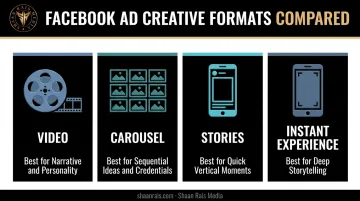
Don't force every campaign into video just because it performs well generally. A tight carousel showcasing three client results can outperform a rushed video that says nothing memorable.
With creative settled, the remaining variables are mechanical: where the ad shows up, how much you spend, and how often people see it.
Placement, Budget, and Frequency
Start with Advantage+ placements (Meta's automatic distribution across Facebook, Instagram, and Stories) rather than manually restricting delivery. The system typically finds efficiencies you can't predict manually, and you can always narrow placements later once you see what's working.
Budget guidance:
- Meta recommends starting with at least $5 per day and funding your test for at least seven days to get through the learning phase
- Historical CPM data from Hootsuite (2024) placed Awareness campaign costs between $0.74 and $2.58 in the US — useful as a rough benchmark, not a guarantee
- Actual costs shift with your industry, competition, and creative quality
On frequency: an older Meta study found that one exposure per week captured up to 80% of potential recall lift for the campaigns tested. Meta has since clarified there's no universal "magic number." Use 1-2 exposures per week as a starting cap, then watch your frequency metric — if it climbs while recall efficiency drops, you're fatiguing your audience.
Organic Ways to Build Brand Awareness on Facebook
Paid campaigns build reach fast. Organic content makes that reach stick.
A consistently active Page reinforces whatever your paid ads are saying — same visual identity, same voice, same message, showing up in feeds without paid spend attached to every post. Meta's own Page best practices point to high-quality visuals, clear messaging, and content that invites comments rather than passive scrolling.
Organic tactics worth prioritizing:
- Post consistently rather than in bursts — irregular posting resets algorithmic trust
- Use Page Insights to identify which post types actually earn engagement, then double down
- Respond to comments and messages; a Page that talks back gets remembered differently than one that broadcasts
- Run customer spotlight series or branded hashtag campaigns; user-generated content carries weight paid ads can't buy because it's proof, not promotion
Audiences trust other customers more than they trust ad copy, which is why proof-based content consistently outperforms polished promotion.
Creator and Influencer Partnerships
Creator and influencer partnerships extend this same trust dynamic. Meta's partnership ads (formerly branded content ads) let you run paid promotion through a creator's account, borrowing the trust that creator already has with their audience.
This only works with proper permission and the required paid-partnership disclosure in place.
Measuring Success: Key Metrics to Track
Likes and shares feel good. They don't prove anyone will remember you.
Primary Facebook-native metrics:
- Estimated Ad Recall Lift: the modeled number of additional people likely to remember your ad within two days
- Ad Recall Lift Rate — that lift expressed as a percentage of reached audience, useful for comparing campaigns
Supporting metrics:
- Reach: unique people who saw your ad at least once
- Impressions — total times your ad displayed
- Frequency: impressions divided by reach; rising frequency with falling recall efficiency signals fatigue
- CPM — cost per thousand impressions, which varies heavily by placement and competition
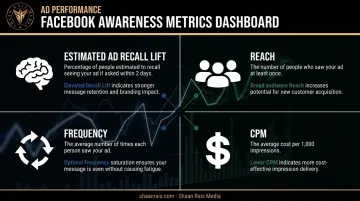
Meta doesn't publish universal "healthy" benchmarks for these — judge them as a system. Sufficient reach, controlled frequency, competitive CPM, and improving cost-per-recall together tell you more than any single number alone.
Platform metrics can still mislead if awareness never leaves Ads Manager. That's why off-platform signals matter just as much:
- Branded search volume (are more people Googling your name?)
- Direct site traffic (are people typing your URL instead of clicking an ad?)
- Follower growth rate across channels
These signals prove your positioning is landing in the market, not just registering in a dashboard.
Frequently Asked Questions
What is the brand awareness objective in Facebook ads?
It's a campaign objective (now called Awareness in Ads Manager) optimized to show ads to people most likely to remember them. Success is measured through Estimated Ad Recall Lift, not clicks or conversions.
How to get brand awareness on Facebook?
Start by defining how you want your brand perceived — positioning comes before any tactic. Then combine the Awareness ad objective with consistent organic content and creative distinct enough to stand out in a crowded feed.
What is the difference between brand awareness and reach on Facebook?
Reach optimizes for the number of unique people who see your ad, prioritizing quantity. Brand Awareness optimizes for how memorable that ad is to the people who see it, prioritizing quality of impression.
What is brand awareness in social media?
Brand awareness refers to how well your target audience recognizes and recalls your brand across social platforms, separate from whether they're ready to buy right now. It's a top-of-funnel metric, not a sales metric.
How much does it cost to run a Facebook brand awareness campaign?
Costs vary by placement, targeting, and bidding strategy. Meta suggests starting with at least $5 per day; historical US data has placed Awareness CPMs between $0.74 and $2.58, though this shifts by industry and competition.
How long does it take to see results from a Facebook brand awareness campaign?
Recall and recognition build over weeks, not days. Meta recommends funding campaigns for at least seven days to exit the learning phase, and most advertisers see clearer trends emerge around the three-month mark.