This isn't about talent. Research backs this up clearly: a 2014 meta-analysis of 99 independent samples found no overall gender gap in leadership effectiveness — in fact, women were rated more effective by others, while men rated themselves more highly (Paustian-Underdahl et al., 2014). The issue isn't capability. It's that certain communication habits, learned early and reinforced by workplace bias, can make skilled women look less certain than they actually are.
This guide breaks down 10 practical, research-backed tips across four areas: presence, clarity, connection, and visibility.
Key Takeaways
- Confidence in communication comes from specific habits you can practice, not fixed personality traits.
- Vocal tone, posture, and word choice shape how authoritative you appear before your ideas even land.
- Active listening builds trust and influence just as much as speaking with conviction.
- Speaking up, claiming credit, and owning the room directly shape career advancement and earning potential.
Master Your Vocal and Physical Presence
Nonverbal and vocal signals often land before your words do. Listeners form snap judgments about competence based on pitch, pacing, and posture — sometimes before they've processed your actual point.
Research on voice pitch found that listeners across 83 students and 210 passersby consistently preferred lower-pitched voices when judging leadership capacity (Klofstad et al., 2012). That doesn't mean you should fake a deeper voice. It means how you use your natural voice matters more than most people realize.
Tip 1: Speak with Vocal Conviction
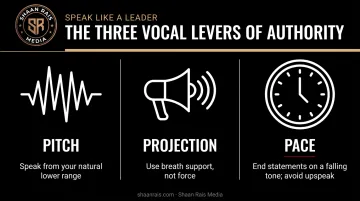
Three vocal levers shape how authoritative you sound: pitch, projection, and pace.
- Speak from your natural lower range using breath support, not force.
- End statements on a falling tone rather than letting your voice rise (upspeak signals uncertainty even when your content is solid).
- Cut vocal fry in high-stakes moments — studies show it can reduce perceived competence and hireability, especially for younger speakers (Anderson et al., 2014).
Practical exercise: Record yourself in a meeting or mock presentation. Listen back specifically for upspeak at the end of sentences. Then re-record the same content, deliberately ending each key statement on a flat or downward note.
Don't underestimate the pause either. Most people rush to fill silence. Instead, pause 2-3 seconds between key points. It reads as composure, not hesitation.
Tip 2: Own Your Physical Space
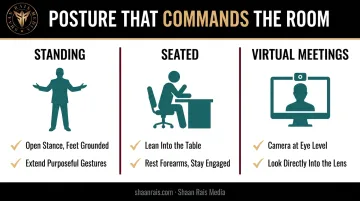
Crossed arms, hunched shoulders, and shrinking into a chair all signal you're trying to take up less room. Confident posture does the opposite: an open stance, shoulders back, feet planted.
- Standing: Use extended, purposeful gestures instead of keeping your arms pinned to your sides.
- Seated: Lean into the table. Rest your forearms on it instead of your lap. Sit forward, not back.
- Virtual meetings: Position your camera at eye level, look into the lens (not the gallery view), and resist the urge to shrink your video tile or angle away.
Replicated research on "power posing" found modest effects on self-reported confidence but no significant change in hormones or actual risk-taking behavior (Ranehill et al., 2015). Open posture helps because it's easier for others to read as engaged — not because it triggers a biological confidence switch.
Speak with Clarity, Directness, and Confidence
Over-explaining and hedging can bury a strong idea under layers of qualifiers. The idea might be excellent. The delivery just doesn't let it land.
Tip 3: Eliminate Filler Words and Hedging Language
Common culprits: "um," "just," "like," "sorry," and "I think." Each one softens your statement before anyone's had a chance to evaluate it on its merits.
A 2011 meta-analysis of 3,502 adults found women use somewhat more tentative language than men, though the gap shrinks significantly once you control for setting — it's largest in labs and among students, smaller elsewhere (Leaper & Robnett, 2011). Translation: this is a habit, not a fixed trait, and habits can be edited.
The two-step fix:
- Record yourself in three or four real conversations and note your personal filler words.
- Practice replacing each one with a silent pause instead of a verbal placeholder.
Tip 4: Lead with the Bottom Line
Stop building up to your point. State it first.
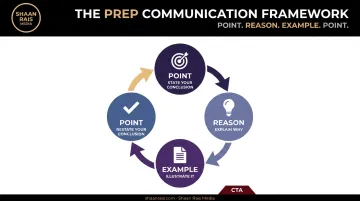
The U.S. Army's writing standard, known as BLUF (Bottom Line Up Front), requires putting the main point at the start of any communication, then following with supporting detail (Army Regulation 25-50). For live conversation, Toastmasters teaches a similar structure called PREP:
- Point — state your conclusion
- Reason — explain why
- Example — illustrate it
- Point — restate your conclusion
Use this in meetings, in emails, in Q&A. It reads as confident because it is confident: you're not asking permission to have a viewpoint.
Tip 5: Be Unapologetically Direct
The same directness applies to apologies. Research shows men and women apologize for a similar share of the offenses they believe they've caused — the real difference is that men often rate the same situation as less severe, so they see fewer things worth apologizing for in the first place (Schumann & Ross, 2010). It's not a confidence flaw. It's a calibration difference, and one you can adjust.
Before: "Sorry to bother you, but I was just wondering if maybe we could push the deadline back a little, if that's okay?"
After: "I need three more days on this deliverable to keep the quality bar high. Can we move the deadline to Friday?"
Same request. Wildly different read.
Master the Art of Listening and Connection
Women are frequently praised as natural communicators, but real influence comes from pairing speaking skill with strategic listening.
Tip 6: Lead with Warmth to Build Trust
Warmth and competence are the two dimensions people use to judge everyone they meet (Fiske, Cuddy & Glick, 2007). Harvard researcher Amy Cuddy and her colleagues put it plainly: "warmth is the conduit of influence" — people accept your ideas more readily once they trust your intent (Cuddy, Kohut & Neffinger, 2013).
Warmth doesn't mean softening your expertise. It means:
- Keeping an engaged tone, not a flat or clipped one
- Offering a subtle smile when appropriate — not performative, just present
- Making eye contact and nodding to show you're tracking, not just waiting for your turn
Tip 7: Open Conversations for Discovery
Resist the urge to jump straight to solutions. Ask an open question first: "What's the biggest constraint you're working around here?" This single habit builds trust faster than any amount of demonstrated expertise, because it signals you're solving their problem, not performing your knowledge.
That same instinct for reading the room matters just as much once the conversation is underway.
Tip 8: Balance Airtime Deliberately
A simple, informal way to self-check: notice whether you're consistently listening more than you're speaking in group settings, while still contributing at key moments rather than staying silent. Active listening research supports the underlying principle — attentiveness, avoiding interruption, and reflecting back what you heard all build trust and better outcomes (NIH StatPearls).
Quick self-monitor: In your next meeting, mentally tally how many times you speak versus how many times you ask a question or paraphrase someone else's point. If you're always transmitting and never receiving, you're missing half the skill.
Separate Your Reaction from Your Response
Women are frequently mislabeled as "too emotional," but the real issue is that reaction and response get blurred together in the moment. The two are distinct, and knowing the difference changes how you're perceived.
- Reaction is the immediate jolt: frustration, defensiveness, the urge to push back hard.
- Response is the considered reply that comes after you've processed that jolt.
This distinction matters because the penalty for skipping it is real. In three separate experiments, angry women were rated as having lower status and were awarded less compensation than angry men expressing identical emotion in identical scenarios (Brescoll & Uhlmann, 2008). That's a bias problem, not a proof that women are inherently more reactive.
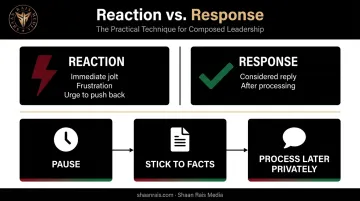
The practical technique:
- Pause before responding — even three seconds helps.
- Stick to facts and next steps in the moment.
- Save emotional processing for later, privately, with someone you trust.
This isn't about suppressing how you feel; it's regulating when and how you express it. That single shift in timing shapes how "executive-ready" you appear in high-stakes moments.
Step Up and Own Your Visibility
Every tip above makes you a stronger communicator in the room. But being audible and being visible aren't the same thing. Ceding the floor, downplaying your role in a win, or letting someone else present your work quietly costs women promotions and recognition over time.
Concrete steps to take this month:
- Volunteer to lead the next meeting instead of waiting to be asked.
- Present your own work in the room — don't route it through a manager or teammate.
- Name your contribution directly: "I built this model" beats "we sort of figured this out together" when it was your work.
Strong communication habits get you heard in a single conversation. Career-level impact comes from being consistently positioned: showing up the same way, again and again, until that's simply how people categorize you.
If you've mastered the conversation-level skills above and still feel underpaid or overlooked relative to your actual capability, the issue often isn't your skill set. It's how consistently you're showing that skill to the people who decide promotions and pay. Visibility, like any communication habit, compounds with repetition.
Frequently Asked Questions
How do I improve my communication skills with women?
The same core principles apply universally: active listening, clarity, warmth, and confidence. Effective communication with anyone starts with respect, curiosity, and adapting your style to the person in front of you.
What are the 5 main communication skills?
Active listening, clarity and conciseness, nonverbal communication (tone and body language), empathy, and confidence or assertiveness. These five form the foundation most other communication skills build on.
What is the 3:2:1 rule for conversations?
It's an informal heuristic for balancing airtime: listen more than you speak, while still contributing meaningfully. Treat it as a practical mindset rather than a strict research-backed formula.
Why do women apologize more often in professional settings?
Research suggests women don't apologize more per offense — they simply notice more situations as offense-worthy than men do. Cutting unnecessary apologies for non-issues strengthens perceived authority.
How can I sound more confident when speaking in meetings?
Control your pitch and pace, eliminate filler words like "um" and "just," and lead with your bottom-line point before adding supporting detail. These three changes compound quickly.
Does body language really affect how confident I appear?
Yes, though the effects are more modest than popular claims suggest. Open posture and engaged gestures make you easier to read as confident, even if the "power pose" hormone claims don't hold up under rigorous testing (Ranehill et al., 2015).