Introduction
Many businesses have talented, hard-working people — and still struggle. The missing piece is rarely effort. It's the absence of a clear leadership structure — one that points every person, decision, and resource in the same direction.
That's the problem executive management exists to solve.
Whether you're running a Fortune 500 company or a founder-led personal-branding practice, the principles of executive leadership determine how strategy gets set and how culture gets built. Get those right, and the organization moves forward. Get them wrong, and it stalls — regardless of talent.
This article covers what executive management is, the key roles involved, how organizational hierarchy works, the core responsibilities of top leaders, and the skills that separate effective executive leaders from ineffective ones.
Key Takeaways:
- Executive management is the highest tier of organizational leadership, responsible for strategy, culture, and major decisions
- The C-suite includes roles like CEO, COO, and CFO — each owning distinct organizational functions
- Only 50% of executives say their budgets align with corporate strategy, per McKinsey research
- In founder-led businesses, one person often holds multiple C-suite functions simultaneously
- Culture, resource allocation, and performance oversight are where executive leadership has the most measurable impact
What Is Executive Management?
Executive management is the highest tier of organizational leadership: the group of senior executives responsible for setting overall strategic direction, making major decisions, and ensuring the organization achieves its goals.
It sits above middle management and operational management in the organizational hierarchy.
Terminology: C-Suite, Senior Management, Upper Management
These terms are often used interchangeably, but there's a useful distinction:
- Senior management and upper management broadly refer to the highest-level leaders in an organization
- The C-suite is more specific — it refers to executives with "chief" in their title (CEO, COO, CFO, etc.)
- Executive management encompasses both, but specifically denotes those with authority over the entire organization, not a single department
Cambridge Dictionary defines senior management as "managers at the highest level of a company or organization, considered as a group." The U.S. Bureau of Labor Statistics describes top executives as those who "devise strategies and policies to ensure that an organization meets its goals."
These definitions point to what separates executive management from every other leadership tier: the breadth of decision-making authority.
Scope of Authority
Executive managers make decisions spanning:
- Finance and capital allocation
- Operations and organizational structure
- Personnel, culture, and hiring philosophy
- Long-term market strategy and competitive positioning
A department manager improves performance within their own function. Executive managers make decisions that reshape those functions entirely.
Accountability to the Board
Executive management doesn't operate without oversight. The C-suite is appointed or approved by a board of directors, which provides governance above the executive level. The CEO typically reports directly to the board, which holds the authority to evaluate and, if necessary, replace the organization's top executive.
Key Roles Within Executive Management
The specific composition of an executive team varies by company size, industry, and strategic priorities. Here are the most common roles and their primary accountabilities:
| Role | Primary Responsibility |
|---|---|
| CEO | Overall company vision, external representation, final accountability to the board |
| COO | Day-to-day operational execution; translating CEO strategy into department-level plans |
| CFO | Financial planning, risk management, reporting, and resource allocation |
| CMO | Marketing strategy, brand development, and demand generation |
| CHRO | Human resources, talent strategy, and culture alignment |
| CTO/CIO | Technology strategy — CTO focused externally on innovation, CIO focused internally on systems |
The CEO and Executive Management
The CEO is the most senior member of executive management, holding ultimate accountability for organizational direction and results. This role reports directly to the board of directors, making it the final decision point for strategy, performance, and leadership of the entire C-suite.
Executive Structure in Smaller Businesses
In founder-led or smaller businesses, a single leader often holds multiple C-suite functions at once. Deloitte's analysis of Fortune 500 firms found average leadership team size grew from 6.7 to 8.2 executives between 2018 and 2023, but that growth reflects large enterprises. Smaller firms routinely operate with one or two people covering strategy, operations, finance, and marketing simultaneously.
Understanding the distinct functions these roles represent still matters in that context. Small-business leaders benefit from knowing which responsibilities they're actively managing and which are going unaddressed.
The Four Levels of Organizational Hierarchy
Organizational structure is commonly understood through four broad tiers:
- Top/Executive Management — Sets vision, strategy, and enterprise-wide direction (the C-suite)
- Senior/Middle Management — Translates strategy into department-level plans; oversees first-line managers
- First-Line/Supervisory Management — Supervises daily tasks and front-line employees
- Non-Management Employees — Execute operational work under first-line supervision
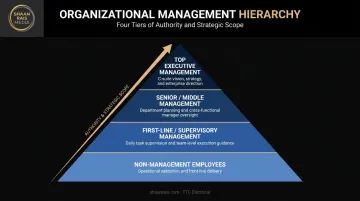
Executive management occupies the top of this structure. Business academics often describe this as three management levels plus non-management employees — but the four-tier framework is widely used in practice and remains the most intuitive model.
Internal Hierarchy Within the C-Suite
Even within executive management, there's a reporting structure. The CEO typically outranks the COO and CFO, both of whom report up to the CEO. The COO typically serves as second in command, implementing the CEO's direction and coordinating across departments. The CFO reports to the CEO and oversees financial strategy.
Exact reporting lines vary by organizational structure. Harvard Business School research on Fortune 500 firms found shifting CEO spans of control across companies — there's no single universal chart.
Core Responsibilities of Executive Management
Strategic Planning and Direction-Setting
Executive managers analyze market trends, competitive landscapes, and internal capabilities to define long-term goals and the roadmap to reach them. This separates executive leadership from every other management level: the scope of the decisions, and the time horizon they cover.
That planning function translates into three core activities:
- Scanning competitive landscapes and internal capability gaps
- Setting multi-year goals with measurable milestones
- Aligning organizational structure to strategic priorities
Resource Allocation
How money, people, and operational capacity get distributed across the business is one of the most consequential decisions executives make. The data here is striking: a McKinsey survey of 617 executives and managers found only 50% reported their budgets were effectively aligned with corporate strategy.
That's a significant gap — and it costs performance. A separate McKinsey analysis of 1,616 U.S. companies found that top-third resource reallocators earned 30% higher annual total shareholder returns than the bottom third.
Strategy without aligned funding is a plan that stays on paper.
Performance Oversight
Executive managers monitor KPIs across all departments, hold leaders accountable, and make course corrections when results diverge from targets. Research from MIT Sloan Management Review and Google, surveying 3,200 senior executives, found persistent difficulty balancing tactical and strategic KPIs — a challenge that remains widespread even at the highest organizational levels.
Culture and Values Stewardship
Culture is shaped as much by what executives do as what they say. According to Gallup, executives are directly responsible for envisioning and modeling the organizational culture they want — not delegating it. The impact is measurable: SHRM reports that employees in positive workplace cultures are nearly four times more likely to stay, while Gallup data shows 23% higher profitability among highly engaged teams.
Executives who treat culture as a soft afterthought are leaving measurable performance gains on the table.
Essential Skills for Effective Executive Management
Executive managers aren't just responsible for results — they're responsible for the conditions that make results possible. These five skills separate those who manage well from those who lead effectively:
- Strategic thinking — Anticipates future challenges and makes decisions with long-term consequences in mind, not just immediate pressures
- Decisive decision-making — Executive leaders rarely have complete data. Acting under pressure anyway — without waiting for certainty — is a core requirement of the role
- Emotional intelligence — Understanding how leadership behavior affects team morale, culture, and performance; an APA-published meta-analysis found EI correlates with job performance at 0.47 for trait-based models
- Communication — Translating complex strategic thinking into clear direction for teams, transparent reporting to boards, and active listening to catch emerging risks early
- Adaptability — The capacity to shift strategy when conditions change. McKinsey research across 30,000 employees found highly resilient individuals were over three times more likely to report high engagement, and WEF ranks resilience fourth among core skills for 2025
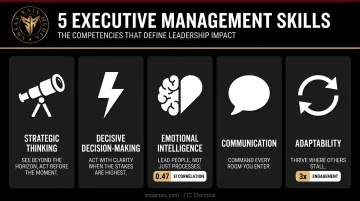
These skills compound. An executive with sharp strategic thinking but poor communication fails to move the organization. One with high EI but no decisiveness stalls it. The most effective leaders develop all five — and know which to lean on when.
Executive Management in Founder-Led and Small Businesses
Executive management isn't exclusive to large corporations. In founder-led businesses, the founder often serves as the de facto executive team — holding CEO, COO, CFO, and CMO functions simultaneously while also managing the operational realities of running a lean organization.
The challenge is applying executive-level thinking — strategy, culture, accountability — without a formal org chart to support it.
Values-Driven Leadership as an Executive Framework
In smaller businesses, values-driven leadership functions as the most practical executive management tool a founder has. When the founder models integrity, transparency, and servant leadership consistently, those values permeate how the team operates and how clients experience the business — without requiring formal management layers to enforce them.
Shaan Rais, founder of Shaan Rais Media, his personal-branding and positioning practice, is a clear example. His background as an Industrial-Organizational Psychologist instilled a positioning-first mindset that became the operational standard for the entire company — not a policy document, a lived behavior.

Following a period of ambitious overexpansion and hard-won lessons, Rais made a deliberate executive decision to reset Shaan Rais Media's strategic focus back to its core competencies in branding and positioning.
That reset wasn't just operational. The Emmaus Walk, a spiritual experience that followed, clarified his purpose and produced a codified values framework that now functions as Shaan Rais Media's management structure:
- Honesty
- Timeliness
- Safety
- Empowering people
When he joined the 120-Day Brand Launch Program to professionalize the company's external identity, one of the primary objectives was translating those internal values into a visible, market-facing brand built on servant leadership and transparent communication.
The result is a founder-led firm that competes not just on technical capability, but on character — attracting clients and recruits who are aligned with those values. For founders navigating growth without a formal executive team, that alignment between personal values and business strategy is the management structure.
Frequently Asked Questions
What does executive management mean?
Executive management refers to the top tier of an organization's leadership — the senior executives responsible for overall strategic direction, major decisions, and organizational performance. Common synonyms include upper management, senior management, and the C-suite.
What does a management executive do?
A management executive sets strategy, allocates resources, monitors organizational performance, leads senior teams, and makes high-stakes decisions across finance, operations, and personnel. Their focus is enterprise-wide, not department-specific.
Is the CEO part of executive management?
Yes. The CEO is typically the most senior member of executive management, reporting directly to the board of directors and holding ultimate accountability for the organization's direction and results.
What are the four levels of executive hierarchy?
The four common organizational tiers are: top/executive management (C-suite), senior/middle management, first-line/supervisory management, and non-management employees. Executive management is the highest level, responsible for organization-wide strategy.
How is executive management different from general management?
General management typically refers to overseeing a specific business unit, function, or location. Executive management has authority over the entire organization and is focused on enterprise-wide strategy, culture, and long-term direction.
What skills are most important for effective executive management?
Strategic thinking, emotional intelligence, sound judgment, communication, and adaptability are the most critical skills. Strong executive leaders distinguish themselves by aligning people around a shared vision, not simply directing tasks.