
Introduction
You have the credentials. The title. The years of experience that supposedly should make you feel like you've arrived. So why does the work still feel hollow some days?
Many professionals chase certifications, promotions, and titles only to discover that none of it resolves a quieter problem: they don't feel like the professional they're supposed to be. This gap between doing the work and feeling like the person who does it has a name in academic research: Professional Identity Formation (PIF).
Researchers Toubassi, Schenker, Roberts, and Forte proposed a compelling idea in their study, Professional Identity Formation: Linking Meaning to Well-Being: identity and meaning aren't separate from well-being. They're the mechanism behind it.
This article breaks down what PIF actually is, why it matters for burnout and career longevity, and the core attributes of a well-formed identity. That internal clarity doesn't stay internal for long — once you know who you are professionally, the market starts to notice, and pricing follows perception.
Key Takeaways
- Professional identity formation means internalizing a profession's values until you genuinely think, act, and feel like a member of that community
- Research links identity clarity to higher job satisfaction and lower burnout across multiple fields
- Identity development moves through recognizable patterns (becoming, aligning, exploring) and can stall into "struggling" without support
- Internal identity clarity is also the foundation for how you're positioned and valued externally
What Is Professional Identity Formation?
Professional identity formation is a complex, transformational process of internalizing a profession's core knowledge, skills, values, and beliefs. The result: you think, act, and feel like a member of that professional community, not just someone performing its tasks.
This definition comes from Cruess et al.'s widely cited 2014 medical education research, and it's been echoed by pharmacy education researchers at the American Association of Colleges of Pharmacy.
Here's the distinction that matters most: PIF is not a skills checklist. Learning to code, diagnose, or litigate is competency, while feeling like a developer, physician, or attorney at your core is identity. It starts before formal training begins and never really finishes.
The Insider-Outsider Shift
Professional identity development describes the socialization process behind this shift — moving from outsider to insider through experience, mentorship, and reflection. Nobody wakes up one day fully formed. It happens through:
- Repeated exposure to real professional dilemmas
- Feedback from mentors and peers
- Reflection on decisions and their outcomes
- Gradual absorption of a community's unwritten norms
What This Looks Like in Practice
Identity shows up in reflexive behavior, not job descriptions:
- A physician instinctively centers patient welfare, even under pressure
- A lawyer who feels a personal responsibility to the rule of law, not just to winning cases
- Founders show it too: their decisions consistently reflect a stated set of values, even when it costs them short-term
This same pattern shows up in positioning work: an operator whose communication style, pricing decisions, and daily priorities all reflect a genuinely internalized professional identity reads as credible, while one who's just adopted a title doesn't. That's the real difference between a role and an identity. A role is assigned to you; an identity is something you internalize, and the market can tell which one it's looking at.
The Well-Being Connection: Why Meaning Drives Resilience
The Toubassi et al. paper makes a specific proposal worth understanding clearly: it's a conceptual framework, not a clinical trial. The authors argue that an adaptive professional identity helps people experience coherence, purpose, and significance — three ingredients they connect to meaningful work and, in turn, well-being.
The mechanism is straightforward. When your daily work aligns with values you've genuinely internalized, there's less friction between who you are and what you're doing. Less friction means less chronic stress.
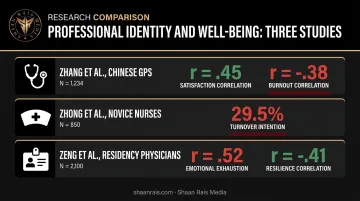
The data backs this pattern up, even if it can't prove causation:
| Study | Population | Key Finding |
|---|---|---|
| Zhang et al. (2021) | 3,236 Chinese GPs | Identity linked to satisfaction (β=0.36), inversely linked to burnout (β=−0.21) |
| Zhong et al. (2024) | 526 novice nurses | 54.37% reported high turnover intention; identity correlated with lower intention (r=−0.459) |
| Zeng et al. (2024) | 2,267 residency physicians | Identity inversely associated with emotional exhaustion (β=−0.380), positively linked to resilience (β=0.169) |
Identity Dissonance Is the Warning Sign
When personal identity and professional expectations don't reconcile, researchers call this identity dissonance. A qualitative study of medical students documented students describing feelings of being lost, inadequate, or hopeless while trying to reconcile who they were with who they were expected to become.
This isn't passive. Building coherent identity requires active work — reflection, mentorship, deliberate socialization. Researchers call this ongoing effort professional identity work (PIW). It doesn't happen automatically just by showing up to work.
The career payoff for doing this work is tangible. Professionals with clearer identity report:
- Better day-to-day decision-making under ambiguity
- Sharper career goal-setting
- More confidence in the path they've chosen, even when it's unconventional
The 5 Core Attributes of a Strong Professional Identity
Synthesizing patterns across medicine, law, pharmacy, and education research, five attributes consistently define a well-formed professional identity. This isn't a validated psychometric scale — it's a cross-source pattern researchers keep circling back to.
1. Internalized values. Your personal values align with the profession's core values, going beyond mere compliance with a code of conduct you memorized.
2. Behavioral consistency. Your actions and communication style reliably reflect your identity, especially under pressure. This is where identity gets tested — not in easy moments, but in hard ones.
3. Sense of belonging. A felt connection to a professional community, described by researchers as "being, becoming, and belonging" within a shared landscape of practice.
4. Self-awareness and reflective capacity. The ability to recognize your own biases and blind spots, and to notice how your relationship to the profession shifts over time.
5. Adaptive resilience. The capacity to hold a coherent sense of self through transitions, setbacks, or role changes — without abandoning who you fundamentally are.
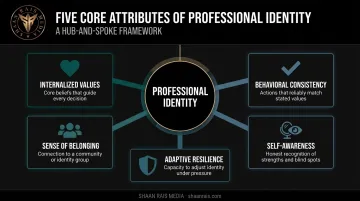
These five attributes rarely operate in isolation. Research from Zeng et al. found resilience positively associated with identity strength (β=0.169) and negatively associated with emotional exhaustion, supporting the idea that these traits reinforce one another.
How Professional Identity Develops (and Where It Gets Stuck)
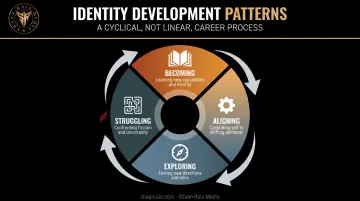
A 2024 integrative review by Reissner and Armitage-Chan, analyzing 77 empirical studies across 15 professions and 23 countries, identified four recurring patterns in how identity work unfolds:
- Becoming — actively learning the knowledge, skills, and behaviors of the profession
- Aligning — adjusting personal assumptions to match expectations from clients, employers, or professional bodies
- Exploring — figuring out what type of professional you actually want to become, not just what's expected
- Struggling — when identity work breaks down and personal identity can't reconcile with professional demands
These aren't sequential stages you graduate through. They're patterns that recur throughout a career, especially during transitions. You might be "aligning" in your first year and "struggling" again after a promotion five years later.
Because struggling tends to resurface at every major transition, it's worth naming clearly: struggling isn't a personal failure. It's documented and common. Left unaddressed, it tends to produce disengagement or eventual attrition.
Professionals stuck in this pattern benefit far more from deliberate reflection, mentorship, or coaching than from waiting for the friction to resolve on its own. This is precisely where positioning work often intersects with identity work — when the gap between who you are and how the market sees you becomes the source of the friction, not just the symptom.
From Internal Identity to External Positioning
Here's the gap almost nobody talks about: a well-formed professional identity answers "who am I as a professional." It does not automatically answer "how does the market see and price me."
Those are two different problems. You can have complete internal clarity about your values, competence, and community, and still be invisible to the exact clients or opportunities that should be seeking you out.
This is the exact space Shaan Rais's positioning work operates in. Rais, an Industrial-Organizational Psychologist known for his work with over 400 operators across 50-plus industries, argues that positioning without identity clarity produces generic, forgettable branding — while identity without visibility leaves genuinely talented professionals underpaid and overlooked. His guiding belief: "you are more valuable than you are visible."
The pattern shows up repeatedly in his client work. One consultant had built genuine coaching expertise over years but had never landed a single paying client — clarity without market translation. Another described the shift from "selling yourself" to being "positioned for your ideal customers," with the same expertise producing a completely different market outcome.
His 120-Day Personal Brand Legacy Protocol follows a specific sequencing logic: identity before strategy, positioning before tactics. It starts by diagnosing the gap between who a professional actually is and how the market currently perceives them, before any funnel, content calendar, or social media plan enters the picture.
Only after that foundation is locked in does the protocol move into conversion systems, brand identity, and visibility execution.
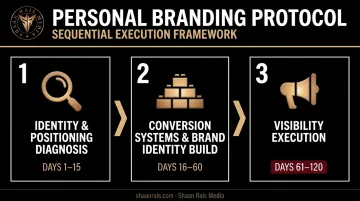
This sequencing reflects a core truth from identity research: identity is necessary, but not sufficient. It's the foundation. Positioning is what makes that foundation legible to the people who should be paying for it.
Frequently Asked Questions
What is professional identity development?
Professional identity development is the ongoing process of internalizing a profession's knowledge, values, and norms until you think, feel, and act as a member of that community. It starts before formal training and continues across your entire career.
What are examples of professional identity?
Consider a physician who reflexively centers patient welfare, or a lawyer who feels a deep responsibility to uphold the rule of law. A founder whose decisions consistently reflect stated values, even under pressure, shows the same thing.
What are the 5 attributes and criteria for professional identity?
Internalized values, behavioral consistency, sense of belonging, self-awareness, and adaptive resilience. Research across medicine, law, and pharmacy consistently points to these five dimensions.
How does professional identity affect well-being?
Identity clarity reduces the friction between your personal and professional self. Research links this reduced dissonance to lower burnout, higher job satisfaction, and less intention to leave your field.
Is professional identity the same as personal branding?
No. Professional identity is your internal, psychological sense of self as a professional. Personal branding is how you communicate that identity externally. Strong branding should be built on a clear identity, not used as a substitute for one.
Can professional identity change over time?
Yes. Identity evolves throughout a career, shaped by transitions, new experiences, and deliberate reflection. It's never "finished" at any single point in your career.