Introduction
Picture this: a top-performing electrician gets promoted to foreman. Same job site. Same crew. Completely different demands. Suddenly, technical expertise isn't enough — because the job is no longer about running conduit, it's about running people.
This gap between being good at a craft and being good at leading others is one of the most common — and costly — transitions in any industry. According to a 2023 CMI study, 82% of managers entered management without formal leadership or management training. The result? Teams underperform, people disengage, and leaders burn out trying to manage by instinct alone.
Leadership skills are learnable — and certain core competencies show up in every effective leader, from a job site foreman in Kentucky to a Fortune 500 executive. This article breaks down exactly what those skills look like and how to build them at any level of your career.
Key Takeaways
- 82% of managers enter leadership roles without formal training — making deliberate skill-building essential
- Core leadership skills are learnable behaviors, not fixed personality traits
- Six skills apply at every level: self-awareness, communication, emotional intelligence, influence, decision-making, and learning agility
- As you advance, your skills don't change — the scale at which you apply them does
- Values-based leadership is what makes these skills durable under pressure
Why Core Leadership Skills Matter at Every Level
Most promotions are earned through technical performance. Someone is the best electrician, the top salesperson, or the most productive analyst — so they get moved into a leadership role. What organizations rarely account for is whether that person can lead.
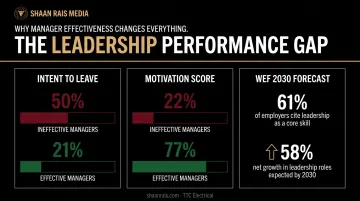
The consequences are measurable. That same CMI study found that among employees with ineffective managers, 50% planned to leave within a year — compared to just 21% under effective managers. Motivation scores showed an even starker gap: 22% versus 77%. The World Economic Forum's Future of Jobs Report 2025 found that leadership and social influence were already core skills for 61% of employers — with a 58% net expected increase in importance by 2030. The demand for leadership capability is rising. The supply isn't keeping up.
Core leadership skills are not personality traits. They are observable, learnable behaviors — which means they can be developed. Whether you're a job site foreman or a company founder, the path forward is the same:
- Study what effective leaders actually do (not just who they are)
- Seek specific feedback on how your communication and decisions land
- Practice the behaviors consistently until they become instinct
The Core Leadership Skills Every Leader Needs
These aren't abstract concepts from a business school textbook. They're the behaviors that separate leaders who build high-performing teams from those who struggle to hold them together — across every industry, role, and team size.
Self-Awareness
Self-awareness means knowing your own values, behavioral patterns, biases, and the impact your actions have on others. It's the starting point for every other leadership skill.
A leader who doesn't understand themselves cannot reliably lead others. Without that self-knowledge, they react when they think they're being decisive, create friction without realizing it, and treat personal preferences as best practices.
Developing self-awareness requires honest input from outside yourself — peer feedback, mentor observations, 360-degree assessments. It also requires reflection: after a tough conversation or a project that went sideways, asking what did I do that helped or hurt here?
Communication
Effective communication isn't just speaking clearly. It's creating alignment, building trust, and ensuring everyone — from a crew member to a client — understands what's expected and why it matters.
Strong communicators do three things well:
- Adapt their style to different audiences without losing the core message
- Listen actively rather than waiting for their turn to talk
- Create psychological safety by communicating in ways that invite questions and flag problems early
Poor communication is almost always the root cause when a team is confused, disengaged, or pulling in different directions.
Emotional Intelligence
Emotional intelligence (EQ) is the ability to recognize and manage your own emotions — and to perceive and respond thoughtfully to the emotions of others. The WEF's 2025 report found that 50% of employers already treat empathy and active listening as core workplace skills, with a 46% net expected increase in their importance through 2030.
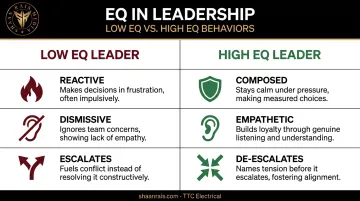
What low EQ looks like in a leader:
- Reactive decisions made in frustration
- Dismissiveness toward team members' concerns
- Escalating conflict instead of de-escalating it
What high EQ looks like in practice:
- Staying calm under pressure when the team is watching
- Naming tension before it becomes a blowup
- Building loyalty because people feel genuinely heard
Influence and Empowerment
There's a meaningful difference between positional authority — the power that comes from a title — and earned influence, which comes from credibility, relationships, and clear purpose. Effective leaders rely on the latter.
Influence is also the gateway to empowerment. Motivation gets people moving; empowerment gives them genuine ownership over outcomes. That ownership multiplies what a leader can accomplish far beyond what they could do alone.
Delegation done well isn't just offloading tasks — it's trusting people with responsibility and supporting them in seeing it through.
Decision-Making
Managers spend an estimated 37% of their time making decisions — and McKinsey found that 58% of that time is considered ineffective. Poor decision-making costs organizations an enormous amount, in wages, missed opportunities, and eroded team trust.
Sound decision-making means:
- Gathering the right information without analysis paralysis
- Including relevant stakeholders early rather than announcing decisions late
- Communicating your rationale — Gartner found employees are 4.3 times more likely to trust leaders who explain the reasoning behind decisions
- Staying open to adjusting course when outcomes don't match intent
Learning Agility and Adaptability
Learning agility is the ability to extract lessons from new experiences and apply them to unfamiliar situations. It's what separates leaders who grow through adversity from those who stall when conditions change.
Korn Ferry followed 83 managers over 10 years and found those with the highest learning agility scores were promoted twice as often as those with the lowest scores. The pattern shows up consistently across leadership research.
Adaptability is learning agility in action: the willingness to change your approach when what used to work stops working, rather than doubling down out of habit or ego.
How These Skills Evolve as You Move Into New Roles
These skills don't change as you advance — their scope does.
| Career Stage | How Skills Scale |
|---|---|
| Individual contributor | Build self-awareness, communicate clearly, influence through expertise, learn from mistakes |
| Frontline supervisor | Achieve results through others, give feedback, resolve conflict, create day-to-day learning |
| Middle leader | Align teams across functions, influence without direct authority, translate strategy into execution |
| Senior executive | Communicate strategic intent, influence systems and stakeholders, build enterprise learning culture |
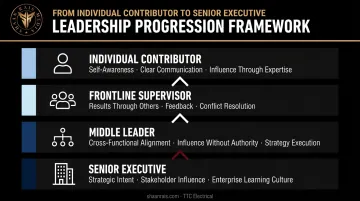
An early-career leader uses influence to persuade a peer. A senior leader uses it to align entire departments around a multi-year strategy. The skill is the same — the stakes and complexity are different.
The risk of skipping development in any of these areas is that blind spots surface in high-stakes moments. A leader who never built strong EQ can function adequately in stable conditions, but tends to struggle when a crisis exposes the gap. The leaders who close those gaps deliberately — at any career stage — are the ones who hold up under pressure.
Leadership Through Adversity: How Values Shape Real Leadership
The most accurate measure of a leader's core skills isn't how they perform when everything is going well. It's what they do when things go wrong.
Shaan Rais, founder of Shaan Rais Media, his personal-branding and positioning practice, learned this firsthand. His path included ambitious early expansion beyond his core positioning work — a strategic move that stretched the business beyond its core competencies — followed by hard lessons that forced a strategic reset. These back-to-back setbacks didn't just create operational pressure. They exposed the gap between the leader Shaan had been and the leader he needed to become.
His response was deliberate. Rather than defaulting to the same instincts that led to the overexpansion, he pursued what he calls the Emmaus Walk — a faith-based retreat that re-centered his leadership around four principles:
- Honesty — transparency in every client and team interaction
- Timeliness — reliability as a non-negotiable standard
- Safety — a cultural commitment, not a compliance checkbox
- Empowering people — investing in the team's growth, not just output
That values clarification produced a concrete strategic reset: pulling Shaan Rais Media back to its core strengths in branding and positioning, and formalizing Perception Engineering as the company's operating identity.
Shaan didn't just survive the setback. He used it to become clearer about who he was as a leader and what the company stood for. The adversity mattered less than the deliberate reflection it forced.
Effective leaders share this pattern. Clear values don't prevent adversity — they shape the response to it. Teams trust leaders who behave consistently under pressure, and that consistency comes from anchoring decisions in something more durable than circumstance.
How to Build Your Core Leadership Skills
Leadership development is a system, not a single event. The research points to a clear sequence: assess, practice, receive feedback, apply on consequential work, reflect, repeat.
The most effective development pathways:
- Honest feedback from all directions — people you lead, peers, and mentors. Seek the kind that surfaces friction you can't see yourself, not the kind that confirms what you already believe
- Stretch assignments with real stakes — unfamiliar roles or projects that force adaptation. CCL identifies challenging assignments as central to experience-driven development, provided they include clear goals, support, and reflection time
- Reflection after both wins and failures — ask what you did, what worked, and what you'd do differently next time
These three practices build the foundation. The next layer is structural: tools and relationships that compress the learning curve.
Structured resources that accelerate development:
- Leadership assessments (360-degree feedback tools surface blind spots that self-reflection alone misses)
- Mentorship relationships — structured, with clear expectations and mutual accountability
- Leadership training programs — a 2017 meta-analysis of 335 independent samples found well-designed programs produce positive effects on learning, behavior transfer, and organizational results
- Industry peer networks — exposure to how other leaders navigate similar challenges

What connects all of this is a simple principle: the work of becoming a better leader doesn't stop when you reach a certain title. Shaan Rais, founder of Shaan Rais Media, joined the 120-Day Brand Launch Program after more than two decades building his business and serving as a volunteer firefighter. He brought that same commitment to growth into developing his brand presence and communication — because he understood that stagnation at the top sets the ceiling for everyone below it.
That's the standard worth holding yourself to.
Frequently Asked Questions
What are the 7 core skills of a leader?
Commonly cited core leadership skills include self-awareness, communication, emotional intelligence, influence, decision-making, delegation and empowerment, and learning agility. Different frameworks may name or group them differently, but these categories appear consistently across credible leadership research including CCL, DDI, and Gallup.
Can leadership skills be learned, or are they innate?
Leadership skills are learnable. Natural tendencies may make some feel easier to develop, but CCL's research treats leadership as developable, not fixed — and a 2017 meta-analysis of 335 training samples confirmed that well-designed programs improve leadership behaviors across diverse contexts.
What is the most important core leadership skill?
Self-awareness is the foundation. A leader who understands their own impact — their blind spots, default reactions, and effect on others — is better positioned to develop every other competency. No single skill covers everything, but this one underlies them all.
How does self-awareness improve leadership?
Self-aware leaders recognize where they create friction, respond more intentionally under pressure, and build greater trust because their behavior is consistent rather than reactive. That consistency is what makes people feel safe following them into uncertain territory.
What is servant leadership and why does it matter?
Servant leadership is a philosophy where the leader prioritizes their team's growth over personal authority. A meta-analysis of 130 independent studies found it drives stronger trust, engagement, and performance — building the kind of loyalty that outlasts any single project or role.
How do you develop leadership skills when running a small business or leading a trade team?
Through mentorship, honest self-reflection, and peer accountability — and by modeling the values you want your team to live by. Shaan Rais's experience at Shaan Rais Media illustrates this: clarity about values like safety, integrity, and empowerment became both a leadership framework and a business differentiator.