Introduction
The executive coaching industry now generates $5.34 billion in annual revenue globally — a 17% increase over 2023, according to the International Coaching Federation's 2025 Global Coaching Study. There are 122,974 coach practitioners worldwide, and leadership coaching is the dominant specialization for 54% of them.
Yet pricing remains one of the most misunderstood parts of this market. Rates span from $150 per session for new managers to over $3,500 per hour for elite C-suite coaches.
Without a clear picture of what drives those differences, leaders either underbudget for the experience level they need — or overpay for a format that doesn't match the challenge they're trying to solve.
This guide covers what coaching actually costs at each leadership level, what pushes rates up or down, how fees are structured, and how to assess whether the investment delivers a return.
Key Takeaways
- New managers typically pay $150–$300/session; mid-level leaders pay $250–$500/hour; senior executives start at $500/hour, with elite programs exceeding $50,000
- Structured multi-month programs commonly run $5,000–$30,000, with enterprise engagements going higher
- Price reflects coach credentials, leader seniority, engagement format, and program length — each tied to measurable outcomes
- The 2009 ICF Global Coaching Client Study found 86% of companies recovered their coaching investment, with a median ROI of 700%
- ROI is driven by consistent action between sessions — execution matters as much as the coaching itself
How Much Does Executive Coaching Cost?
Executive coaching has no fixed price. Fees are shaped by the leader's role, the specific challenge, and the engagement format. The two most common mistakes: underbudgeting for the experience level the situation actually requires, or paying for a premium package when a shorter, focused engagement would deliver the same outcome.
Coaching Costs for New and Mid-Level Managers
New managers (first leadership role) typically pay $150–$300 per session. The focus at this stage is foundational — delegation, feedback conversations, managing up, and building credibility as a leader. Engagements tend to be shorter and more skills-focused, often running 3–6 months.
Mid-level leaders — VPs, senior managers, and directors — typically pay $250–$500 per hour. Coaching at this tier gets into more complex territory: cross-functional influence, managing other managers, and turning organizational goals into team-level action. The work is grounded in each leader's actual organizational context, not generic frameworks.
Best fit for these tiers:
- Leaders building specific skills over a defined timeframe
- Professionals navigating their first major transition in scope or authority
- Managers preparing for promotion into senior leadership
Coaching Costs for Senior and C-Suite Executives
At the senior and C-suite level, fees commonly start at $500/hour and can reach $3,500/hour for top-tier coaches. Some full-program engagements for senior executives exceed $50,000.
Pricing at this level reflects two realities: the complexity of challenges (board relationships, enterprise-wide decisions, leadership under public scrutiny) and the coach's ability to function as a genuine strategic peer — someone who can push back credibly, not just listen.
Structured multi-month programs for executives typically run:
| Program Type | Typical Cost Range |
|---|---|
| Standard executive coaching program (6 months) | $5,000–$30,000 |
| Enterprise program with assessments + stakeholder interviews | $30,000–$50,000+ |
| Elite full-year engagement (top-tier coach) | $50,000–$150,000+ |
IBISWorld's 2026 US procurement benchmark puts the aggregate hourly rate at $486/hour — a useful reference point when evaluating proposals, though rates shift considerably based on coach credentials and engagement scope.
Group and Team Coaching Costs
Group coaching — where a cohort of leaders is coached simultaneously — typically runs $2,500–$5,000 per participant. The per-person cost is lower, with leaders working through shared challenges alongside peers facing similar situations.
This model works well for:
- Organizations developing multiple leaders at once
- Companies building consistent leadership culture across teams
- Situations where budget doesn't support individual one-on-one programs for every leader
The tradeoff is personalization. Group coaching handles shared challenges well, but one-on-one work goes deeper on individual context — the stakes, the personalities, the specific dynamics each leader is navigating.
Key Factors That Drive Leadership Coaching Rates
Coaching pricing isn't arbitrary. It reflects a combination of the coach's background, the engagement structure, and the complexity of the leadership challenge being addressed.
Coach Credentials and Experience
An ICF-credentialed coach commands higher rates — and for good reason. The ICF credential system has three levels:
- ACC: 100+ coaching hours, 60+ hours of coach-specific training — entry-level credentialing with verified foundational practice
- PCC: 500+ coaching hours, 125+ hours of training, 25+ clients — advanced proficiency confirmed by the ICF
- MCC: 2,500+ coaching hours, 200+ hours of training, 35+ clients — the highest ICF credential, reserved for coaches with demonstrated mastery
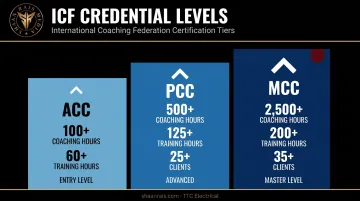
These aren't just labels. They represent verified hours with real clients. A coach with 2,500+ hours has encountered a significantly broader range of leadership situations than one with 100.
The Leader's Seniority and Role
This is the single biggest reason rates vary so widely. Coaching a CEO whose decisions affect hundreds of employees — and whose blind spots can cost millions — requires a different depth of coach expertise than coaching a team lead working through their first performance conversation.
Pricing scales with the scope of what's at stake. The higher the leader's responsibility, the more the coach needs to be capable of operating at that altitude.
Format and Engagement Length
- One-on-one coaching is the most personalized and most expensive format
- Group coaching reduces per-person cost while retaining expert facilitation
- Virtual coaching is generally priced lower than in-person, reflecting eliminated travel costs
- Longer engagements (9–12 months) cost more in total but often less per month than short, intensive programs
A 3-month targeted engagement for a specific skill costs less overall than a 12-month comprehensive development program. Session frequency — weekly versus bi-weekly versus monthly — also affects total program cost.
Customization and Add-On Services
Standard packages cost less. Deeply customized programs that include:
- 360-degree assessments (gathering structured feedback from peers, direct reports, and managers)
- Stakeholder interviews (understanding how the leader is perceived across the organization)
- Individualized development plans built from diagnostic data
...cost more but deliver more targeted results. Skipping the assessment phase to save money is a common mistake. Without it, the coach has less to work with, and the engagement is less likely to produce lasting behavior change.
How Coaches Charge: Pricing Models Explained
There are three primary ways coaches structure their fees. Each serves a different use case.
Hourly / Per-Session:
- Pay-as-you-go, maximum flexibility
- Best for: testing a new coach, addressing a specific short-term issue
- Rates: $200–$3,500/hour depending on coach and leadership level
- Least cost-efficient for longer engagements
Package Pricing (6 or 10 sessions):
- Often includes a modest discount versus the hourly rate
- Creates structured commitment with clear beginning and end
- Best for: leaders with a defined goal and a 2–4 month timeframe
- Provides more continuity than ad hoc sessions
Monthly Retainer:
- Typically ranges from $1,000–$5,000/month
- Provides ongoing access with scheduled sessions plus ad hoc support between them
- Common for senior executives who need a strategic advisor available as situations arise
- Best for: C-suite leaders, high-stakes roles, or ongoing organizational transitions
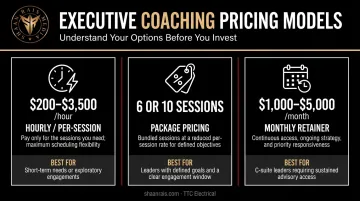
Which model fits depends on where you are in the engagement. Most senior executives start hourly or with a package, then shift to a retainer once trust is established. At that point, access between sessions stops being a perk and becomes a practical necessity.
What Is the ROI of Leadership Coaching?
Most executives evaluating coaching ask whether it's expensive. The more useful question is what it returns.
The Evidence Base
The MetrixGlobal LLC study commissioned by ICF found 529% ROI from a leadership development coaching engagement (excluding retention benefits) — based on 43 participants at a Fortune 500 firm. This is the most rigorous primary-source ROI study in the executive coaching field.
The 2009 ICF Global Coaching Client Study found that among respondents who could calculate company ROI, 86% reported their organization at least recovered its investment, with a median company ROI of 700%. These are not guarantees for any individual engagement — but they reflect what well-structured coaching programs have historically returned in corporate contexts.
What Coaching Actually Changes
The downstream business impact of better leadership is measurable. Stronger leaders produce:
- Higher team productivity and engagement
- Lower voluntary turnover (replacing an employee costs 50–200% of annual salary)
- Faster, clearer decision-making at critical junctures
- Stronger organizational culture that compounds over time
Each outcome carries a measurable dollar value. A coach who helps a leader reduce turnover by 10% in a 50-person team can return multiples of the coaching investment within the first year alone.
The 70-20-10 Rule: Where Coaching Value Actually Lives
The numbers won't always be this clean — but running the exercise turns a vague budget conversation into a specific investment decision.
How to Estimate the Right Executive Coaching Budget
Fit Over Price
The right coaching investment matches the complexity of the leadership challenge, the seniority of the leader, and the organization's capacity to support the engagement.
Anchoring to the lowest available rate without evaluating coach credibility or program fit is the most common budgeting mistake — one that typically produces poor results and makes stakeholders skeptical of coaching as a whole.
Factors to Reverse-Engineer a Budget
Before contacting coaches, work through these questions:
- Define the intended outcome — skill-building for a new manager requires far less investment than a strategic transformation for a C-suite leader
- Clarify the timeline — a focused 3-month engagement costs a fraction of a 12-month comprehensive program
- Decide whether assessments are needed — if the challenge involves blind spots or interpersonal dynamics, skipping a 360 will undermine the work
- Consider one leader versus a cohort — group coaching is significantly more cost-effective when multiple leaders need development at the same time
- Account for seniority — this single factor determines the minimum credential level required in a coach, and therefore the floor on price
What Leaders Most Often Miss
Four patterns consistently lead to wasted coaching spend:
- Focusing on hourly rate while ignoring total program cost: a $200/hour coach over 12 months can cost more than a $500/hour coach in a focused 3-month package
- Skipping the assessment phase — cutting this cost reduces personalization and limits behavioral change
- Choosing based on price alone, without checking credentials, track record, or fit with the specific leadership challenge
- Underestimating time commitment: leaders who attend sessions but skip between-session application see a fraction of the potential ROI
Frequently Asked Questions
What is the 70/30 rule in coaching?
The term often refers to the 70-20-10 model: 70% of leadership development happens through real work experience, 20% through coaching and feedback relationships, and 10% through formal training. Most of the ROI from coaching is realized through what the leader applies on the job between sessions.
What is the ROI of leadership coaching?
The most-cited benchmarks are the MetrixGlobal LLC study (529% ROI) and the 2009 ICF Global Coaching Client Study (median ROI of 700%, with 86% of respondents reporting full investment recovery). Those gains come through improvements in decision-making, team performance, and retention.
How much does an executive coach cost per hour?
The range runs from roughly $200 to $3,500 per hour, depending on the coach's credentials and the leader's seniority. IBISWorld's 2026 US aggregate benchmark is $486/hour. Hourly billing is just one model — packages and retainers are often more cost-effective for engagements beyond a few months.
How long does an executive coaching engagement typically last?
Most engagements run 3–12 months, with 6 months being the most common structure. CCL and Korn Ferry both offer tiered options in that range, and senior leaders frequently extend beyond the initial term as new challenges emerge.
Is executive coaching worth it for small business owners and entrepreneurs?
Yes — particularly during growth phases, leadership transitions, or when growing a team. Shorter, focused engagements (3 months) or group coaching options can make the investment more accessible. The key is matching the engagement format to a specific, high-priority challenge rather than entering open-ended coaching without a defined goal.
What is the difference between executive coaching and leadership training?
Executive coaching is personalized and typically one-on-one, focused on the specific challenges of an individual leader. Leadership training is skills-based, group-delivered, and covers standardized content across a cohort. The two work best in combination: training supplies the frameworks, coaching ensures they actually get used.