
Introduction
Online coaching has expanded across fitness, business, life, and career development — driven by remote access, digital tools, and growing demand for flexible support outside traditional in-person settings.
But the marketing around online coaching often oversells it. Whether it works depends heavily on the coaching type, the coach's quality, and how seriously the client shows up.
This article breaks down the benefits and drawbacks of online coaching so you can make an informed decision before committing.
Key Takeaways
- Online coaching delivers strong results in nutrition, life, business, and career development
- Geographic freedom lets you choose the best-fit coach, not just whoever's nearby
- Cost is lower than in-person alternatives, but cheap options often sacrifice personalization
- Remote-only coaching is a poor fit for beginners working on complex physical skills
- Outcomes improve when clients stay consistent and work with a qualified, responsive coach
What Is Online Coaching?
Online coaching is a structured development process — for fitness, life, business, or professional goals — delivered via video calls, messaging platforms, apps, or email rather than in-person sessions.
It spans a wide range of categories:
- Fitness and nutrition coaching — programming, accountability, and dietary guidance
- Life coaching — personal clarity, habit change, and goal achievement
- Business and career coaching — strategy, positioning, and professional growth
- Executive development — leadership skills, decision-making, and organizational impact
Online coaching is a delivery format, not a shortcut. The International Coaching Federation (ICF) defines coaching as "partnering with clients in a thought-provoking and creative process that inspires them to maximize their personal and professional potential." That definition holds whether sessions happen in person or on Zoom.
What changes online is how the coach observes, responds, connects, and reads the client. That difference matters more for some goals than others.
Key Benefits of Online Coaching
Flexibility and Convenience
Online coaching removes the logistical friction that derails in-person arrangements. No commute, no fixed location, no rescheduling because a client is traveling.
In practice, this means clients can complete sessions from home, a hotel room, or between shifts. That adaptability matters because consistency is one of the strongest predictors of coaching outcomes — and anything that reduces barriers to showing up directly improves results over time.
This benefit matters most for:
- Busy professionals and executives with irregular schedules
- Business owners who travel frequently
- Parents managing competing demands
- Anyone in a rural area with limited local access to qualified coaches
Access to a More Specialized Coach Pool
Geography used to be a hard constraint. You worked with whoever was local — regardless of whether they were the right fit for your specific goal.
Online coaching removes that ceiling. A small-business owner can access a coach who specializes in values-driven leadership. Someone with a niche fitness goal can find a trainer certified in exactly that discipline. The match quality improves measurably when you're choosing from a national or global pool rather than a five-mile radius.
Fit is foundational to outcomes. Research on 158 coach-coachee dyads found that deep-level similarity in values and personality predicted stronger working alliance — and working alliance mediated the connection between fit and perceived effectiveness. A two-wave study of 181 coaching clients further confirmed that working alliance positively correlates with psychological-need satisfaction throughout the coaching process.
That kind of fit is hard to find when your options are limited to a zip code — and it's exactly what expanded access makes possible.
Cost Efficiency Relative to In-Person Alternatives
Better fit doesn't have to mean a bigger price tag. Online coaching is generally less expensive than in-person alternatives — coaches carry less overhead, and clients skip travel costs entirely.
For context on what the market looks like:
- Fitness coaching: ISSA's pricing guide cites $30–$125+ per hour as a typical hiring range for personal trainers
- Life, business, and executive coaching: The ICF's 2023 Global Coaching Study reports regional averages ranging from $114 per hour (Latin America/Caribbean) to $277 per hour (Western Europe), with a worldwide average around $244

The practical consequence: clients who might only afford two to four in-person sessions per month can often access weekly online coaching for a comparable or lower investment.
One caveat: The lowest-cost options typically come with less personalization and fewer real-time touchpoints. Weigh price against level of access — not as the primary decision factor, but as part of it.
Key Drawbacks of Online Coaching
Limited Real-Time Feedback and Physical Presence
For skill-based coaching — particularly strength training, movement mechanics, or any physical technique — the absence of in-person observation is a real disadvantage.
A coach cannot react in real time to what they cannot see clearly. Video check-ins, while useful, miss the tactile and spatial cues that experienced coaches use to catch form errors early.
A 2023 survey of 468 experienced trainers and trainees found that virtual supervision received the lowest ratings for both safety and program design. 89.4% of trainers identified technical coaching as critical — a function that remote formats handle least well.
This drawback matters most for:
- Beginners who haven't yet developed technique through hands-on instruction
- Anyone learning complex physical skills — Olympic lifts, gymnastics, sport-specific movement
- Clients with injury history where form precision directly affects safety
For nutrition, business, career, and life coaching — where physical observation is irrelevant — this limitation simply doesn't apply.
Variable Coach Quality and Accountability Gaps
The online coaching space has no universal licensing requirement. Anyone can build a website and start marketing themselves as a coach. For clients, that makes finding qualified help genuinely difficult.
In practice, this means some clients end up with:
- Generic, templated programs dressed up as personalized plans
- Coaches managing too many clients to give meaningful individual attention
- Minimal check-ins or feedback between sessions
Accountability gaps are another real factor. Without face-to-face meetings, motivation and follow-through fall more heavily on the client — which is often exactly what people seek coaching to build in the first place.
The ICF's 2025 Global Coaching Study found that 74% of surveyed coaches held a credential or certification — but that still leaves roughly 1 in 4 who don't.
How to vet a coach before committing:
- Look for recognized credentials: ICF (ACC, PCC, MCC), NASM, ACE, NSCA for fitness; ICF or BCC for life and business coaching
- Review verifiable client testimonials — not just screenshots, but outcomes
- Assess communication style and responsiveness during an initial consultation
- Confirm there's a structured intake and check-in process, not just ad hoc contact
When Online Coaching Works — and When It Doesn't
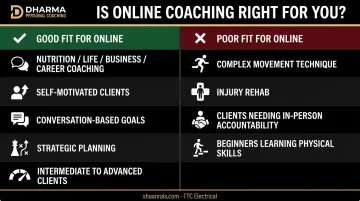
Not every coaching goal translates equally well to a remote format. Here's a practical breakdown:
| Factor | Good Fit for Online | Poor Fit for Online |
|---|---|---|
| Coaching type | Nutrition, life, business, career, advanced fitness programming | Complex movement technique, injury rehab, hands-on skill development |
| Client readiness | Self-motivated, clear goals, comfortable with digital tools | Relies heavily on external accountability and in-person structure |
| Goal complexity | Conversation-based growth, strategic planning, habit change | Real-time physical observation or correction required |
| Experience level | Intermediate to advanced in the relevant domain | Complete beginners learning physical skills for the first time |
A 2023 meta-analysis of workplace coaching found no statistically significant difference in outcomes between face-to-face and virtual coaching for professional goals — though the virtual evidence base was limited to just two studies. For conversation-based coaching, the quality of the coaching relationship drives outcomes far more than whether sessions happen over video or in person.
That picture shifts when physical skills are involved. Online delivery holds up well for clients with solid technique foundations who need programming, nutrition, or accountability support. It falls short for anyone who requires real-time hands-on correction to build those foundations in the first place.
How to Get the Most Value from Online Coaching
Online coaching delivers results when clients treat it as a structured commitment, not a passive service. How you show up determines what you get out of it.
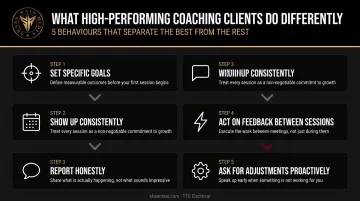
What high-performing coaching clients do differently:
- Set specific goals at the start — not vague intentions, but defined outcomes with a timeline
- Show up consistently to every check-in, even when progress feels slow
- Report honestly — share what's working, what isn't, and where resistance shows up
- Act on feedback between sessions rather than waiting for the next call to move forward
- Ask for adjustments proactively instead of waiting until the program stops working
Beyond behavior, values alignment shapes the quality of the relationship itself. Working with a coach whose approach reflects your own principles — whether that's a science-backed methodology, a faith-driven framework, or a servant-leadership orientation — builds the trust that makes honest feedback possible and long-term commitment sustainable.
Shaan Rais, founder of Shaan Rais Media — his personal-branding and positioning practice — experienced this firsthand. He built the 120-Day Personal Brand Legacy Protocol with goals grounded in his values and Perception Engineering philosophy. The program helped him codify a mission and values platform, build a professional brand identity, and develop a conversion-ready digital presence, moving Shaan Rais Media from word-of-mouth referrals to a structured, market-ready position.
The outcome reflected what the numbers and the strategy alone couldn't have produced — a coaching relationship built on shared principles, not just shared goals.
Conclusion
Online coaching is genuinely effective for the right person in the right coaching category. Its value comes from the flexibility, access, and personalization it enables, not from the format alone.
Its benefits compound when clients show up consistently, select a qualified coach, and engage with a clear goal in mind. Its drawbacks surface most sharply when expectations are mismatched — particularly when beginners expect remote instruction to substitute for hands-on skill development, or when coach quality goes unvetted.
Ultimately, the coaching format matters far less than the match between coach expertise, client readiness, and the specific outcome being pursued. Get those three aligned, and online coaching delivers.
Frequently Asked Questions
Is online coaching effective?
Research shows positive outcomes for online coaching, particularly in professional and conversation-based goals. A 2023 meta-analysis found no significant difference between virtual and face-to-face workplace coaching — though the evidence base remains limited. Effectiveness is tied more to coach quality and client consistency than to delivery format.
Is online coaching cheaper than in-person coaching?
Generally yes, because coaches face lower overhead and clients have no travel costs. Pricing varies widely — fitness coaching runs $30–$125+ per hour, while life and business coaching averages $114–$277 per hour depending on region. The cheapest options typically sacrifice personalization.
What are the biggest drawbacks of online coaching?
Two main limitations: limited real-time physical feedback (a meaningful risk for beginners learning complex movement), and inconsistent coach quality due to the industry's lack of standardized credentialing requirements. Both are manageable with careful coach selection.
Who should avoid online coaching?
Complete beginners learning complex physical skills benefit more from in-person instruction where hands-on correction is possible. Those who need strong in-person accountability structures may also find the format's self-directed nature difficult.
What types of coaching work best online?
Nutrition, life, career, business, and advanced fitness programming are the strongest use cases — areas where physical presence isn't essential and the coaching relationship is conversation- and accountability-driven.
How do I choose the right online coach?
Start with these four checks:
- Verify credentials from recognized bodies (ICF, NASM, ACE, NSCA, BCC)
- Review testimonials for specific outcomes, not just general praise
- Assess communication style during an initial consultation
- Confirm the coach runs a structured check-in process, not just reactive contact