Guess which team has lower turnover a year later.
This isn't a hypothetical. It's the difference between transactional management and transformational leadership — and it's one of the most studied leadership frameworks in organizational psychology because the data on engagement, innovation, and retention keeps backing it up.
This guide breaks down where the theory came from, its four core components, how it stacks up against transactional leadership, and how to actually build these skills instead of just admiring them from a distance.
Key Takeaways
- Transformational leadership connects individual effort to a shared vision, driving intrinsic motivation instead of relying on rewards or punishment
- Bass's Four I's predict job satisfaction (.58 correlation) and leader effectiveness (.64 correlation)
- The most effective leaders pair transformational vision with transactional structure
- Core behaviors like active listening and vision communication can be trained, even if charisma feels innate
- The style has real trade-offs: without workload limits, it can fuel burnout
What Is Transformational Leadership? Origins and Meaning
Transformational leadership is a style where leaders inspire followers to exceed their own expectations by tying individual effort to a shared, compelling vision. It's less about issuing orders and more about making people want to contribute at a higher level.
The term didn't start in a corporate boardroom.
- James V. Downton coined "transformational leadership" in his 1973 book Rebel Leadership, describing revolutionary movements
- James MacGregor Burns developed the concept further in his 1978 book Leadership, describing it as a process where leaders and followers "raise one another to higher levels of motivation and morality"
- Bernard Bass translated Burns's political framework into organizational psychology with his 1985 book Leadership and Performance Beyond Expectations, later building the Multifactor Leadership Questionnaire to measure it
Bass's contribution mattered because he made the theory testable. Instead of just describing inspiring leaders, he gave researchers a way to score leadership behavior and correlate it with actual business outcomes.
From Political Theory to Organizational Practice
The core philosophy is simple: transformational leaders spend less energy controlling decisions and more energy building collaboration, shared purpose, and follower growth. The organization moves forward because people want to move it, not because they're told to.
The Four Key Elements of Transformational Leadership (The Four I's)
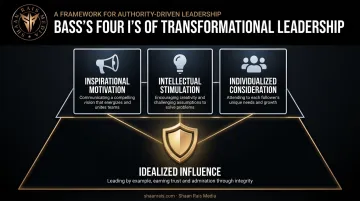
Bass identified four specific behaviors that define transformational leadership. These aren't personality traits; they're observable actions any leader can practice.
Idealized Influence
Leaders act as ethical role models who "walk the talk." They place collective purpose above self-interest and make decisions consistent with stated values. Followers trust them enough to want to emulate them, not just obey them.
Inspirational Motivation
This is about painting a vision that makes daily tasks feel meaningful. A leader with strong inspirational motivation can explain why a mundane task matters to the bigger picture, turning routine work into purposeful contribution.
Intellectual Stimulation
Transformational leaders challenge assumptions and invite new approaches without punishing mistakes. Credibility comes first, and the table shows why: every other component depends on Idealized Influence being established. Without it, vision statements sound hollow and coaching feels intrusive, no matter how well-intentioned the leader.
Transformational vs. Transactional Leadership: What's the Difference?
Transactional leadership runs on exchange: you meet performance criteria, you get the reward (or the consequence). It's a contract-based approach, and it works well for stability.
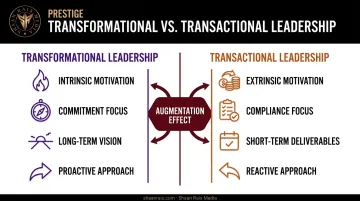
The two styles differ across four dimensions:
| Dimension | Transformational | Transactional |
|---|---|---|
| Motivation | Intrinsic — purpose, identity, growth | Extrinsic — pay, promotion, recognition |
| Focus | Commitment | Compliance |
| Time horizon | Long-term vision | Short-term deliverables |
| Approach | Proactive, vision-driven | Reactive, correction-based |
Here's the part most leadership content skips: these aren't rivals. They work together. Judge and Piccolo's meta-analysis found corrected validities of .44 for transformational leadership and .39 for contingent reward (a transactional behavior), meaning both predict outcomes. Bass called this the "augmentation effect": transformational behavior adds value on top of transactional structure instead of replacing it.
The best leaders use transactional clarity for accountability and transformational vision for growth. Neither alone gets you the full picture.
Transformational leadership also stands apart from other common styles:
- Authoritarian: control-heavy, top-down decision-making
- Bureaucratic: rule-heavy, process over judgment
- Democratic: consensus-heavy, group input drives decisions
- Laissez-faire: hands-off, minimal direct oversight
What sets transformational leadership apart isn't more or less control. It's the emphasis on a shared vision that followers help carry forward.
Traits and Real-World Examples of Transformational Leaders
Research links certain traits to transformational behavior, though none of them are prerequisites on their own:
- Self-awareness
- Open-mindedness
- Adaptability
- Proactivity
- Humility
- Empathy
- Emotional intelligence
These leaders tend to occupy positions of influence because turning vision into reality usually requires some authority to act on it. How a leader is perceived often determines how much authority they're granted in the first place, which is why positioning and vision-setting tend to move together.
Historical and Political Figures
- Nelson Mandela — released in 1990, inaugurated as South Africa's first democratically elected president in 1994. His reconciliation-focused vision united a deeply divided nation
- Martin Luther King Jr. — his nonviolence principles, resisting evil without violence while seeking understanding rather than humiliation, have been formally analyzed against transformational leadership criteria in peer-reviewed research
- Mahatma Gandhi — led the 240-mile Salt March in 1930, a mass act of civil disobedience that turned shared sacrifice into a unifying political tool
Business Examples
- Steve Jobs — after returning to Apple, he cut a sprawling product line down to four priorities and drove the iMac, iPod, iPhone, and iPad through relentless vision-setting, though HBR's leadership analysis also documents his abrasive management style
- Henry Ford — facing 370% labor turnover, he announced the $5 workday in 1914, roughly doubling prevailing pay and reshaping industrial labor practices
None of these are formal MLQ diagnoses. They're illustrations of the Four I's in action, and each figure spent years refining how their vision was communicated and perceived before it translated into influence.
That distinction matters: transformational leadership is a developed skill, not an innate trait, and the next section breaks down how it's built.
How to Develop Transformational Leadership Skills
Charisma feels innate. But the underlying behaviors — active listening, empathy, self-reflection — can be deliberately practiced. A 1996 field experiment on transformational leadership training found measurable improvements in subordinate-rated individualized consideration and even branch-level financial results after structured coaching.
Practical starting points:
- Learn individual goals and concerns — sit down with each team member and ask what they actually want out of their role, not just what their job description says
- Seek regular feedback — use 360-degree input, not just self-assessment, since blind spots are, by definition, invisible to you
- Clarify your organization's mission — you can't communicate a vision you haven't articulated to yourself first
- Find a mentor to study — mirror specific behaviors, not their entire persona
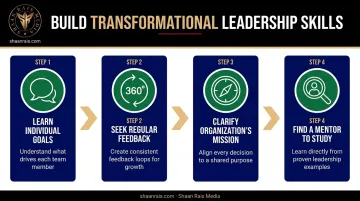
These practices reinforce a point leaders often underestimate: a vision only motivates people if it's communicated with credibility and clarity. You can have the right vision and still fail to inspire anyone if your delivery undermines it.
None of these behaviors require natural charisma. They require repetition — asking better questions, sitting with uncomfortable feedback, and revisiting your own mission statement often enough that it stops sounding rehearsed.
Benefits and Potential Pitfalls of Transformational Leadership
The documented upside is substantial. Research links transformational leadership to:
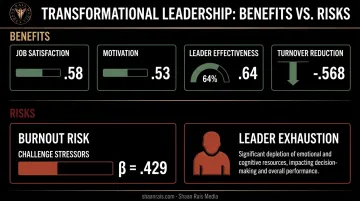
- Higher job satisfaction (corrected correlation of .58)
- Stronger motivation (.53)
- Greater leader effectiveness (.64)
- Lower turnover intention (one study found a correlation of -.568 among 478 employees during COVID-19)
These numbers are strong, but the research doesn't stop there — it also documents real limits and risks worth knowing before you lead this way.
A three-year study of 127 employees found no significant prospective effect of transformational leadership on psychological well-being — meaning the correlational benefits don't automatically translate into long-term causal guarantees.
Two specific pitfalls to watch for:
- Burnout risk. Transformational leadership has been linked to higher "challenge stressors" (beta = .429) in at least one study. Asking people to constantly exceed expectations works only until they hit that ceiling.
- Leader exhaustion. When followers lack competence or conscientiousness, leaders practicing transformational behaviors report greater emotional exhaustion themselves, according to a 2019 study of 130 leader-follower pairs.
This style also falls short with teams that need tight, structured guidance rather than open-ended inspiration. Vision without clear expectations can leave some people directionless.
The fix: pair the vision with real support — workload limits, role clarity, and enough transactional structure that inspiration doesn't turn into unpaid overtime.
Frequently Asked Questions
What is the meaning of transformational leadership?
Transformational leadership inspires followers to exceed expectations by connecting their individual effort to a shared vision. The focus is on intrinsic motivation rather than rewards or punishment.
What are the key elements of transformational leadership?
Bass identified four components: idealized influence (ethical role modeling), inspirational motivation (compelling vision), intellectual stimulation (encouraging new ideas), and individualized consideration (tailored coaching).
What is an example of transformational leadership?
Steve Jobs reshaped Apple's product strategy by pairing a bold vision with constant intellectual stimulation, pushing his teams to challenge assumptions and rethink what a product could be.
How is transformational leadership different from transactional leadership?
Transformational leadership drives intrinsic motivation through purpose and vision. Transactional leadership drives extrinsic motivation through rewards and consequences tied to specific performance. Research shows the strongest leaders combine both.
Can transformational leadership be learned?
Yes. While some traits feel natural, behaviors like active listening, empathy, and vision communication can be developed through deliberate practice and feedback. Studies on leadership training show measurable improvement in these areas.
What are the benefits of transformational leadership?
Transformational leadership is linked to higher job satisfaction, stronger commitment, lower turnover, and greater innovation. Results vary by outcome, but the pattern across studies stays consistently positive.