Most "best leadership books" lists recycle the same five titles without asking who they're actually for. A new manager struggling to give feedback needs a different book than a founder trying to scale a culture across 200 people. Treating every leadership book as interchangeable wastes time and money.
This guide breaks down six books by the specific problem each one solves, explains the leadership frameworks worth knowing (and the ones that are more marketing than research), and makes the case that reading is only step one. Capability without visibility rarely gets rewarded.
Key Takeaways
- Match the book to your bottleneck — feedback, behavior change, coaching, culture, courage, or strategy each require a different title
- Reading builds skill, not recognition — capability that stays invisible to decision-makers often goes unrewarded
- Treat frameworks as checklists, not law — the 5 C's and 5 P's vary by source and author
- One book applied deeply beats five skimmed — pick one behavior and practice it first
The Best Leadership Books to Develop Your Skills
These six titles made the list because each one builds a specific, observable competency: feedback, behavior change, coaching, culture, courage, or strategic thinking. None of them rely on generic motivation to make their point.
Radical Candor by Kim Scott
Kim Scott's core idea is simple: good feedback combines "Care Personally" with "Challenge Directly." That combination replaces the vague, ineffective compliment sandwich most managers default to.
Leaders who either avoid hard conversations entirely or soften feedback until it loses all meaning will find the most value here. Scott, who led teams at Google and taught management at Apple, built the framework around a two-axis model — care and challenge — that's easy to apply the same day you read it.
| Attribute | Detail |
|---|---|
| Best For | Leaders who avoid difficult conversations or give vague feedback |
| Core Concept | The Radical Candor framework (Care Personally + Challenge Directly) |
| Ideal Reading Stage | New and mid-level managers |
What Got You Here Won't Get You There by Marshall Goldsmith
Marshall Goldsmith's premise cuts against ego: the habits that got you promoted aren't the habits that will sustain you at the next level. Winning too much, failing to listen, withholding recognition — Goldsmith identifies 20 specific behaviors that quietly sabotage successful leaders (marshallgoldsmith.com).
High performers stepping into bigger roles often can't figure out why their old playbook stopped working — this book explains why. Goldsmith also introduces "feedforward" — asking for future-focused suggestions instead of past-focused criticism — a technique he's used with more than 30,000 leaders (marshallgoldsmith.com).
| Attribute | Detail |
|---|---|
| Best For | Newly promoted executives and senior leaders |
| Core Concept | Letting go of ego-driven habits that block executive growth |
| Ideal Reading Stage | Senior/executive leaders |
The Culture Code by Daniel Coyle
Daniel Coyle studied groups ranging from Navy SEAL Team Six to IDEO and found that high-performing teams aren't built by hiring talent alone. They're built through three repeatable skills: safety, vulnerability, and shared purpose.
Anyone responsible for fixing or building team culture from scratch will recognize the challenge, especially in hybrid or newly formed teams where trust hasn't developed naturally yet.
| Attribute | Detail |
|---|---|
| Best For | Leaders managing hybrid, remote, or newly formed teams |
| Core Concept | Culture is built through everyday habits, not slogans |
| Ideal Reading Stage | Team leads and department heads |
The Coaching Habit by Michael Bungay Stanier
Michael Bungay Stanier's argument: leaders default to giving advice, but that habit creates dependent teams. Better questions build stronger, more self-sufficient ones.
The book organizes around seven core questions, including "What's on your mind?" and "What's the real challenge here for you?" Managers stuck being the answer person for every problem on their team will find this especially useful — that role simply doesn't scale.
| Attribute | Detail |
|---|---|
| Best For | Managers who want to develop their team's problem-solving ability |
| Core Concept | Seven core coaching questions that replace unsolicited advice |
| Ideal Reading Stage | First-time and mid-level managers |
Good to Great by Jim Collins
Jim Collins researched what separates companies that sustain greatness from those that merely have a good run. His answer centers on disciplined people, disciplined thought, and disciplined action, not charisma.
Three linked concepts drive the argument: Level 5 Leadership, the Hedgehog Concept, and the Flywheel. The lens is organizational, not interpersonal — it fits founders and senior leaders better than someone looking for tomorrow's one-on-one script.
| Attribute | Detail |
|---|---|
| Best For | Founders and executives focused on long-term organizational strategy |
| Core Concept | The Hedgehog Concept, the Flywheel, and Level 5 Leadership |
| Ideal Reading Stage | Senior leaders and founders |
Dare to Lead by Brené Brown
Brené Brown's central claim is that vulnerability, not armor, is the foundation of effective leadership. She frames courage as a teachable skill set, not a personality trait you either have or don't.
The book breaks courage into four practices: rumbling with vulnerability, living into your values, building trust, and learning to rise after setbacks. It's a strong fit for leaders trying to build psychological safety and navigate genuinely hard conversations.
| Attribute | Detail |
|---|---|
| Best For | Leaders wanting to build trust and openness on their teams |
| Core Concept | Courage-building skills that can be taught and practiced |
| Ideal Reading Stage | All leadership levels |
Leadership Frameworks Explained: The C's and P's of Leadership
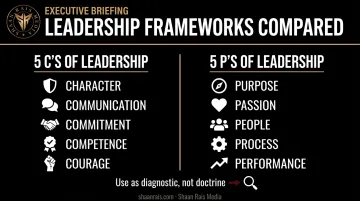
Search "5 C's of leadership" or "5 P's of leadership" and you'll find a dozen conflicting lists, each attributed to a different source. There's no single, universally agreed-upon version of either framework.
The 5 C's — Multiple Versions, No Single Standard
Some commonly cited versions include:
- Forbes Coaches Council: Creativity, Courage, Curiosity, Confident Humility, Collaboration (Forbes)
- Editorial mnemonic version: Character, Communication, Commitment, Competence, Courage
Neither is an industry-wide standard, but both work as diagnostic checklists. If "Communication" is your weak point, that maps directly to Radical Candor. If "Courage" is missing, Dare to Lead addresses it head-on.
The 5 P's — Also Contested
Versions here range even wider:
- Open University's academic model: Person, Process, Position, Product, Purpose (Open University)
- Editorial version often cited: Purpose, Passion, People, Process, Performance
"Purpose" and "People" show up across nearly every version. Both connect naturally to The Culture Code, which treats purpose and people-first habits as the building blocks of team performance.
The takeaway: treat these lists as a diagnostic, not doctrine. Pick the one or two terms that expose your actual weak spot — say, Courage or Communication — and read the book that targets it directly.
Most leaders close two or three competency gaps a year this way, rather than expecting one book to fix everything.
Beyond the Books: Why Skill-Building Must Come With Visibility
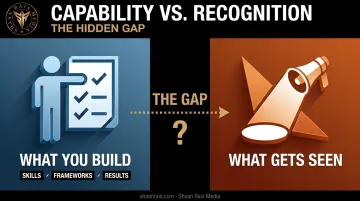
Reading builds capability, but capability alone doesn't guarantee recognition. Plenty of genuinely skilled leaders get passed over for promotions, board seats, or speaking invitations , not because they lack ability, but because almost nobody outside their immediate team knows they have it.
Perception and positioning determine how the market values a leader's capability. This gap between skill and recognition shows up constantly:
- A manager delivers exceptional results but gets skipped over for a promotion because leadership doesn't see her as "the strategic type"
- A founder builds a genuinely strong company but struggles to raise a next round because investors have never heard his name
- A team lead masters every framework in their industry but never gets invited to speak, write, or advise because no one outside their company knows they exist
This isn't a knock on reading. It's a sequencing problem.
Reading the book is the input. Being recognized as someone who embodies it is a separate project entirely.
How to Choose the Right Leadership Book for Your Stage
Skip the bestseller list. Start with a diagnosis.
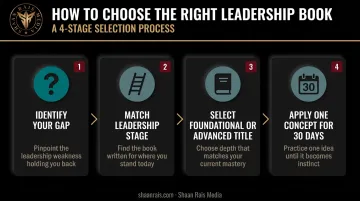
- Identify your specific gap first: Are you avoiding feedback conversations? Struggling with team culture? Stuck making every decision yourself? Name the problem before picking a title.
- Sequence foundational before advanced: First-time managers should build self-awareness (Radical Candor, The Coaching Habit) before tackling enterprise strategy (Good to Great).
- Apply one concept before adding another book: The most common mistake is reading five leadership books in a quarter and applying none of them. One well-practiced habit beats five half-remembered frameworks.
The diagnosis matters more than the title's popularity. A senior executive battling ego-driven blind spots needs Marshall Goldsmith's What Got You Here Won't Get You There, not a coaching primer meant for first-time managers.
Match the Book to the Leadership Stage
| Stage | Core Challenge | Book Type to Prioritize |
|---|---|---|
| First-time manager | Self-awareness, feedback | Foundational (Radical Candor) |
| Mid-level leader | Team culture, delegation | Practical frameworks (The Coaching Habit) |
| Senior executive | Blind spots, legacy | Behavioral (What Got You Here Won't Get You There) |
| Enterprise leader | Strategy, scale | Strategic (Good to Great) |
Use this table as a starting filter, then confirm the fit by asking whether the book addresses the specific gap identified in step one.
Conclusion
The best leadership book isn't the one with the most five-star reviews. It's the one that addresses the specific challenge sitting on your desk right now.
Pick one title from this list. Apply a single concept — one feedback framework, one coaching question, one courage practice — for 30 days. Reassess before you buy the next book.
Skill-building is only the starting point, though. Once you've sharpened how you lead, the next challenge is making sure the market actually sees that growth. That's the gap Shaan Rais's practice helps close, through positioning work that helps capable leaders become visibly recognized as such.
Frequently Asked Questions
What is the best book on leadership skills?
There's no single universal best book. If feedback is your gap, start with Radical Candor. If you're newly promoted, read What Got You Here Won't Get You There. Match the book to your specific challenge, not to popularity.
What are the C's of leadership?
There's no single agreed-upon list. Commonly cited versions include Creativity, Courage, Curiosity, Confident Humility, and Collaboration, or alternatively Character, Communication, Commitment, Competence, and Courage. Use whichever version helps you diagnose your gap.
What are the 5 P's of leadership?
Versions vary by source. One academic model lists Person, Process, Position, Product, and Purpose; a commonly cited editorial version uses Purpose, Passion, People, Process, and Performance. Purpose and people consistently appear across most versions.
What is the best leadership book for first-time managers?
The Coaching Habit and Radical Candor both work well for first-time managers. The Coaching Habit helps you stop over-advising; Radical Candor helps you give direct feedback without damaging relationships.
Can leadership skills really be learned from books alone?
Books build knowledge and frameworks, but skill only develops through practice, feedback, and real application. Reading without applying even one concept rarely changes behavior on its own.
How many leadership books should a leader read in a year?
No verified optimal number exists. Quality beats quantity: four to six books applied deeply, with one behavior practiced from each, will outperform a dozen books skimmed and forgotten.