Researchers James Kouzes and Barry Posner spent decades studying what actually separates good managers from great leaders. Starting in 1983, they collected personal-best leadership stories from hundreds of professionals and cross-checked those accounts against what followers said made them feel genuinely led. The result was the Five Practices of Exemplary Leadership — a framework now backed by 40+ years of research and over 8 million respondents.
This isn't about personality. It's about behavior. Below, we'll break down each practice, show you how to apply it, and explain why demonstrating these practices matters just as much as mastering them internally.
Key Takeaways
- Leadership is a set of learnable behaviors, not an innate trait you're born with
- Kouzes and Posner's research on 1,000+ leaders identified five practices that separate effective leaders from the rest
- Manager effectiveness accounts for at least 70% of the variance in team engagement scores
- These five practices work dynamically together, not as a checklist you complete once
- Your influence depends on being visibly recognized as a leader, not just privately mastering the practices
What Are Leadership Practices?
Leadership practices are observable behaviors — not fixed traits — that leaders consistently repeat to build trust and produce results. You can learn them. You can measure them. You can get better at them with feedback, the same way you'd improve a golf swing or a sales pitch.
This distinction matters because it separates leadership from management.
Management vs. Leadership: Not the Same Job
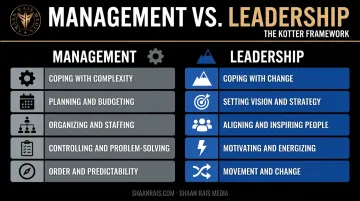
Harvard Business School's John Kotter drew a clean line between the two roles:
| Dimension | Management | Leadership |
|---|---|---|
| Primary challenge | Coping with complexity | Coping with change |
| Direction | Planning and budgeting | Setting vision and strategy |
| People | Organizing and staffing | Aligning and inspiring people |
| Execution | Controlling, problem-solving | Motivating, energizing |
| Result | Order and predictability | Movement and change |
Kotter's point, made in his HBR piece What Leaders Really Do, is that organizations need both. Good management keeps the lights on. Leadership moves the organization somewhere new. One isn't a promoted version of the other.
Kotter explains the difference in function. Kouzes and Posner set out to find the difference in behavior. Over five-plus years, they studied more than 1,000 high-performing leaders and their direct reports to isolate the specific actions (not titles or personalities) that separated leaders people wanted to follow from leaders people merely tolerated.
The 5 Practices of Effective Leaders
Here's what makes this framework credible: the five practices weren't theorized in a conference room. They emerged from matching what leaders believed made them effective against what their teams actually experienced as good leadership. When both sides agreed on a pattern, it made the list.
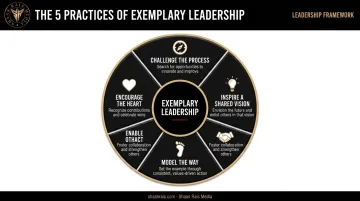
Practice 1: Challenge the Process
Effective leaders don't treat setbacks as failures. They treat them as data. They're often the first to try a new approach, and they're comfortable being wrong in public because that's how improvement happens.
What this looks like in practice:
- Piloting a new workflow with a small team instead of waiting for a company-wide mandate
- Asking "why do we still do it this way?" without apologizing for the question
- Treating a failed experiment as useful information, not a career risk
Try this: Name one process on your team that everyone quietly complains about but nobody has challenged. That's your starting point.
Practice 2: Inspire a Shared Vision
People don't get motivated by fear or bonus structures for very long. They get motivated by ideas that capture their imagination, and that vision has to be repeated constantly rather than crafted once and filed away.
A good leader takes an abstract mission statement ("we help businesses grow") and turns it into something a warehouse employee or a junior analyst can feel personally connected to. That translation work is the job. It's also, in essence, positioning work: the same instinct that helps a leader clarify what their organization stands for is what helps a professional clarify their own market value.
Self-check: Can your team repeat your organization's vision without looking it up? If not, you haven't communicated it. You've just written it down somewhere.
Practice 3: Enable Others to Act
Leaders get results through other people. That means real delegation, handing over actual authority rather than just tasks, so people build genuine ownership instead of just following instructions.
This connects directly to retention. A meta-analysis of 94 studies covering 42,212 participants found that psychological empowerment correlates with lower turnover intention (r = -0.36) and higher organizational commitment (r = 0.51), according to research published in Current Psychology. Gallup's data tells a similar story: employees who feel genuinely supported by their manager are about 70% less likely to experience regular burnout.
Delegating authority isn't generosity. It's a retention strategy disguised as trust.
Practice 4: Model the Way
Teams don't believe what you say. They believe what you consistently do. If your stated values and your daily actions don't match, credibility erodes fast, and it's almost impossible to rebuild.
A concrete example: a leader who cuts their own department's budget before asking other teams to make cuts. Or one who takes a pay reduction during a rough quarter instead of protecting their own compensation first.
Small, consistent actions matter more than grand gestures here. One leader showing up early for a team's tough project builds more trust than a single motivational speech ever will.
Practice 5: Encourage the Heart
This is the practice most results-driven leaders skip, and it's the one that sustains motivation over the long haul. Recognizing effort and progress, not just final outcomes, keeps people engaged between wins.
Low-cost, high-impact examples:
- Public shoutouts in team meetings for specific contributions (not generic praise)
- Marking small milestones, not just the big launch
- Handwritten notes or a two-minute call acknowledging someone's effort
Leaders who are heads-down on metrics tend to view this practice as soft. It's not. It's the maintenance work that keeps the other four practices from burning people out.
Why These Practices Matter
Gallup's research found that managers account for at least 70% of the variance in employee-engagement scores across business units, based on their State of the American Manager research. That's not a small correlation. The person managing you shapes your day-to-day experience of work more than almost anything else.
A few things to keep in mind:
- These five practices don't operate in isolation; a leader navigating a crisis might lean hardest on Model the Way
- A leader launching a new initiative might lean instead on Inspire a Shared Vision
- Situational demands decide which practice takes priority at any given moment
- None of this is fixed personality. Research materials describe leadership as measurable, learnable, and teachable behavior, much like negotiation
The takeaway: practice specific behaviors deliberately, and get feedback on them.
How to Start Applying the 5 Practices
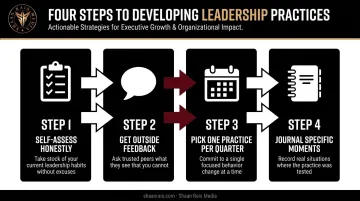
You don't improve at all five simultaneously. Trying to will burn you out and diffuse your focus. Instead:
- Self-assess honestly — Rate yourself 1-10 on each practice. Most people find one or two they consistently underuse.
- Get outside feedback. Ask your team directly, or use a structured 360-style review — self-perception and follower experience are often miles apart.
- Pick one practice per quarter — Focus deliberately on a single behavior instead of scattering effort across all five.
- Journal specific moments. Note the week you challenged a process, modeled a value under pressure, or recognized someone's work — patterns emerge fast.
This is slower than reading a leadership book cover to cover. It's also the only approach that actually changes behavior instead of just changing your vocabulary.
The same principle holds true in positioning work: operators who deliberately practice one shift at a time build a reputation that sticks, rather than one that fades with the next trend.
Practicing Leadership Isn't Enough — You Also Need to Be Seen Leading
Plenty of leaders quietly excel at all five practices. They challenge processes, recognize their teams well, and hold their values under pressure, yet almost nobody outside their immediate circle knows it.
Capability without visibility caps your influence. It limits which boards ask you to speak, which companies recruit you, which opportunities find their way to your inbox. You can be the best-led team in the building and still be invisible to the market that would pay a premium for what you've built.
This is the gap Shaan Rais, an Industrial-Organizational Psychologist who works with operators and executives across dozens of industries, spends most of his time closing. His framing is direct: you are more valuable than you are visible. Leadership practices build the substance. Positioning determines whether the market ever finds out that substance exists.
Here's what that looks like in practice:
- One of Rais's clients generated $250,000 in new business within 72 hours of a single keynote appearance
- The result came directly from positioning expertise in front of the right audience, not chance timing
If you've spent years mastering how you lead internally but haven't translated that into how the market perceives you externally, that gap is about positioning, not leadership. It's the next problem worth solving once the internal work is done.
Frequently Asked Questions
What are leadership practices?
Leadership practices are observable, learnable behaviors that leaders consistently use to build trust and achieve results. Unlike fixed personality traits, they can be developed through awareness, feedback, and deliberate repetition.
What are the five leadership practices?
Kouzes and Posner's framework identifies five practices: Challenge the Process, Inspire a Shared Vision, Enable Others to Act, Model the Way, and Encourage the Heart. Each is backed by specific, measurable behaviors.
What is an example of a leadership practice?
Publicly recognizing a team member's specific contribution during a meeting demonstrates Encourage the Heart. Piloting a new workflow instead of defaulting to convention demonstrates Challenge the Process.
Who developed the five practices of leadership model?
Researchers James Kouzes and Barry Posner developed the model, beginning their research in 1983. They studied over 1,000 leaders and their followers, analyzing personal-best leadership experiences to identify recurring behavioral patterns.
How can I improve my leadership practices?
Start with an honest self-assessment across all five practices, then seek direct feedback from your team since self-perception often differs from follower experience. Focus on improving one practice at a time rather than all five at once.
What is the difference between management and leadership?
Managers maintain stable, predictable systems through planning and control. Leaders set direction and align people around change, often challenging existing norms to get there.