Gallup's research backs this up: organizations fail to select the right management talent 82% of the time, and most new managers say they were chosen because of tenure or success in a previous individual role, not because they showed people-development ability. Coaching used to be an HR checkbox. Now it's a core leadership skill.
TED Talks have become a go-to resource for managers trying to close that gap. Search "how to coach employees" and you'll find dozens of talks recommended. But watching a talk isn't a strategy. This article breaks down the TED questioning model, shares practices that actually work, and points you toward the talks worth your time.
Key Takeaways
- Coaching is a learnable skill built on questions, listening, and structured feedback
- The TED model — Tell me more, Explain that, Describe what happened — prompts employees to think instead of wait for answers
- The strongest coaching TED Talks cover psychological safety, motivation, and honest conversation
- How you develop your team increasingly shapes how the market judges your leadership
What Is the TED Model in Coaching?
TED stands for three open-ended prompts: Tell me more, Explain that further, and Describe what you mean. Coaches use them to invite an employee to elaborate without steering the answer or passing judgment on it.
This TED has nothing to do with the media organization behind TED Talks. It's a separate mnemonic that shows up in coaching guides and institutional communication training.
Why These Prompts Work
Closed questions ("Did you check the numbers?") invite one-word answers. TED prompts don't allow that shortcut. Compare the two approaches:
| Directive Language | TED-Style Coaching |
|---|---|
| "Here's what you should do." | "Tell me more about what you tried." |
| "That's wrong, fix it this way." | "Explain how you'd approach it differently." |
| "You need to hit this target." | "Describe what success looks like to you." |
The directive version puts the manager in the driver's seat. The TED version keeps the employee there, which is the entire point. Here's how that distinction plays out in a real conversation.
A Quick Example
Picture a rep who missed a client deadline. A directive manager says, "You should've flagged this sooner." A coaching manager asks:
- "Tell me more about what happened this week."
- "Explain how you'd handle the same situation next time."
- "Describe what success looks like for this account going forward."
Notice none of these questions assign blame. They open a door instead of closing one.
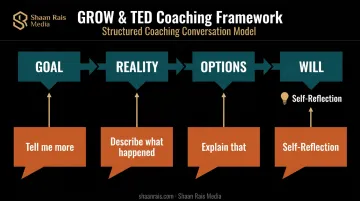
TED pairs naturally with GROW (Goal, Reality, Options, Will). Think of GROW as the map for the conversation and TED as the specific phrases you use to keep someone talking within each stage. Used consistently, this combination builds something more valuable than a single good conversation: employees start self-reflecting before they even come to you with a problem. That shift from reactive to reflective thinking is the same outcome that positioning-focused coaching aims for at the executive level: people who can articulate their own value without being prompted.
How to Effectively Coach Employees: Best Practices
Start With Curiosity, Not Correction
Jumping to solutions feels efficient. It rarely is. Harvard Business Review's "The Leader as Coach" distinguishes directive coaching (supplying answers) from nondirective coaching (asking questions) and recommends choosing based on the situation, not defaulting to one.
A 2023 workplace-coaching meta-analysis covering 1,643 participants found a real overall effect on skill outcomes, though it couldn't isolate questioning alone as the cause. The practical takeaway still holds: ask before you tell, especially when the employee has the knowledge to solve it themselves.
Create Psychological Safety First
Employees only open up in coaching conversations when they believe there's no penalty for admitting mistakes. Simon Sinek calls this the "circle of safety" in his leadership work.
Google's Project Aristotle studied 180 teams and found psychological safety was the single most important factor in team effectiveness, ranking above skill mix or experience. Without it, TED questions just produce guarded, safe answers.
Build safety before you ask hard questions. That means:
- Responding to mistakes with curiosity, not criticism
- Sharing your own missteps first
- Following through on confidentiality when someone admits a struggle
Make Feedback a Two-Way Conversation
Vague praise ("good job") or vague criticism ("needs improvement") gives employees nothing to act on. Effective feedback references specific, observed behavior.
Try this sequence:
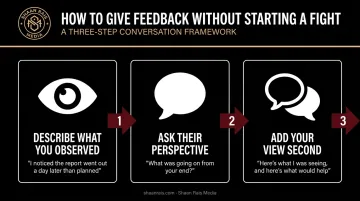
- Describe what you observed — "In yesterday's client call, you cut the pricing discussion short."
- Ask their perspective — "What was your read on how that landed?"
- Add your view second — Not first. Let them process out loud before you weigh in.
Gallup found 80% of employees who received meaningful feedback in the past week were fully engaged. But only 26% said their feedback actually helped them improve. Frequency without specificity doesn't move the needle.
Set Clear Goals and Follow Through
Every coaching conversation should end with a concrete commitment. Not "let's keep working on it" but "you'll draft the revised proposal by Thursday, and we'll review it Friday morning."
Then actually revisit it. Skipping the follow-up is where most coaching habits quietly die.
Adapt Your Coaching Style to the Individual
A new hire needs more structure. A senior employee needs more autonomy and fewer step-by-step prompts. Coaching isn't a script — it's a calibration based on:
- Experience level — junior employees may need more directive guidance early on
- Personality — some people think out loud, others need silence to process
- Personal goals — someone eyeing a promotion needs different conversations than someone optimizing for work-life balance
Practice Active Listening
A 2021 field study of 268 employees during a company restructuring found that increases in managers' active listening predicted lower job insecurity, largely because employees felt more control over the situation.
Active listening isn't passive. It looks like:
- Paraphrasing what you heard before responding
- Letting silence sit instead of jumping in
- Naming the emotion you're picking up ("It sounds like that was frustrating")
Most coaching breakdowns happen because managers listen to respond, not to understand.
Top TED Talks Every Manager Should Watch
This isn't an exhaustive "best of" list. It's a short, skill-specific shortlist worth your lunch break, covering safety, coaching style, motivation, and feedback — the four skills that show up most in day-to-day management.
On Psychological Safety and Trust
Simon Sinek: Why good leaders make you feel safe — Sinek argues great leaders build a "circle of safety" so employees feel protected internally, freeing them to focus outward on the actual work instead of office politics.
On Coaching as a Leadership Style
Saba Imru-Mathieu: "Leaders Who Coach Are Creating Better Workplaces, and So Can You" — A TEDx talk making the case that solution-focused coaching drives employee empowerment and builds workplaces that are both humane and high-performing.
On Motivation and Engagement
Dan Pink: The puzzle of motivation — Pink's research shows traditional rewards don't reliably drive performance on complex work. Autonomy and purpose outperform bonuses in most knowledge-work settings.
On Difficult Conversations and Feedback
Celeste Headlee: 10 ways to have a better conversation — Practical rules centered on honesty, brevity, and genuine listening. Directly applicable to feedback conversations.
Consider watching one talk per week with your team as a lightweight coaching-culture ritual. Fifteen minutes, then a short discussion. It builds shared language faster than a formal training program — and reinforces a point worth remembering: how a manager shows up gets noticed long before any strategy does.
Common Coaching Mistakes Managers Make
Managers who coach well still fall into predictable traps. Watch for these three:
- Jumping straight to solutions. Solving the problem for the employee instead of letting them work through it teaches them to bring problems, not solutions, next time.
- Treating coaching as an annual event. A Gallup study found 74% of employees receive a review only once a year or less. Coaching that happens once a year isn't coaching — it's a report card.
- Giving vague feedback. "Good job" and "needs improvement" tell employees nothing about what to repeat or change. Specific feedback is what employees can actually use.
Coaching Employees Is Also a Leadership Branding Asset
Here's something most managers overlook: how you coach and develop people has become a visible marker of leadership capability. Boards, peers, and the broader market increasingly judge leaders not just on results, but on the strength of the teams they build.
Executives known for developing strong people get positioned for bigger opportunities. The pattern is consistent: capability alone rarely gets noticed. Visibility does. This tends to show up in a few concrete ways:
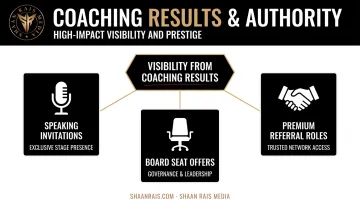
- Speaking invitations at industry events
- Board seat offers from companies seeking proven talent-builders
- Premium roles that come through referral, not application
This is where positioning work matters. Coaching results are exactly the kind of substance that, when shared deliberately, becomes a career advantage rather than a private accomplishment buried in a performance review.
Start documenting the people you've developed and the outcomes they've achieved. That record is what turns quiet mentorship into recognized leadership.
Frequently Asked Questions
How to effectively coach employees?
Ask open-ended questions before offering solutions, build psychological safety so employees speak honestly, give specific feedback tied to observed behavior, and follow up on commitments at the next check-in.
What is the TED model in coaching?
TED stands for Tell me more, Explain, and Describe. It's a set of open-ended prompts that push employees to elaborate and self-reflect instead of giving one-word answers.
What are the best TED Talks for coaching employees?
Simon Sinek's talk on psychological safety, Dan Pink's talk on motivation, and Saba Imru-Mathieu's talk on coaching-driven leadership each address a different core coaching skill.
What is the difference between coaching and managing employees?
Managing typically means telling people what to do and how to do it. Coaching means asking questions that guide employees toward finding their own answers and building their own judgment.
How often should managers coach their employees?
Frequent, brief check-ins beat rare, formal sessions. Weekly or biweekly conversations keep feedback timely and relevant instead of stale by the time it's delivered.
Can coaching skills be learned, or are some managers naturally better at it?
Coaching is learnable. It's built through frameworks like TED and GROW, practiced through repetition, and improved with feedback, not something people are simply born good at.