This happens constantly. Executives operate at a different level of the organization, connecting dots across departments, budgets, and long-term strategy. Most professionals default to too much detail and too little framing, and credibility disappears in the first two minutes.
Harvard Business School's landmark study of CEO time tracked 60,000 hours across 27 CEOs over 13 weeks, confirming what most of us sense intuitively: executive time is brutally scarce. This guide breaks down 15 practical tips into four clusters: how executives think, how to prepare, how to deliver, and how to build the relationship afterward.
Key Takeaways
- Executives lead with impact and outcomes, not process or step-by-step detail
- Strong preparation, metrics, alternatives, and a clear ask separate memorable briefings from forgettable ones
- Confidence and brevity influence your reputation more than a polished slide deck
- Master these habits, and executives start seeking your input before decisions are made
Understand How Executives Think Before You Speak
Executives don't process information the way peers do. They're connecting dots across the entire organization, not just your slice of it. A message built for your team lead often lands flat with a VP because it's missing the strategic frame.
The real constraint is attention scarcity. According to McKinsey's research on decision-making, 61% of executives believe at least half their decision-making time is ineffective, and only 37% report their organizations make decisions that are both high-quality and fast. Every minute you spend on setup is a minute you're borrowing against a shrinking budget.
Tip 1: Think Like an Executive First
Before you draft a single slide, ask what this person actually tracks:
- Revenue impact
- Risk exposure
- Growth trajectory
- Organization-wide ripple effects
Research those priorities before you draft a single word.
Tip 2: Match Your Message to the Setting
A formal boardroom briefing and a hallway run-in call for different depth. Read the room. If your executive is glancing at their phone or standing rather than sitting, that's your cue to compress further, not push through your prepared script.
Executives also want new information, not a rehash. If they already know the background, skip straight to what's changed or what surprised you. Leading with the unexpected insight, rather than the setup, keeps them engaged from sentence one.
Preparation Tips: Do Your Homework Before the Conversation
Good executive conversations rarely happen spontaneously. They're the product of groundwork laid days or weeks earlier.
Study Their Communication Style
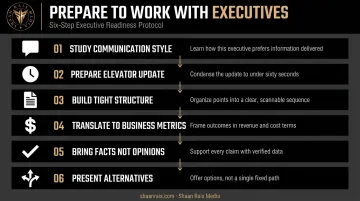
Tip 3: Observe how they prefer to communicate. Some executives want a two-line email. Others want five minutes in person. If you're not sure, ask their assistant. Guessing wrong wastes the one shot you get.
Tip 4: Always have an elevator-ready update. Opportunities with executives are rarely scheduled. You might get thirty seconds in an elevator or a hallway. Have a compressed version of your update ready at all times, so you're never caught flat-footed.
Structure Your Materials for Speed
Tip 5: Build a tight, structured presentation. Nancy Duarte's guidance for executive presentations is to design the opening as if you only had five minutes, even in a thirty-minute meeting slot. That means:
- Lead with findings and recommendation, not a slow buildup
- Use bullet points over dense paragraphs
- Push supporting data into an appendix, not the main flow
Tip 6: Translate team wins into business metrics. A 30% reduction in clicks means nothing to a CFO, but a 30% reduction that saves $40,000 in support costs annually gets their attention. Keep asking "so what does that mean for the business" until you land on a number leadership actually tracks.
Tip 7: Bring facts, not opinions. Every recommendation needs data behind it. Be ready for follow-up questions on the spot. Executives test credibility by probing, and hesitation on basic questions undoes even a strong opening.
Tip 8: Bring alternatives, not just one path. McKinsey's DARE decision model calls for recommenders to lay out alternatives with clear pros and cons before proposing a course of action. Executives want to see you've weighed trade-offs, not just landed on the first workable idea.
Delivery Tips: How to Speak So Executives Actually Listen
Preparation gets you in the room. Delivery determines whether you're remembered.
Open Strong, Skip the Preamble
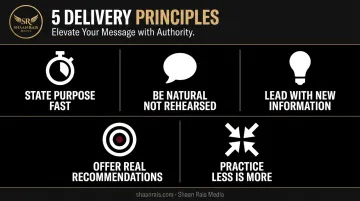
Tip 9: State your purpose in the first 15-30 seconds. No lengthy setup. Connect your point to a company goal immediately, so the executive knows within seconds why this matters to them.
Tip 10: Be natural, not rehearsed. Forbes contributor Elizabeth Freedman, who has coached numerous C-suite clients, notes that methodically walking through slides can come across as junior, while executives respond better to genuine back-and-forth conversation. Composed body language and a steady voice do more work than a beautifully designed deck ever will.
Tip 11: Lead with what they don't already know. Senior leaders have deep institutional context. Skip the background they've already absorbed, and open with the new insight or the thing that's changed since you last spoke.
Take a Position and Stay Flexible on Time
Tip 12: Offer a real recommendation. When asked for input, don't hand back a neutral list of options. You're the expert in the room on this topic; act like it. State what you'd do and why.
Tip 13: Practice "less is more." Prepare a 3-minute version of your message in advance. If your allotted time gets cut, and it often does, you compress instantly instead of scrambling.
That same discipline applies to what you leave behind: a one-page visual summary, like an executive dashboard, ensures your idea survives even if someone else presents it on your behalf. That single page becomes the artifact people remember and forward.
Build the Relationship: Listen, Get Feedback, and Follow Up
The meeting doesn't end when you stop talking. How you close it, and what you do afterward, shapes whether you get invited back.
Tip 14: Ask clarifying questions before diving in. A quick "What's top of mind for you today?" surfaces the executive's real priority before you commit to a talking point they may not care about.
Tip 15: Stay flexible mid-conversation. If new information surfaces, adjust your position. Rigidly defending your original pitch after the room has clearly shifted only signals you weren't really listening.
Bonus Tip: Invite feedback and name what you need. Ask directly: "What are your thoughts?" Then state what support you need from them. This makes the executive a stakeholder in the outcome, not just an approver.
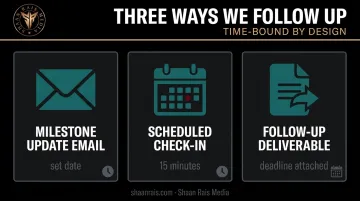
That sense of ownership fades fast without a concrete follow-up, so close every interaction with a specific next step:
- A milestone update email by a set date
- A scheduled 15-minute check-in
- A follow-up deliverable with a deadline attached
Vague endings like "I'll keep you posted" get forgotten. Specific dates get remembered.
What Great Executive Communication Says About Your Personal Brand
How you show up with executives isn't just a meeting skill. It's a live demonstration of how you're positioned, and every interaction either reinforces or chips away at how the market perceives your capability.
Operators who communicate with clarity and confidence at the executive level tend to get remembered and recommended, even ahead of peers with equal or greater technical skill. That gap between talent and positioning often decides who gets the next opportunity.
Branding strategist Shaan Rais, who coaches executives on this exact gap, puts it simply: your positioning often lags behind your actual capability, and that lag is what keeps you invisible in the room. Operators who close that gap tend to communicate with more precision, translate their expertise into language executives immediately trust, and get remembered long after the meeting ends.
Strong positioning is what turns a single boardroom conversation into a lasting reputation, one that keeps your name in the room long after you've left it.
Frequently Asked Questions
How to effectively communicate with executives?
Lead with the bottom-line impact first, keep your message brief and direct, and back every claim with relevant data. Close with a clear next step or specific ask.
What are the 7 C's of executive presence?
There's no single standardized list, but commonly cited traits include confidence, clarity, composure, connection, credibility, conviction, and courtesy. Harvard Business Review's research-backed model condenses this to three dimensions: gravitas, communication skill, and appearance.
What is the 3-2-1 rule for conversations?
One common framework suggests structuring talking points around 3 key priorities, 2 supporting details or examples, and 1 clear ask. Treat it as a practical structuring tool rather than a universal standard.
How long should a presentation to executives be?
Aim for a core message you can deliver in 5 minutes or less, with a 3-minute fallback ready in case time is cut. Keep supporting detail available for questions rather than baked into the main flow.
What should you avoid when speaking with a CEO?
Avoid over-explaining background they already know, hiding behind slides instead of having a real conversation, and showing up without a clear recommendation. Neutral options without a stance frustrate time-pressed leaders.
How can you build executive presence over time?
Executive presence builds through repeated exposure to high-stakes conversations, consistent preparation, and intentional positioning of your results and expertise. It's a habit built over dozens of interactions, not a one-time performance.