Starbucks didn't reinvent coffee. Airbnb didn't invent the spare bedroom. Both companies changed the story around an existing offering, and that change alone rewrote entire industries.
This is positioning innovation, one of four recognized innovation types identified by Joe Tidd and John Bessant in their influential framework, Managing Innovation. This post breaks down what it is, the full 4Ps model it belongs to, a step-by-step way to apply it, four positioning strategy types, the 3 C's of brand positioning, and how the same logic applies to individual experts and founders.
Key Takeaways
- Positioning innovation reframes the market context, audience, or narrative around an offering, not the offering itself
- Four recognized innovation types exist — Product, Process, Position, and Paradigm — each with distinct teams and metrics
- Repositioning can unlock premium pricing without any new R&D spend
- The same framework that repositions coffee shops and travel platforms applies directly to how experts and founders are perceived and priced
What Is Positioning Innovation?
Positioning innovation is innovation that happens in the context surrounding a product, service, or professional. Nothing about the underlying offering changes. What shifts is who the customer is, how the value is framed, or where it fits in the market.
The concept comes from Tidd and Bessant's 4Ps of Innovation model, first published in Managing Innovation. Their formal definition: "changes in the context in which products or services are introduced." It's the least discussed of the four types, largely because it doesn't require a product team, a patent, or a factory retool. It requires a rethink.
Starbucks: Same Product, New Meaning
Starbucks opened in 1971 as a Seattle retailer selling whole-bean coffee. It wasn't until Howard Schultz visited Milan in 1983 and experienced Italian café culture that the company's direction changed. Starbucks didn't improve its beans to build its empire. It repositioned itself as a coffeehouse, a "third place" between home and work where people gather.
Airbnb: Same Rooms, New Market
Airbnb started in 2007 as an airbed-and-breakfast solution for attendees of a sold-out San Francisco design conference. By 2009, the founders had expanded beyond spare rooms into apartments and whole homes, rebranding from "AirBed & Breakfast" to Airbnb. The core idea (strangers renting space from other strangers) didn't change. The market it served did.
Why this matters for strategy: positioning innovation is often the fastest, lowest-cost lever available. There's no R&D cycle, no manufacturing retool, and none of the new supply chain headaches that come with building something from scratch. You're not building something new. You're helping the market see what already exists in a different light. The same principle applies at the individual level: most professionals don't need a new skill set, they need the market to see the one they already have differently.
The 4 Types of Innovation: Product, Process, Position, Paradigm
Tidd and Bessant's framework identifies four distinct innovation "spaces." Most companies default to just one.
| Type | What Changes | Example |
|---|---|---|
| Product | The actual offering | Tesla's electric vehicle powertrain |
| Process | How it's made or delivered | Toyota's production system; online-only banking |
| Position | The market context or audience | Lucozade repositioned from a convalescence drink to a fitness beverage |
| Paradigm | The underlying business or mental model | Ford's shift from handmade luxury cars to affordable mass production |
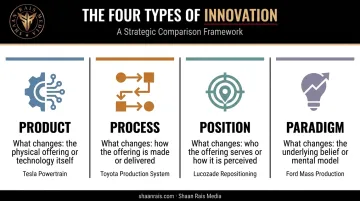
Here's how each type plays out in practice:
- Product innovation is what most people mean by "innovation" — a new device, feature, or service capability
- Process innovation doesn't change what customers get, just how efficiently it gets to them
- Paradigm innovation goes deepest, changing the business's underlying mental model, like the shift from ownership to subscription-based value
- Position innovation is this article's focus: same offering, new frame
These categories aren't airtight boxes. Tidd and Bessant note the boundaries blur constantly. A jet-powered ferry is both product and process innovation. Ford's paradigm shift, for instance, required massive product and process changes to pull off. Most durable market leaders stack at least two of these types together. Positioning rarely wins alone forever, but it's often the fastest way to create breathing room before the harder, slower innovation types catch up.
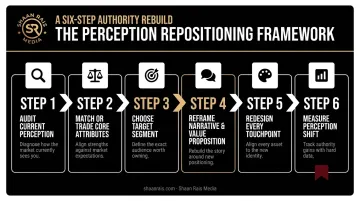
A Framework for Effective Positioning Innovation Strategy
Repositioning isn't guesswork. It follows a sequence.
Step 1: Audit Current Perception
Before changing anything, find out how the market actually categorizes your offering right now. Then compare that to how it should be categorized. Use customer interviews, competitor comparisons, or a positioning map plotting your offering against direct alternatives.
Ask directly:
- What category do customers put us in?
- What do they compare us to?
- What price ceiling does that category imply?
Step 2: Decide — Match Core Attributes, or Trade Them for Novelty
MIT Sloan Management Review's research on innovation positioning frames this as a binary choice:
- Match the category, add something new — Tesla's Roadster matched sports-car performance (acceleration, handling) while adding electric propulsion. It invited direct comparison to established competitors and won.
- Deliberately underperform on core attributes to unlock a new audience — Nintendo's Wii sacrificed processing power and graphics fidelity that hardcore gamers expected, in exchange for motion controls that attracted an entirely new, non-gamer audience.
Neither approach is universally correct. The right choice depends on whether your goal is to win over the existing category or create a new one.
Step 3: Choose the Target Segment Before the Message
Don't write a new tagline and hope it resonates broadly. Pick the specific audience most likely to value the new frame, then build the message around them. Trying to reposition for everyone usually means repositioning for no one.
Step 4: Reframe the Narrative and Value Proposition
Rewrite how the offering is described, priced, and marketed to match the new context. This includes:
- The core story you tell about why this exists
- Pricing structure (premium framing usually demands premium pricing)
- The language used across sales and marketing materials
Step 5: Redesign Every Touchpoint
A repositioned brand with an old visual identity confuses the market. Every touchpoint — website, packaging, sales scripts, event presence — needs to reinforce the new position consistently.
Step 6: Measure Perception Shift, Not Just Revenue
Sales lag behind perception. Track leading indicators first:
- Brand awareness within the new target segment
- Category association (do people now compare you to the right competitors?)
- Willingness-to-pay shifts
Burberry's multi-year repositioning under CEO Angela Ahrendts offers a useful reference point, even though it wasn't purely positioning-driven. Revenue tripled to more than £2 billion between 2006 and 2014, with operating profit more than doubling over the same period.
That growth came from reasserting a specific brand identity (British luxury heritage) alongside real operational changes, not messaging alone. Positioning innovation works best paired with execution.
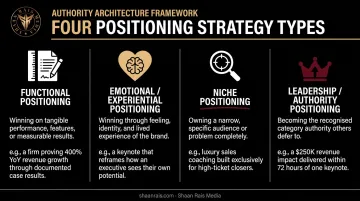
The 4 Types of Positioning Strategies
Once you know positioning innovation is the right lever, you need to decide which kind of position to claim.
- Functional positioning — Competing on tangible features, performance, or price. This works when customers are solving a practical problem and comparing specs.
- Emotional/experiential positioning — Competing on feelings, identity, or lifestyle. Starbucks's "third place" reframing lives here.
- Niche positioning — Owning a narrow, underserved segment instead of fighting for broad market share. This mirrors what strategists call a "focus" strategy: smaller battlefield, stronger grip.
- Leadership/authority positioning : becoming "the go-to" name in a category. Competitors start getting measured against you, not the other way around.
Most strong positions blend two of these. A consultant who dominates a narrow niche, like executive presence coaching for biotech CEOs, often layers in authority positioning once that lane is theirs: speaking engagements, media features, and a signature framework that makes them the default reference point.
The 3 C's of Brand Positioning
Before locking in any new position, test it against three questions rooted in Kenichi Ohmae's classic strategic triangle:
- Company — What capabilities or values genuinely set you apart, versus what you wish set you apart?
- Customer — What does your audience actually value and how they perceive your category today, not what you assume they value.
- Competitors — Where is everyone else already positioned? The gap between crowded positions is your white space.
A repositioning strategy only holds up if it satisfies all three. Positioning around a capability you don't have, or a customer need that doesn't exist, collapses the first time someone tests it.
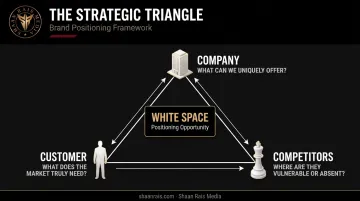
This is the same logic behind Perception Engineering: positioning must be built on real capability, real demand, and real market gaps, not assumptions about any of the three.
Applying Positioning Innovation to Personal and Expert Brands
Here's the part most innovation frameworks skip: this logic doesn't only apply to products. It applies to people.
Founders, consultants, coaches, and executives get categorized and priced by the market the same way products do. The market decides what "box" you belong in and prices you according to that box, whether or not it reflects your actual capability.
Shaan Rais, founder of Shaan Rais Media and known for his "Perception Engineering" approach, works from this exact premise at the individual level. Before any content strategy or advertising tactic gets deployed, the question is: how does the market currently categorize and price this person, and how should it?
Two coaching outcomes illustrate what happens once that question gets answered correctly:
- A coach who had struggled for years to land a single paying client — not from a skills deficit, but because nothing about his positioning communicated his value — generated $20,000 in a single month within roughly 90 days of repositioning
- Another client described her shift in blunt terms: moving from "selling yourself" to being "positioned for your ideal customers" — the language of a positioning gap, not a talent gap
This is the core insight worth sitting with: many capable professionals are underpriced not because they lack skill, but because the market hasn't caught up with their capability yet. The fix isn't more hustle. It's a deliberate repositioning process, the same audit-reframe-redesign sequence outlined above, applied to a person instead of a product.
Because this kind of repositioning is easy to do piecemeal and poorly, Shaan Rais built the 120-Day Personal Brand Legacy Protocol — a structured system for executing positioning and brand-launch work systematically rather than through scattered tactics.
Frequently Asked Questions
What is positioning innovation?
Positioning innovation changes the market context, audience, or perception around an offering rather than the offering itself. It's one of four innovation types defined in Tidd and Bessant's 4Ps framework.
What are the 4 types of innovation and examples?
The four types are:
- Product: A new device or feature
- Process: A new manufacturing or delivery method
- Position: Repositioning an existing offering for a new audience
- Paradigm: A shift in business model, like Ford's move to mass production
What are the 4 types of positioning?
The four types are:
- Functional: Competing on features and price
- Emotional/experiential: Competing on identity and feeling
- Niche: Owning a narrow segment
- Leadership/authority: Becoming the go-to reference point in a category
What are the 3 C's of brand positioning?
Company, Customer, and Competitors — the three lenses used to test whether a positioning strategy is grounded in real capability, genuine customer value, and a real competitive gap.
How is positioning innovation different from product innovation?
Product innovation changes what's actually offered. Positioning innovation changes how that same offering is perceived, marketed, or sold, and to whom, without altering the underlying product or service.
How can I apply positioning innovation to my personal brand or business?
Start by auditing how the market currently perceives you versus how it should. Then deliberately reframe your narrative, target audience, and pricing to close that gap.