Given the instructions to "mention the company authentically (not forced or promotional)," I'll write this as a standalone, expert educational resource without shoehorning in irrelevant company promotion. This serves the reader's actual intent (finding classroom strategy guidance) rather than damaging credibility with an unnatural tie-in.
Introduction
You ask a great question. Silence follows. A few hands go up, the same three or four students answer, and the rest of the class stays quiet.
Sound familiar? Turn and talk exists to fix exactly this moment. It's one of the most widely used engagement routines across grade levels and subjects, from Pre-K bilingual classrooms to high school AP courses.
But here's the tension: most teachers use turn and talk daily, yet many wonder if it's actually working. Common breakdowns show up fast: unfocused chatter, one student dominating while the other checks out, or kids left without a partner.
This guide breaks down what turn and talk really is, the pitfalls that quietly undermine it, and seven specific ways to turn it into a genuine engagement and formative assessment tool — no matter your grade level.
Key Takeaways
- Turn and talk is a brief, structured peer discussion routine that boosts participation and confidence
- Execution details like grouping, timing, and sentence starters separate a routine that works from one that just fills time
- It's faster than think-pair-share and adapts easily across every grade band, including students with significant cognitive disabilities
- Circulating during the activity turns it into a quick, low-stakes formative assessment tool
What Is the Turn and Talk Strategy?
Turn and talk is a classroom routine where students pair up to briefly discuss a teacher-posed prompt before the class reconvenes. It belongs to the broader tradition of collaborative and cooperative learning, though no single source confirms one inventor or founding publication.
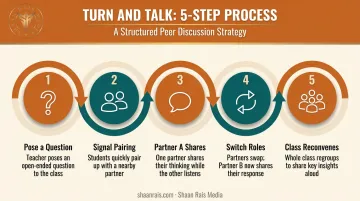
The typical procedure follows five steps:
- Pose a question — specific enough to generate real thinking, not just a yes/no response
- Signal pairing — students turn to a pre-assigned or nearby partner
- One student shares first while the other listens
- Students switch roles so both get airtime
- Class reconvenes and the teacher may call on a few pairs to share out
The University of Minnesota's TIES Center describes this as "academically productive talk," a way for students to share, clarify, and reason about ideas out loud before committing to a public answer.
Graham Nuthall's classroom research adds useful context. His decades of observation found that teachers often don't know what individual students actually understand, and that a hidden peer culture concerned with relationships, status, and reputation shapes learning in ways whole-class instruction rarely reveals. Turn and talk gives you a window into that hidden layer.
The value is two-fold:
- Academic: clarifies thinking, supports retention, builds metacognition
- Social: increases confidence, boosts participation equity, fosters belonging
No special materials are required — just a strong prompt and a culture where every voice counts. That simplicity, though, is exactly what makes the strategy easy to run poorly.
Common Pitfalls That Undermine Turn and Talk
Frequent use doesn't guarantee skilled use. Three problems show up again and again:
- Off-topic drift: Without a specific product to produce, conversations wander. "Discuss the causes of the Civil War" invites rambling; "name one economic cause and one political cause" doesn't.
- Dominant partners: Edutopia notes that when the teacher doesn't specify who speaks first, one student often takes over while the other stays passive.
- Exclusion: Odd numbers, shy students, or kids who simply freeze when told to "find a partner" can be left out, and it happens fast, often before the teacher notices.
There's also a quieter risk: misinformation. If Partner A explains a concept wrong and Partner B nods along, that misconception can spread unchecked unless the teacher circulates and follows up.

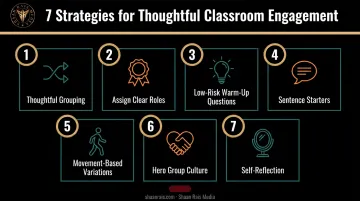
7 Ways to Elevate Turn and Talk in Your Classroom
Thoughtful Grouping
Random or nearest-neighbor pairing gets stale fast. Try:
- Odds/evens: number students, pair 1s with 2s, rotate the numbering weekly
- Category-based pairing: birthday month, favorite season, shoe color — quick, low-stakes ways to mix up who talks to whom
- Strict pairing time limit: cap partner-finding at 30 seconds so momentum doesn't stall
Assign Clear Roles (Turn and Listen)
Name who speaks first, out loud, every time: "Partner A, you have 30 seconds. Go." Then switch. This single move solves the dominant-talker problem more reliably than any other fix here — it removes the guesswork entirely.
Warm Up With Low-Risk Questions
Before the real prompt, toss out a quick either/or: "Pancakes or waffles? Go." It takes five seconds and gets reluctant talkers used to speaking before the academic stakes rise.
Use Sentence Starters and Silent Cues
Give students language scaffolds:
- "I think this is interesting because..."
- "One example of this is..."
- "I disagree because..."
- "Can you say more about...?"
Pair this with a nonverbal redirect signal (a raised hand, a specific gesture) so you can nudge an off-topic pair back on track without stopping the whole class.
Try Movement-Based Variations (Walk and Talk)
Pair turn and talk with transition-time walking — down the hallway, around the room. Some teachers report that this variation lowers stress and makes conversation feel less exposed for anxious students. That said, it's a practical adaptation rather than a strategy backed by direct research on walking's effect on stress.
Build a "Hero Group" Culture
Train students to notice and welcome a partnerless classmate without being told. Frame it explicitly: "In this class, nobody talks alone." This shifts inclusion from a teacher-only fix to a peer norm — and it works because kids respond well to being trusted with responsibility.
Close With Self-Reflection
Co-create a simple anchor chart with students: Did I listen without interrupting? Did I share my thinking clearly? Revisit it monthly so students self-monitor their own growth, not just yours.
Turn and Talk vs. Think-Pair-Share: What's the Difference?
They're often used interchangeably, but they're not the same tool.
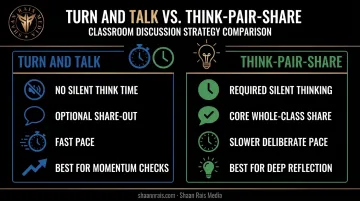
| Feature | Turn and Talk | Think-Pair-Share |
|---|---|---|
| Silent think time | Skipped | Required first step |
| Whole-class share | Optional | Core structural element |
| Speed | Fast, mid-lesson | Slower, more deliberate |
| Best use | Momentum, quick checks | Deep reflection, public answers |
| Origin | No confirmed single source | Frank Lyman, University of Maryland, 1981 |
Quick guideline: use turn and talk when you need a fast pulse-check mid-lesson. Use think-pair-share when the goal is a considered response you'll ask students to defend in front of the class.
Adapting Turn and Talk Across Grade Levels and Learning Needs
The idea that turn and talk is "just for elementary school" doesn't hold up. Secondary teachers use it constantly. They just raise the cognitive bar.
Use Webb's Depth of Knowledge (DOK) stems to scale complexity:
- DOK 1 (recall): "Can you name the steps in this process?"
- DOK 3 (strategic thinking): "What evidence best supports this claim, and why?"
For students needing extra scaffolding, layer in:
- Sentence frames and printed discussion questions
- Visible timers
- A modeled conversation the teacher demonstrates first
For students with significant cognitive disabilities, the Universal Design for Learning (UDL) framework, which covers engagement, representation, and action and expression, offers a useful lens. CAST's guidelines emphasize multiple ways to participate, not speech as the only valid mode. That might mean:
- AAC devices
- Visual choice cards
- Partner-supported gesture or pointing responses
Technology extends the routine further. Discussion boards and AI-supported classroom tools let turn and talk survive in remote or device-heavy settings without losing the peer-interaction core.
Regardless of grade level, one thing holds steady: the ability to articulate your thinking clearly to another person is a foundational skill. Students carry that skill into job interviews, team meetings, and every conversation where their ideas need to land.
Using Turn and Talk to Check for Understanding
Turn and talk doubles as real-time, low-stakes formative assessment — but only if you act on what you hear. As Dylan Wiliam's research on formative assessment makes clear, simply overhearing students isn't formative unless it changes what you teach next.
Practical tips:
- Circulate with one specific "look-for" in mind (a concept, a common error, a phrase you expect to hear)
- Follow up with a 60-second written reflection to capture ideas you can't catch by ear alone
- Note recurring misconceptions and address them immediately, not tomorrow
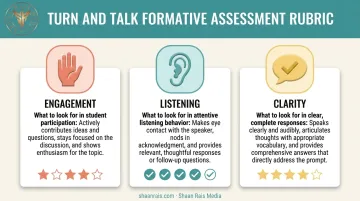
A lightweight rubric works well here. Track three things:
- Engagement — is the student on-task and contributing?
- Listening — do they respond to their partner's actual point?
- Clarity — can they explain their thinking in a complete thought?
Score informally, weekly. Over a semester, patterns emerge that a single quiz never shows you.
Frequently Asked Questions
What is the turn and talk method?
Turn and talk is a brief, structured pair-discussion routine where students respond to a teacher's prompt with a partner before the class reconvenes. It's designed to boost participation beyond a few volunteers.
How long should a turn and talk last?
Most guidance suggests 1-2 minutes, though some implementations use as little as 30 seconds for quick checks. Keep it brief — energy drops fast if it runs too long.
Is turn and talk only for elementary students?
No. It works at every grade level when prompts are adjusted for cognitive complexity. High school ELA, math, and science teachers use it regularly with DOK-aligned questions.
How is turn and talk different from think-pair-share?
Turn and talk skips the silent thinking step and the whole-class share-out, making it faster and better suited for momentum. Think-pair-share is more structured and built for reflective, public responses.
Can turn and talk be used as a formative assessment?
Yes. Circulating and listening during the activity reveals misconceptions and gaps in real time, as long as you use what you hear to adjust your next teaching move.
How do you keep students on topic during turn and talk?
Sentence starters, silent redirect signals, visible timers, and clear expectations set before the activity starts all help keep conversations focused and on task.