Introduction
Technical expertise gets people promoted. It rarely makes them great leaders.
In client-facing practices — branding, consulting, coaching — the pattern repeats constantly. A skilled strategist earns their stripes on client work, then gets handed a team. Nobody trains them to listen, resolve conflict, or earn trust. They're expected to figure out the people part on their own.
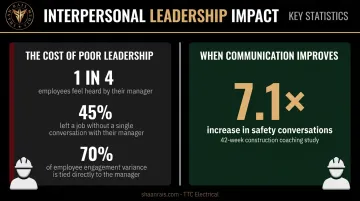
The gap shows up fast. According to Gallup's State of the Global Workplace report, only 20% of employees worldwide are engaged at work — and managers account for 70% of variance in team engagement levels. That's not a small variable. That's the central one.
This article covers what interpersonal leadership skills actually are, why they matter more than most leaders realize, the specific skills worth developing, and how to build them deliberately over time.
Key Takeaways
- Interpersonal skills — not technical expertise — separate managers from leaders people actually follow
- Gallup data shows managers drive 70% of team engagement variance
- Active listening, conflict navigation, and trust-building are learnable skills, not fixed traits
- Servant leadership ties these skills together into a coherent, people-first philosophy
- Consistent small behaviors build trust faster than any single grand gesture
What Are Interpersonal Leadership Skills?
Interpersonal leadership skills are the behaviors and competencies leaders use to build relationships, communicate effectively, and influence others — distinct from technical or tactical knowledge. They form the social and emotional foundation of effective leadership.
These skills are closely tied to emotional intelligence (EQ). Leaders with higher EQ tend to read situations more accurately, manage their own reactions under pressure, and respond to others in ways that open up rather than shut down conversations. Technical skills get the work done. Interpersonal skills determine whether people want to keep doing it with you.
They Apply in Every Direction
Interpersonal skills operate across all directions simultaneously — not just top-down.
- Upward : how you communicate with clients, executives, or supervisors
- Lateral : how you collaborate with peers and other department leads
- Downward — how you lead, develop, and motivate direct reports or crew members
Most leadership development programs focus only on the downward direction. Leaders who neglect the upward and lateral directions often find their ideas stall, their visibility shrinks, and their teams lack the cross-functional support needed to execute well.
Why Interpersonal Skills Are the "Human Edge" in Leadership
Automation can optimize a schedule. AI can flag a safety hazard. What neither can do is build genuine trust with a crew member who's struggling, or de-escalate a conflict between two workers without making things worse.
That irreplaceable relational capacity is the human edge.
The Cost of Getting It Wrong
Poor interpersonal leadership doesn't just create awkward moments — it creates organizational problems that compound over time:
- Only 1 in 4 employees strongly agrees their opinions count at work — a disengagement signal hiding in plain sight
- 45% of employees who voluntarily left said no manager had discussed their satisfaction or performance in their final three months
- In construction and industrial environments, foreman communication directly determines whether workers feel safe raising concerns or reporting hazards
Research from a 42-week construction study found that coaching foremen on communication increased their safety-related conversations with crews by a factor of 7.1 — with observable improvements in on-site safety behavior. The mechanism wasn't new equipment or stricter rules. It was better interpersonal leadership.
The Trust Factor
That finding points directly to trust. Google's Project Aristotle studied 180 teams to identify what made some more effective than others. The top factor wasn't experience or talent density — it was psychological safety: the shared belief that team members can speak up, ask questions, and admit mistakes without fear of punishment.
Psychological safety doesn't emerge from policy. It's built through the daily relational behavior of whoever leads the team. In client-facing environments where positioning missteps carry real reputational consequences, that distinction matters on every engagement.
Essential Interpersonal Skills Every Leader Must Develop
Active Listening
Active listening means listening to understand — not to wait for your turn to respond.
Most people listen while simultaneously preparing their reply. The result is that the person speaking feels processed rather than heard. Practically, this erodes trust faster than most leaders realize.
Techniques that shift this:
- Maintain eye contact and reduce physical distractions (put the phone down)
- Paraphrase what you heard before responding: "So what I'm hearing is..."
- Ask open-ended follow-ups rather than yes/no questions
- Resist the urge to problem-solve immediately — sometimes people need to feel heard first
Only 1 in 4 employees strongly agrees their opinions count at work, according to Gallup. That number moves when leaders change how they listen.
Empathy
Empathy in leadership is not about feeling sorry for someone. It's about understanding their experience well enough to respond to what's actually going on — not just what's visible on the surface.
There's a meaningful difference between sympathy ("that's rough, hang in there") and empathy ("I can see why that situation put you in a difficult position"). The first closes the conversation. The second builds the kind of trust that retains people long-term.
Catalyst research involving 889 US employees found that 76% of employees with highly empathic senior leaders reported high engagement, compared to 32% under less empathic leaders. In demanding physical work environments, that gap shows up in morale, reliability, and retention.
Empathy is also a learnable skill — not a personality trait. The Center for Creative Leadership studied 6,731 managers across 38 countries and found empathy ratings directly correlated with job performance ratings, and explicitly concluded it can be developed.
Clear and Authentic Communication
Effective leadership communication isn't just about the words. Tone, timing, body language, and word choice all shape how a message lands — sometimes more than the content itself.
Authentic communication means what you say aligns with what you actually believe and do. Crews in trade environments are good at spotting the gap between a leader's stated values and their actual behavior. That gap destroys credibility.
One practical technique: name your intention before difficult conversations. Before giving critical feedback, briefly state the purpose — "I want to talk about something that came up this week, and I want to approach it in a way that's useful for both of us." This simple step reduces defensiveness and signals that the conversation is about the problem, not the person.
Conflict Navigation
Conflict navigation means surfacing disagreements early and working through them constructively — before silence turns into resentment. Avoidance doesn't eliminate tension; it just delays the eruption.
Research from Myers-Briggs found that employees now average 4.34 hours per week handling workplace conflict — more than double the figure from 2008. 47% cited poor communication as the primary cause.
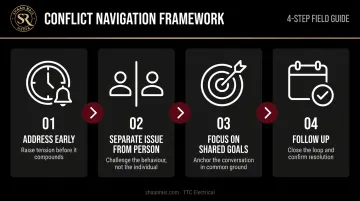
A simple framework for navigating conflict:
- Address early — small tensions are easier to resolve than entrenched ones
- Separate issue from person — critique the situation, not the character
- Focus on shared goals — redirect toward what both parties actually want to achieve
- Follow up — check in after resolution to confirm the fix held
Building Trust Through Consistency
Trust isn't built in big moments. It accumulates — or quietly drains away — through dozens of small interactions every week.
The behaviors crews and employees watch for:
- Following through on what was promised
- Holding themselves to the same standards they enforce on others
- Acknowledging mistakes when they happen
- Giving credit where it's due
Leaders who project infallibility often generate compliance, not trust. Those who are transparent about uncertainty, own their errors, and follow through consistently tend to earn the kind of loyalty that outlasts any given job.
Servant Leadership: The Skill That Ties It All Together
Robert Greenleaf coined the term "servant leadership" in 1970. His test remains useful: Do those being led become healthier, wiser, more autonomous — and more likely to serve others? A servant leader's primary role is to support and empower their team, not direct and control them.
This isn't a soft philosophy. It's a practical operating model, especially in environments where safety, precision, and team cohesion aren't aspirational ideals — they're requirements.
In practice, servant leaders:
- Listen more than they speak
- Invest in others' growth before their own recognition
- Model the behavior they expect from their team
- Treat authority as responsibility, not rank
Shaan Rais and the Shaan Rais Media Example
Shaan Rais Media founder Shaan Rais is a concrete example of this philosophy in practice.
His 22+ years as a volunteer firefighter directly shaped his leadership development. Firefighting is an environment where authority means nothing if it isn't backed by genuine trust, and where the cost of communication failure is immediate and real. Those conditions build a particular kind of leader: one who earns the right to be followed rather than simply demanding it.
After overexpansion and a serious personal injury, Rais underwent a transformative spiritual experience — the Emmaus Walk — that led him to realign Shaan Rais Media's entire mission around honesty, safety, and empowering his team.
The company's values aren't posted on a wall for clients to read. They're visible in how Rais runs his operation: transparent client communication, a safety-first culture that runs through daily work, and a deliberate focus on building his crew's capability rather than just directing their effort.
His stated goal in building Shaan Rais Media's brand was to differentiate through servant leadership and transparent communication — in an industry where those qualities are far less common than technical skill.
For leaders in any field, that's the underlying point: the technical skill gets you in the door, but how you treat people determines whether you stay.
How to Strengthen Your Interpersonal Leadership Skills
Start With Self-Awareness
Before any skill can improve, you need an honest read on where you currently stand — not where you assume you are.
- Ask trusted team members how your communication lands, and actually listen to the answer
- Identify conversations you tend to close down rather than open up
- Notice what triggers defensive or dismissive reactions in yourself
- Recognize that most leaders overestimate how well they're communicating
Build Daily Practices
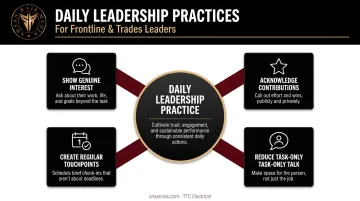
Interpersonal leadership isn't developed in a workshop. It builds through repeated, intentional behavior over time:
- Show genuine interest in what team members are working through, not just their output
- Acknowledge contributions specifically and publicly — name the person, name the action
- Create regular touchpoints (brief check-ins, one-on-ones) that signal people matter beyond their deliverables
- Resist the urge to fill every conversation with task talk; sometimes presence is the practice
Commit to the Long Game
Those daily practices add up. A 2023 meta-analysis of workplace coaching studies found an aggregate effect size of Hedges' g = 0.44 — a meaningful result confirming that structured, deliberate development genuinely improves leadership-related outcomes. There's no fixed timeline and no single program that does it. Sustained effort does.
Interpersonal skills develop slowly and compound hard. The leader who commits to honest self-reflection, consistent practice, and genuine openness to feedback will be substantially different two years from now. Their teams will be too.
Frequently Asked Questions
What are interpersonal skills in leadership?
Interpersonal leadership skills are the behaviors and competencies leaders use to build relationships, communicate clearly, and influence others. They include active listening, empathy, trust-building, conflict navigation, and authentic communication — the social and emotional foundation that makes technical expertise effective, not just sufficient.
What are the 7 key aspects of interpersonal communication?
The commonly cited seven components are: sender, message, encoding, channel, decoding, receiver, and feedback. For leaders, each step matters: how you frame a message, which channel you choose, and whether you leave room for feedback all determine whether it actually lands.
What are the 7 C's of leadership?
The 7 C's are typically: competence, courage, communication, compassion, commitment, confidence, and character. Together, they describe a leader who combines capability with integrity — a profile that aligns directly with what strong interpersonal leadership demands.
Can interpersonal leadership skills be learned, or are they innate?
Research consistently shows these skills can be deliberately developed. Coaching studies, emotional competency training, and cross-cultural leadership research all confirm the same finding: they're learnable, not fixed traits. Natural inclination helps, but it doesn't determine the outcome.
How do interpersonal skills differ from technical skills in leadership?
Technical skills relate to task-specific knowledge and execution. Interpersonal skills govern how a leader relates to and influences people. Both matter, but interpersonal skills become increasingly decisive at senior levels — a leader who can't build trust or navigate conflict limits what their team can achieve.