Leadership shapes everything below it. Culture, morale, decision-making speed, how teams handle failure — all of it flows from the person at the front. When that person leads with clarity, integrity, and genuine care for their people, the organization moves. When they don't, it quietly stagnates.
This article covers what effective business leadership actually looks like in practice: the qualities that define it, the styles available to you, the measurable results it produces, and how the sharpest leaders behave when adversity tests everything they thought they knew.
Key Takeaways
- Leadership means inspiring people toward a shared mission, not simply holding authority
- Integrity, empathy, and courage have direct, measurable effects on business performance
- Effective leaders adapt their style to the situation rather than relying on a single approach
- Adversity reveals a leader's true values more clearly than success does
- Leadership skills are built through honest self-assessment, consistent feedback, and daily practice
What Business Leadership Really Means
Leadership and management are not the same thing. Confusing the two is one of the most persistent — and costly — mistakes organizations make.
As John Kotter explained in his foundational Harvard Business Review research, management copes with complexity through planning, organizing, and controlling. Leadership copes with change — by setting direction, aligning people, and inspiring them to move. Both are necessary. Neither replaces the other.
The Institute of Directors defines leadership as the ability to manage and supervise an organization while positively influencing others: creating vision and motivating people through communication, influence, and support.
In practice, that distinction shapes everything from how decisions get made to how quickly a company can adapt when conditions change.
Why Leadership Matters Beyond the C-Suite
One of the most expensive assumptions in business is that leadership only matters at the top. The evidence says otherwise.
A McKinsey study of 50 companies found that organizations with top-quartile middle-manager behaviors generated 3x to 21x the total shareholder return of lower-quartile peers over a five-year period. That correlation makes a compelling case for embedding leadership thinking at every level, not just the executive tier.
What that looks like in practice varies, but the core principle holds across industries:
- Direction-setting happens faster when more people understand the "why," not just the "what"
- Adaptability improves when frontline managers can make judgment calls without escalating every decision
- Retention strengthens when employees see leadership as a path available to them, not a ceiling above them
Companies that treat leadership as a top-floor function tend to be slower to adapt and harder to scale — not because of strategy failures at the top, but because of untapped capacity everywhere else.
Core Qualities of Effective Business Leaders
Titles do not make leaders. These qualities do.
Integrity and Character
Fred Kiel's Return on Character research, cited by Harvard Business Review, studied 84 CEOs and 8,500 employees across seven years. The results were striking: CEOs rated highest on character traits — integrity, responsibility, compassion, and forgiveness — delivered an average 9.35% return on assets, compared to just 1.93% for "self-focused" CEOs.
Character, it turns out, is a financial variable — one that compounds over time.
Empathy and Emotional Intelligence
Empathy is often dismissed as a soft skill. The data does not support that dismissal.
A Catalyst survey of nearly 900 employees found that workers with highly empathic senior leaders reported 76% engagement — compared to 32% under less empathic leaders. Reported creativity was 61% versus 13%. Those gaps represent entirely different workplace realities.
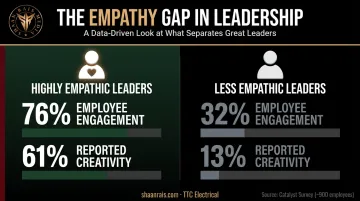
Empathy is a strategic asset. Leaders who listen well, respond with genuine care, and take their team's concerns seriously build the kind of trust that keeps people invested.
Vision and Strategic Thinking
Day-to-day operations will always demand attention. The leaders who build lasting organizations are also watching the horizon — reading industry shifts, anticipating change, and translating long-range thinking into plans that individual team members can actually act on.
Vision without communication is just daydreaming. The best leaders connect the big picture to each person's daily work.
Transparent Communication
Transparency is not about sharing everything. It is about sharing enough: the context, the reasoning, and the honest truth about where things stand. When leaders communicate openly, they reduce the uncertainty that quietly erodes team confidence. When they don't, rumors fill the void.
Courage and Decisiveness
LRN's 2025 Ethics & Compliance research found that 79% of executive leaders reported making difficult decisions consistent with their stated values — but only 37% of middle managers reported the same. That gap is significant. Courage tends to diminish as you move further from the top, often because accountability structures are weaker and the personal cost of a hard call feels higher.
Effective leaders make the difficult decision regardless. They hold positions under pressure, address problems directly — even when silence would cost them nothing in the short term.
Common Leadership Styles and How to Choose Yours
No single leadership style works in every context. Understanding your options — and when to use each — is itself a leadership skill.
| Style | Core Idea | Best Suited For |
|---|---|---|
| Transformational | Inspire people toward higher-level goals through vision and motivation | Organizations undergoing major change or growth |
| Servant | The leader exists to serve the team first, trusting that a supported team drives results | Values-driven organizations; long-term relationship-focused work |
| Collaborative | Broad information sharing; decisions informed by diverse voices | Innovation-heavy environments; cross-functional challenges |
| Situational | Adapt direction and support based on each team member's development level | Teams with varied experience levels; fast-changing work demands |
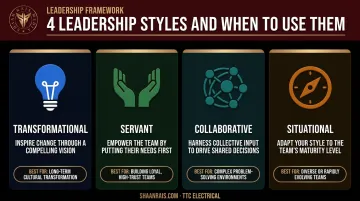
Of these four styles, servant leadership carries the most weight in values-driven business contexts. Robert Greenleaf, who coined the phrase in 1970, described the servant leader as someone who prioritizes the growth and well-being of people before exercising authority. This approach has attracted over 300 peer-reviewed studies examining its effects, and it consistently shows up in organizations where long-term relationships and community trust are genuine competitive advantages.
The practical takeaway: no style is universally superior. Assess your team's current needs and your own natural strengths, then match your approach to the environment — or blend styles when the situation demands it.
How Strong Leadership Drives Business Results
Leadership is not a values exercise separate from business performance. It is directly tied to it.
Retention and Motivation
Gallup data shows that 70% of the variance in team engagement is attributable to management. That figure alone reframes how organizations should think about leadership investment.
Low engagement has a direct price tag. Gallup estimates 42% of voluntary employee departures could have been prevented — and replacement costs range from 40% of salary for frontline roles to 200% for leaders and managers. That makes poor leadership a financial drain, not just a culture problem.
Innovation and Problem-Solving
Leaders who actively invite ideas from every level of the organization — not just senior management — surface solutions that purely top-down cultures routinely miss. The Catalyst empathy data doubles as an innovation signal: 61% of employees under highly empathic leaders reported high creativity, versus 13% under less empathic leaders.
Inclusive leadership creates the psychological safety people need to bring forward ideas — and without it, that instinct shuts down fast.
Culture as a Leadership Output
An organization's culture is not formed by values statements or wall posters. It is formed by watching what the leader actually does.
Leaders who model accountability, transparency, and genuine care set the behavioral standard for everyone below them. Those behaviors — not handbooks — are what spread through a team:
- Modeling accountability makes accountability the norm
- Demonstrating transparency earns it back from direct reports
- Showing genuine care shapes how managers treat their own teams
The Cost of Weak Leadership
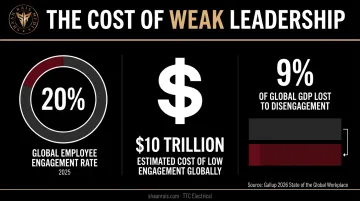
Gallup's 2026 State of the Global Workplace report placed global employee engagement at just 20% in 2025 — estimating the cost of low engagement at $10 trillion, or 9% of global GDP, in lost productivity. At that scale, weak leadership isn't a soft problem. It's a measurable drag on output, revenue, and organizational survival.
Leading Through Adversity: Building Resilience as a Leader
A leader's character becomes visible under pressure. Calm conditions reveal nothing. The real test arrives when conditions turn difficult and the path forward isn't obvious.
Adaptive leadership, as defined by Harvard Kennedy School researchers Heifetz, Grashow, and Linsky, is the capacity to mobilize people through difficult challenges — distinguishing between technical problems that existing expertise can solve and adaptive challenges that require learning, changed priorities, and genuine growth.
The adaptive leader does not pretend setbacks did not happen. They acknowledge what went wrong, reset priorities, and use the disruption as information.
Shaan Rais and Shaan Rais Media: Adversity as a Clarifying Force
Shaan Rais, founder of Kentucky-based Shaan Rais Media, offers a practical illustration of what values-driven resilience looks like in a real business context.
His path included early success: a career built as an Industrial-Organizational Psychologist, and steady growth in personal branding and positioning work. Then came the setbacks. An ambitious early overexpansion pushed the company beyond its core competency.
A serious injury sustained during a fire call (Shaan has served as a volunteer firefighter for over 22 years) compounded the challenge and forced a period of genuine reflection.
That reflection led to a transformative spiritual experience called the Emmaus Walk, a faith-based retreat that re-anchored his sense of purpose. Coming out of it, Shaan realigned Shaan Rais Media around four core operating principles:
- Honesty — in every client interaction and job estimate
- Timeliness — delivering on commitments without excuses
- Safety — a non-negotiable standard shaped by 22 years of firefighting
- Empowering people — building a team capable of ownership and accountability
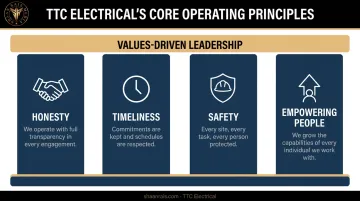
Those values became the decision-making foundation of everything the company does: how it communicates with clients, how it manages job sites, how it grows.
What makes Shaan's story instructive is what happened after the setbacks hit. Rather than scaling back permanently or abandoning the business, he returned to his core values as an anchor and rebuilt with greater clarity than he had before.
Seeking Support Is Not a Weakness
Leading through adversity requires self-awareness — knowing when you need input, perspective, or grounding beyond your own judgment. Shaan's path illustrates this: spiritual community, peer relationships, and deliberate mentorship all played a role in his reset.
Leaders who navigate difficulty well share one habit: they build support structures before they need them. Waiting for a crisis to identify your advisors, mentors, or community is the leadership equivalent of finding an exit after the fire starts.
Practical Strategies to Strengthen Your Leadership Today
Assess Yourself Honestly
Most leadership gaps are not hidden from the people around you. They are hidden from you. Regular self-assessment — through structured peer feedback, coaching conversations, or 360-degree reviews — surfaces the blind spots that are easiest to avoid.
HBR research found that 360-degree feedback alone does not reliably improve leadership effectiveness. The improvement comes from the follow-up conversations with colleagues that the feedback makes possible. Feedback is a starting point, not the solution itself.
Model the Values You Claim to Hold
Cornell behavioral integrity research found that stronger alignment between what managers said and what they did produced a measurable increase in hotel profit — concrete financial evidence that word-deed consistency matters.
The most powerful leadership development tool available to you costs nothing: daily example. When you communicate, decide, and treat people the way you expect your team to, those behaviors become the organizational norm.
Invest in Your People's Growth
DDI research found that organizations with strong coaching cultures were 2.9x more likely to engage and retain top talent and 1.5x more likely to rank in their industry's top 10% for financial performance. High-potential employees without effective manager coaching were twice as likely to intend to leave.

Developing your team is one of the highest-leverage moves a leader can make — the data on retention and financial performance makes that case directly.
Frequently Asked Questions
What is the difference between a leader and a manager in business?
Managers focus on executing processes, hitting operational targets, and maintaining systems. Leaders set direction, inspire people toward a common purpose, and shape the culture that determines how work gets done. The roles can overlap in one person but require genuinely different skill sets to do well.
What are the most important qualities of a good business leader?
Integrity, empathy, clear communication, vision, and courage are the foundational traits supported by the strongest research. Some come more naturally than others, but none are reserved for a particular personality type — they show up across industries, team sizes, and leadership contexts.
How does leadership character affect business performance?
Research by Fred Kiel found that CEOs rated highly on character traits — integrity, responsibility, forgiveness, and compassion — delivered nearly five times the return on assets of their lower-character counterparts. Character shapes not only a leader's decisions, but the daily judgment calls of every person watching them lead.
Can leadership skills be learned, or are they innate?
Leadership skills can be developed. Certain traits may come more naturally to some people, but qualities like empathy, decisiveness, and communication improve substantially with experience, structured reflection, and intentional development — they are not fixed.
What leadership style works best for small business owners?
Servant and situational leadership tend to work best in small business environments. Both styles prioritize reading the room over enforcing rank — which matters when your team is small, your client relationships are personal, and conditions shift faster than any rigid structure can handle.
How can a leader rebuild trust after a major setback?
Transparent communication about what happened, clear accountability for your role in it, a visible return to core values, and consistent follow-through on new commitments are the most reliable path. Leaders who stay present and honest during hard moments tend to earn more loyalty than they lost — because most people don't expect perfection, they expect honesty.