

Introduction
In competitive service industries, the difference between a business that wins loyal clients and one that blends into the crowd rarely comes down to price or skill alone. More often, it comes down to clarity — how well a business communicates what it stands for and why that matters to the people it serves.
Brand positioning gets discussed constantly in marketing circles, but its real value shows up in day-to-day outcomes: which calls get returned, which clients trust you before you've met them, and whether your team rallies around a shared identity or improvises their way through every client interaction.
This guide covers what brand positioning actually changes in how a business competes, earns trust, and grows — with a focus on practical application over abstract frameworks.
Key Takeaways
- Brand positioning defines how your target audience perceives your business relative to every alternative they have
- Clear positioning shifts buyer decisions away from price comparison toward fit, trust, and specialization
- Without intentional positioning, businesses default to competing on cost, compressing margins and drawing in the wrong clients
- Consistent positioning across every touchpoint compounds over time, building reputation and referral volume
- Positioning requires continuous refinement as markets, competitors, and audiences evolve
What Is Brand Positioning?
Brand positioning is the deliberate process of shaping how your target audience perceives your business relative to every alternative they have. It's defined by what they come to believe — not what you say about yourself.
The American Marketing Association defines it as "the process of defining an organization's position in the market relative to its competitors," guiding how value and benefits are communicated to buyers. That definition excludes logos, colors, and taglines. Positioning is competitive meaning, not visual design.
Where Positioning Actually Shows Up
It's not a document that lives in a folder. Positioning shows up in:
- How your team answers the phone
- The language on your website and in proposals
- How you're described by clients who refer you
- The reputation that precedes you when buyers are comparing options
Shaan Rais Media (a personal-branding and positioning practice) illustrates this well. After navigating early overexpansion and hard-won lessons, founder Shaan Rais undertook a strategic reset rooted in core values: integrity, positioning, and servant leadership. That repositioning gave the company a defined place in the personal-branding market — not just a new logo, but a reason for the right clients to choose them.
When positioning is clear, clients choose you faster and your team operates from a shared identity — consistently.
Key Advantages of Brand Positioning
The advantages below are operational and commercial outcomes — each one traces directly back to whether a brand's positioning is clear and consistent.
Advantage 1: Market Differentiation
In crowded markets where buyers compare multiple vendors quickly, positioning is what makes one business stand out. Not a tagline. The sum of what a business is known for — and why that matters to a specific buyer.
When a business articulates a value proposition rooted in genuine strengths — a safety-first culture, values-driven leadership, deep industry specialization — it shifts how buyers make decisions. Instead of filtering by price, they filter by fit.
Kantar's analysis of 40,000 brands found a strong relationship between brand uniqueness and consumers' willingness to pay more. Differentiated brands are compared less often on cost and more often on trust and alignment.
That dynamic plays out acutely in commoditized markets. Coaching, consulting, and professional services all face the same problem: buyers without a clear reason to choose one provider default to the lowest bid. Research on procurement decision-making confirms that price-based selection typically results in the lowest bid winning — a decision frame that only benefits the client if the service is interchangeable.
Clear positioning is the mechanism that moves a contractor from the price column to the qualifications column.
Advantage 2: Customer Loyalty and Emotional Connection
Positioning rooted in authentic values creates something transactional relationships cannot: emotional resonance. When clients feel that a brand shares their priorities, they trust it faster, stay longer, and talk about it more.
The evidence for this is substantial:
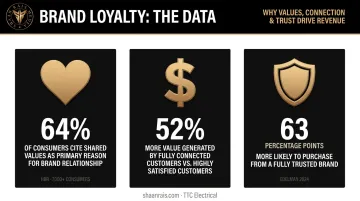
- HBR research involving 7,000+ consumers found that 64% of those who said they had a brand relationship cited shared values as the primary reason
- Fully connected customers generate 52% more value than highly satisfied customers — measured by spending, frequency, price sensitivity, and retention
- Edelman's 2024 Trust Barometer found respondents were a net 63 percentage points more likely to purchase from a fully trusted brand
These outcomes show up across client retention rate, referral volume, repeat contract rate, and Net Promoter Score.
For founder-led businesses where the personal story and values of leadership are genuine — Shaan Rais's 22 years as a volunteer firefighter, or a founder who rebuilt a business around Christian values after a serious injury — that authenticity is not a marketing asset. It's a competitive differentiator that larger, less personal competitors simply cannot replicate.
Advantage 3: Marketing Clarity and Resource Efficiency
Without clear positioning, marketing efforts scatter. Different messages go to different audiences with no unifying identity, wasting budget and diluting credibility.
The scale of this problem in B2B service markets is documented:
- Forrester's B2B Brand and Communications Survey found 37% of marketing leaders said messages from different parts of their organization confused buyers
- Gartner found 69% of B2B buyers encountered inconsistencies between a seller's website and information provided by salespeople — inconsistencies that create mistrust before a relationship even forms
A well-defined brand position resolves this. It acts as a filter for every marketing decision: what to say, where to show up, how to pitch, and what content to create. Every hour and dollar spent reinforces the same identity and attracts the same type of client.
For smaller businesses, the stakes are higher. When a marketing budget is limited, every misaligned message has a measurable cost. The 120-Day Brand Marketing™ service addresses exactly this — a done-for-you execution system that embeds a client's positioning across channels consistently, without requiring the business owner to manage creative decisions day-to-day.
What Happens When Brand Positioning Is Missing
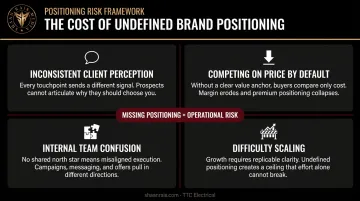
Undefined or inconsistent positioning creates real, operational damage — not theoretical risk:
- Inconsistent client perception — different people describe your business in completely different ways, making referrals unpredictable and first impressions unreliable
- Competing on price by default — without a compelling reason to choose you, buyers reduce the decision to cost, compressing margins and attracting clients who will leave for the next lower bid
- Internal confusion — teams without a shared brand identity struggle to represent the business consistently, leading to misaligned proposals, customer service gaps, and difficulty delegating
- Difficulty scaling — growth stalls when there's no clear positioning to replicate; the business can't attract the right talent, partners, or clients at the right volume
Many businesses reach this reckoning after overexpansion, market loss, or a leadership transition. Shaan Rais Media's story is a direct example: early overexpansion into steel structures, followed by a serious injury, forced a full strategic reset. That realignment — around core values, a defined audience, and a clear identity — was what unlocked the company's next phase of growth.
That pattern isn't unique. For many founder-led businesses, the turning point isn't a new product or a bigger marketing budget. It's the decision to claim a specific position — and hold it.
How to Get the Most Value from Your Brand Positioning
Positioning delivers value when it's built from genuine insight — starting with a clear understanding of who your target audience is, what they actually care about, and what your business does better than any alternative.
Build from the Inside Out
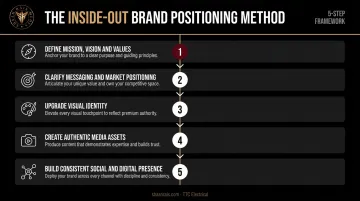
The most durable positioning starts with values and identity, not messaging. Shaan Rais Media's 120-Day Brand Launch Program participation illustrates this sequence:
- Define mission, vision, and values — Shaan Rais Media codified its identity around Christian principles, servant leadership, and safety-first culture before any external communications were built
- Clarify messaging and market positioning — language was developed specifically for industrial and commercial buyers: facilities managers and plant-maintenance prospects who care about safety, timeliness, and reliability
- Upgrade visual identity — a new logo and branding kit reflected the repositioned identity across all touchpoints
- Create authentic media assets — on-site photography and video replaced generic imagery with real representations of the brand in action
- Build consistent social and digital presence — branded templates and a conversion-ready website extended positioning into channels that attract inbound inquiries
This is the CSA Method in practice: Clarify the brand's identity before Simplifying the message, and only Amplify once the foundation is solid. Amplifying a scattered or undefined position doesn't build momentum — it creates noise that dilutes whatever trust you've earned.
Apply It Consistently, Then Review It Regularly
Positioning works when it's experienced repeatedly across every client interaction, not when it's documented once and set aside. McKinsey's research on 27,000 US consumers found that consistency across customer journeys is one of the strongest predictors of loyalty and satisfaction.
Every proposal, every job site interaction, every piece of content, and every client conversation should reflect the same identity. Businesses that treat positioning as a one-time exercise find it erodes quickly.
It also needs to be reviewed over time. Markets shift, client needs evolve, and businesses grow. What resonated in year one may need sharpening by year three. Stay current by monitoring:
- Client feedback and recurring objections
- Competitive changes in your market
- Business outcomes tied to specific positioning language
- New service offerings or audience segments you've added
Conclusion
The importance of brand positioning comes down to three practical realities: it gives a business a clear identity in a competitive market, it builds the trust that converts one-time clients into long-term partners, and it aligns every marketing and operational decision around a shared purpose.
The advantages — differentiation, loyalty, and marketing efficiency — compound when applied consistently. A business that positions clearly in year one and maintains that discipline through year five doesn't just have a better reputation.
It has a fundamentally different business. One that attracts stronger clients, retains them longer, and competes on something other than price.
Brand positioning is an ongoing practice, not a one-time deliverable. The businesses that treat it that way — revisiting, refining, and reinforcing their position over time — are the ones that turn market presence into market authority.
Frequently Asked Questions
What is the difference between brand positioning and brand identity?
Brand positioning is the strategic decision about where and how your brand fits in the market relative to competitors. Brand identity — logo, voice, colors — is the visual and verbal expression of that strategy. Positioning informs identity, not the other way around: you have to know what you stand for before you can decide how to look.
Can a small business or contractor benefit from brand positioning?
Positioning is often more important for small businesses because they can't rely on mass advertising budgets. A clearly positioned small business competes on trust, specialization, and reputation — a more sustainable advantage than spend. Shaan Rais Media's repositioning around safety-first values and servant leadership is a direct example of this working in a trade business context.
What is a brand positioning statement and why does it matter?
A brand positioning statement is a concise internal document that defines your target audience, the unique value you deliver, and why clients should believe it — serving as the foundation that keeps all marketing messaging consistent across every channel and team member.
How do you know if your brand positioning is working?
Signs include unprompted referrals that describe your business accurately, inbound inquiries from the right type of client, reduced pressure to compete on price, and consistent recognition of your core strengths. When strangers describe your business the way you'd describe it yourself, positioning is working.
What are the most common brand positioning mistakes?
The top three: trying to appeal to everyone rather than a specific audience, building positioning around features rather than outcomes and values, and treating positioning as a one-time exercise rather than an ongoing practice.
How long does it take to see results from brand positioning?
Internal alignment — clearer decision-making, more consistent messaging — can happen within weeks of defining positioning. Market-level recognition, where referrals shift and reputation builds, typically develops over six to twelve months of consistent application.