But that assumption misses something critical.
Nearly 6 percentage points separate exam performance between passive lecture audiences and active, engaged ones, according to a 2014 PNAS meta-analysis of 225 STEM studies. That gap doesn't happen by accident. It happens because engagement changes how information moves in the room, even when only one person holds the microphone.
For founders, executives, and experts who speak publicly, this distinction matters more than semantics. How you handle the one-way/two-way spectrum shapes whether you're seen as a broadcaster or a leader people trust. Let's settle the question properly.
Key Takeaways
- Public speaking sits on a spectrum, blending one-way delivery with two-way interaction rather than fitting neatly into either category
- The transactional model treats speaker and audience as co-creating meaning, while the interactional model frames speaking as message-plus-feedback
- Keynotes and pitches lean one-way; workshops and panels lean two-way, but neither is purely one or the other
- Top speakers deliberately inject two-way elements into one-way formats to build trust and authority
Is Public Speaking One-Way or Two-Way Communication? The Direct Answer
Public speaking is transactional by nature, even when it looks one-way from the back of the room.
Here's why: audiences never sit passively. They nod, check their phones, lean forward, laugh, or shift in their seats. Every one of those signals is feedback. A speaker who ignores it is making a mistake, not exercising some pure form of one-way communication.
Three Models That Explain the Confusion
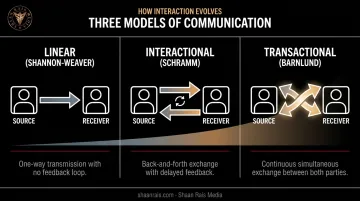
The "one-way vs. two-way" debate exists because communication scholars have described speaking through three different lenses:
| Model | Core Idea | Where It Fits |
|---|---|---|
| Linear (Shannon-Weaver) | Source sends a message through a channel to a receiver — no feedback loop | Explains why a scripted keynote looks one-way |
| Interactional (Schramm) | Adds feedback; source and receiver take turns encoding and decoding messages | Fits speeches with Q&A, applause, or visible reactions the speaker adjusts to |
| Transactional (Barnlund) | Speaker and audience send and receive simultaneously, cocreating meaning in real time | Best describes live speaking, where the speaker talks while continuously reading the room |
Dialogic theory pushes this further. It argues that even a monologue-style speech functions as dialogue once you factor in nonverbal feedback, audience anticipation, and shared context. A speaker who simplifies an explanation mid-sentence because the room looks confused is having a conversation — without a single word spoken by the audience. This is the instinct experienced keynote speakers rely on: reading a room's energy and adjusting positioning, pace, or emphasis in real time, the same way a strategist adjusts a brand's message based on how the market receives it.
The resolution: separate the medium from the process. The medium (one person on a mic) can look one-way. The process (constant mutual feedback and adjustment) is almost always two-way. Treat every speech as a live negotiation with the room, not a broadcast, and the delivery changes accordingly.
What Are the Two Types of Public Speaking? One-Way vs Two-Way Situations
Speaking situations tend to cluster around two poles.
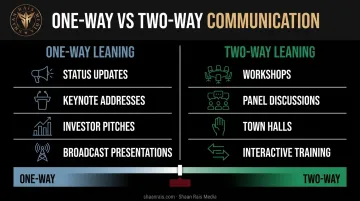
One-way leaning situations:
- Status updates to leadership
- Keynote addresses to large audiences
- Investor pitches to senior stakeholders
- Broadcast-style presentations with a brief Q&A tacked on at the end
Two-way leaning situations:
- Workshops where the agenda shifts based on participant needs
- Panel discussions with cross-talk between speakers and audience
- Town halls built around open floor questions
- Interactive training sessions where exercises shape the pace
A Concrete Example
Picture a town hall where a CEO opens with five minutes of remarks, then spends 40 minutes answering employee questions. The direction of the conversation isn't scripted. It's built live, based on what the room actually wants to know. That's two-way communication in its clearest form: the audience isn't just receiving a message, they're shaping it.
Now compare that to a 20-minute keynote with no questions taken. Even here, though, the speaker is reading faces, adjusting pacing when energy drops, and pausing longer after a joke that lands well. Less obvious, but still transactional.
Purpose Shapes the Format, Not Fixed Rules
Shaan Rais books both formats himself, delivering live 40-60 minute keynotes that range from tightly scripted broadcast-style talks to sessions built almost entirely around audience questions. The format he chooses depends on what the room and the client need, not a fixed template.
Whether a talk leans one-way or two-way often comes down to purpose:
- Informative talks: can be either, depending on format. A demonstration with audience Q&A is two-way; a status report usually isn't
- Persuasive talks: often stay verbally one-way, but resistance, nodding, or later action still supply feedback
- Entertaining or ceremonial talks: typically low on formal turn-taking but high on laughter, applause, and immediate reaction
There's no rule that informative speeches must be one-way or persuasive speeches must be interactive. Design and occasion decide that, not the topic itself.
The takeaway: these aren't fixed categories. They're endpoints on a continuum. A skilled speaker can nudge a talk toward either end depending on the room and the goal.
How to Make Any Speech More Two-Way (Even in One-Way Formats)
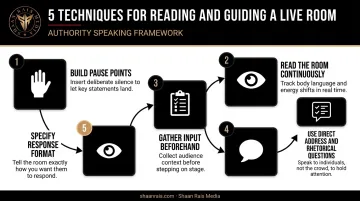
You don't need a full Q&A session to build genuine interaction into a formal talk. A few deliberate techniques go a long way.
- Build in pause points. Ask for a show of hands mid-presentation, even during a formal keynote. It resets attention and shows you where the room stands.
- Read the room continuously. Watch posture, eye contact, and phone-checking. Toastmasters recommends adjusting eye contact and pacing based on what you observe, not sticking rigidly to a script.
- Gather input before you speak. Pre-event surveys or quick conversations with a few attendees let the audience shape your content before you take the stage.
- Use direct address and rhetorical questions. Saying "you've probably run into this exact problem" simulates dialogue even when nobody answers out loud.
- Specify how you want a response. Communication coach Matt Abrahams advises telling audiences explicitly whether to respond silently, raise a hand, or answer aloud — vague questions get vague silence.
The Most Effective Version: Visible Responsiveness
Active listening alone isn't enough. The speaker also has to show they're adapting. A 2026 study of speakers presenting to virtual audiences found that unsupportive behavior, such as checking phones or slouching, measurably changed vocal tone, pacing, and effort. Audience feedback shapes delivery whether the speaker consciously registers it or not.
The most effective two-way communicators close the loop out loud: "I can see a few confused faces, let me back up." That single sentence turns passive feedback into an acknowledged exchange, and audiences notice.
Why Two-Way Communication Skills Shape How You're Perceived as a Leader
Audiences don't just judge what you say. They judge how attuned you are to the room while saying it. A speaker who plows through a script regardless of confusion reads as tone-deaf. One who adjusts in real time reads as competent and in command.
This is the core of what Shaan Rais, founder of Shaan Rais Media, calls Perception Engineering. It means systematically managing the gap between what you know and how the market perceives that knowledge. A speaker's responsiveness on stage is one of the clearest signals an audience uses to price that expertise, before a single sales conversation happens.
Rais's own keynote, "Positioning Creates Opportunity," puts this principle into practice on stage. Delivered as a 20 to 30-minute stage presentation, it's structured as a one-to-many format that still functions diagnostically. Every attendee is guided to identify their own specific gap between capability and market value in real time. That single design choice, making a broadcast-style talk feel personally targeted, is credited with generating $250,000 in new business within 72 hours, along with 60 booked strategy calls in a single day.
That result illustrates the point precisely. The medium was one-way: a single speaker, one stage. The process was transactional, because the content was engineered to make each listener feel individually seen.
The distinction matters:
- Medium describes the format — one speaker addressing many people at once
- Process describes the experience — whether each listener feels personally understood
Operators who master that distinction, per Rais's Authority Architecture framework, gain stronger positioning and premium pricing opportunities.
Frequently Asked Questions
Do most public speaking situations involve two-way communication?
Yes. Even formal, one-directional talks involve feedback through body language, facial expressions, or a closing Q&A. The core delivery may be one-directional, but the process rarely is.
Which situation illustrates two-way communication?
A town hall or workshop where audience questions actively shape the discussion is the clearest example. The direction of the talk changes based on what the room contributes, not a fixed script.
What is the most effective two-way communication?
It combines active listening with visible responsiveness: the speaker doesn't just absorb feedback but adjusts content, tone, or pacing based on what the audience shows or asks in real time.
What are the two types of public speaking?
One-way formats (keynotes, pitches, status updates) prioritize formal delivery with limited interaction. Two-way formats (workshops, panels, town halls) build dialogue directly into the structure.
Is public speaking always one-way even without a live Q&A?
No. Nonverbal feedback — nodding, confusion, disengaged posture — still creates a real-time feedback loop. A speaker without a Q&A is still receiving and reacting to signals from the room.
How can I make my presentations feel more two-way?
Pause for input, read the room continuously, use direct address like "you," and adjust your pacing based on visible reactions. Small shifts like these turn a monologue into something closer to a conversation.